
If the only thing that matters to you is how much weight comes off, the injections still win. If anything else matters — needles, travel, refrigeration, the price of getting started — the pills have become a serious option in a way they were not eighteen months ago.
In the ATTAIN-1 trial, published in the New England Journal of Medicine, orforglipron at its highest dose produced a mean body-weight reduction of 12.4% at 72 weeks — about 27 pounds. Roughly six in ten participants lost at least 10% of their body weight, and about four in ten lost at least 15%.
Those are real results. They are also below what the injectable tirzepatide trials report, and no honest comparison pretends otherwise.
Not a replacement for injections. Not a weaker version of the same thing. Not a decision anyone should make on efficacy numbers alone.
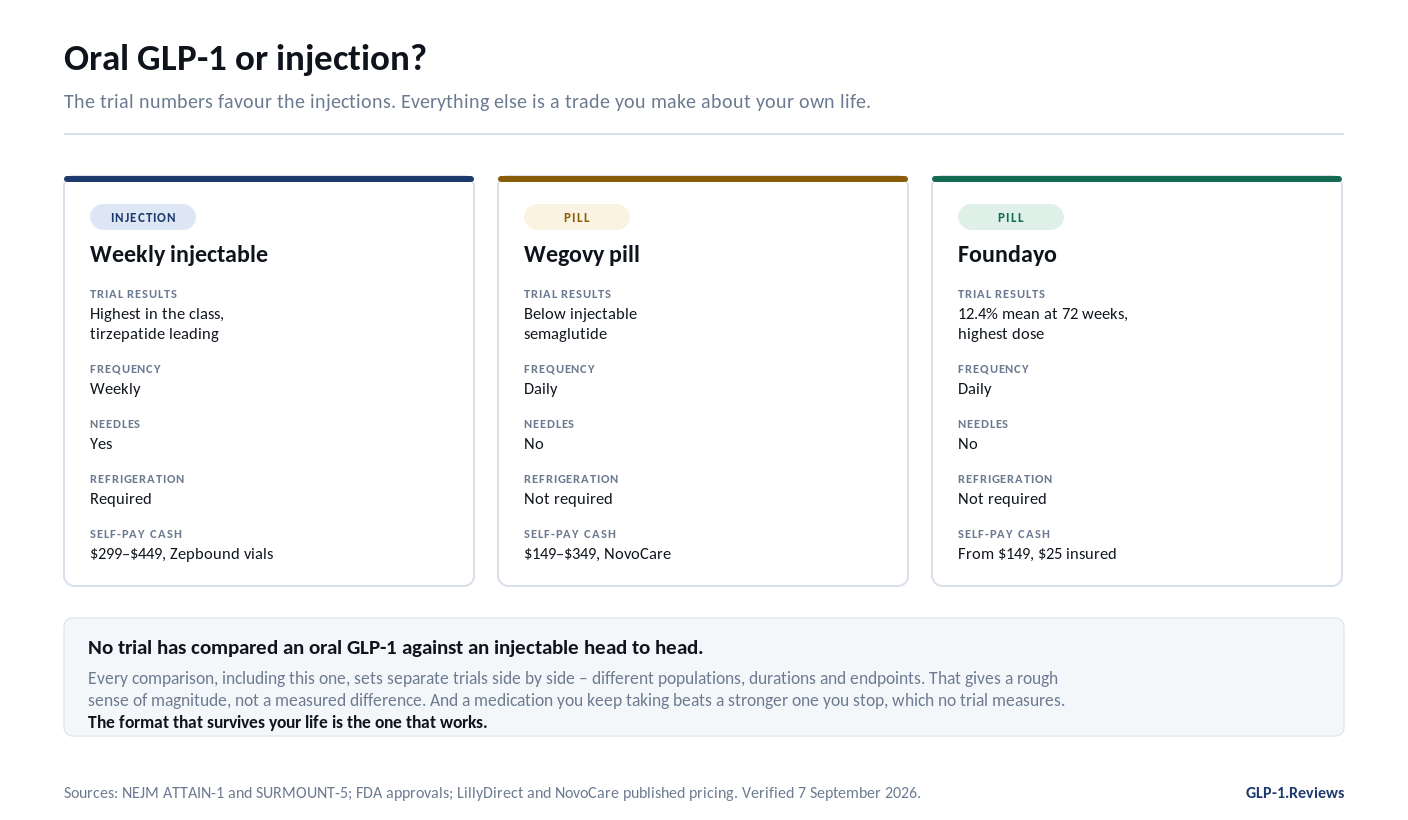
The reason is that no trial has compared an oral GLP-1 against an injectable head to head. Every comparison you will read, including this one, sets separate trials side by side — different populations, different durations, different endpoints. That is a legitimate way to get a rough sense of magnitude and an illegitimate way to declare a winner.
What decides it in practice is usually not the trial gap. It is whether you will still be taking the medication in a year, and the format that survives your actual life is the one that works.
What changed, and when
Until the end of 2025, every GLP-1 approved for weight loss in the United States was an injection. The choice was between injectables, and the oral question did not arise.
If you are already on an injectable, the move has its own checklist: eleven questions to ask before switching to a pill.
Two more pages take this further: who the labels say should not take an oral GLP-1, quoted from both labels, and what is coming next, with CagriSema’s decision expected inside this year.
Two questions this comparison raises have their own pages now: whether the pills are as effective as the injections, trial by trial, and what an oral GLP-1 actually costs once you climb the dose ladder.
Two approvals changed that inside four months. The Wegovy pill — oral semaglutide — was approved on 22 December 2025, the first GLP-1 pill approved for weight management. Foundayo, orforglipron, followed in April 2026.
They are not two versions of the same thing. Oral semaglutide is a peptide, the same molecule as the Wegovy injection, formulated to survive digestion. Orforglipron is a non-peptide small molecule — a chemically different kind of drug that happens to act on the same receptor.
That distinction runs through everything below. It determines how the medications are taken, what they cost, and how easily they can be manufactured and distributed.
Efficacy: the injections lead, and the gap is narrower than it was
The honest version requires holding two things at once.
ATTAIN-1 tested orforglipron over 72 weeks. At the highest dose studied, mean body-weight reduction was 12.4% — approximately 27 pounds. Around 59.6% of participants lost 10% or more of their body weight; around 39.6% lost 15% or more.
The injectable trials report higher figures. Tirzepatide in particular has produced the strongest results in this class, and the SURMOUNT programme established its advantage over injectable semaglutide in a direct head-to-head comparison — the only such comparison in the category, and one worth noting precisely because it is so rare.
So the ranking, as far as separate trials support one: injectable tirzepatide, then injectable semaglutide, then the orals. That ordering is reasonably robust.
What the ranking does not tell you
Three caveats, and they matter more than the ordering does.
No head-to-head oral versus injectable trial exists. Cross-trial comparison is not evidence of relative efficacy. Populations differ in baseline weight, comorbidity, and how much lifestyle support the protocol provided. A four-point difference between two trials is not a four-point difference between two drugs.
Trial results are ceilings, not expectations. Participants in a 72-week trial receive structured support, monitoring and follow-up that ordinary care does not replicate. Real-world results are consistently lower across this entire class, orals and injectables alike.
A medication you take beats a medication you stop. This is the caveat that swallows the others. Adherence in real-world GLP-1 use is poor, and the reasons are practical — cost, side effects, injection burden, supply interruptions. A pill you keep taking will outperform an injection you abandon at month four, and no trial captures that.
The practical differences
Needles
It is tempting to treat needle avoidance as a soft preference. It is not. Injection aversion is common, it is a documented barrier to starting and continuing treatment, and for some people it is the whole decision.
Both injectable GLP-1s use fine, short needles in an auto-injector, and most people manage them without difficulty. But “most people” is doing work in that sentence, and if you are not one of them, an oral option is not a lesser version of treatment — it is the version you will actually take.
The dosing protocol, which is not the same for both pills
This is the difference most comparisons miss, and it is the sharpest practical distinction in the whole category.
The Wegovy pill must be taken in the morning, on an empty stomach, with no more than four ounces of water, and you must wait thirty minutes before eating or drinking anything else. That protocol exists because oral semaglutide’s absorption depends on it.
Foundayo has no food or water restriction and can be taken at any time of day.
For someone with a steady morning routine, the Wegovy protocol is a minor adjustment. For a shift worker, a parent doing school runs, or anyone whose mornings vary, it is a daily obstacle — and a medication whose absorption depends on a protocol you cannot reliably follow is not being taken as prescribed.
If you are choosing between the two pills, this is likely to matter more than any efficacy difference between them.
Cold chain and travel
Injectable GLP-1s require refrigeration. That is manageable at home and an ongoing consideration when travelling, particularly internationally. Tablets do not, which for frequent travellers is a genuine simplification rather than a marginal convenience.
Cost, which now runs the other way
The oral options launched into a market where manufacturers had begun competing on cash price, and Foundayo launched aggressively.
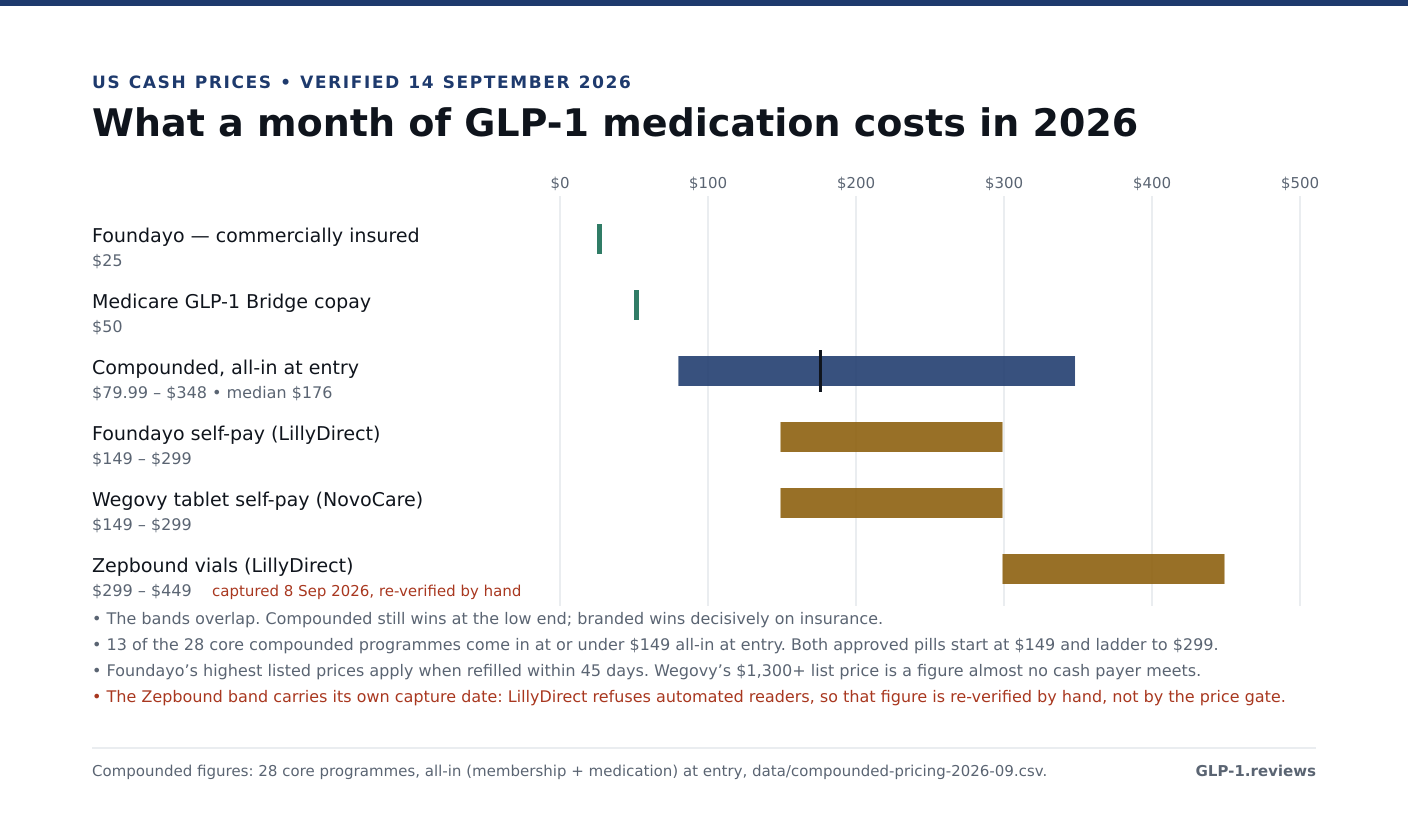
LillyDirect’s published self-pay price for Foundayo starts at $149 a month at the starting dose, rising with dose to $199 and then $299 at the higher doses (the top two strengths at $299 only when refilled within 45 days). With a commercial insurance savings card, the published price is $25 a month, subject to eligibility. NovoCare Pharmacy lists Wegovy — pill and injection — at $149 to $299 for the pill and $199 to $399 for the pen. Zepbound vials through LillyDirect run $299 to $449 by dose.
Which telehealth providers carry each pill, checked against their own pages, is kept in our maintained list; among the brand-name telehealth providers we review, Ro, Found and Ivim Health prescribe both pills, and Mochi Health prescribes the Wegovy pill.
Medicare Part D beneficiaries have had a $50 copay route since 1 July 2026 through the Medicare GLP-1 Bridge, running to 31 December 2027.
The structural point: orforglipron is a small molecule, made by conventional chemical synthesis, with no peptide stability or cold-chain constraints. It is genuinely cheaper to produce at scale than the peptides. That is why its entry price is sustainable rather than promotional, and why the cheapest route into GLP-1 treatment is now more likely to be a pill than an injection.
| Dimension | Injectable GLP-1 | Wegovy pill | Foundayo |
|---|---|---|---|
| Weight loss in trials | Highest, tirzepatide leading | Below injectable semaglutide | 12.4% at 72 weeks, highest dose |
| How it is taken | Weekly injection | Daily tablet, morning, empty stomach, ≤4 oz water, 30-minute wait | Daily tablet, any time, no restriction |
| Needles | Yes | No | No |
| Refrigeration | Required | Not required | Not required |
| Cash price, self-pay | $299–$449 (Zepbound vials) | $149–$299 pill, $199–$399 pen (NovoCare) | From $149, to $299 by dose |
| With commercial insurance | Varies by plan | Varies by plan | $25 with savings card, conditions apply |
| Molecule type | Peptide | Peptide | Non-peptide small molecule |
Who each format suits
An injectable probably suits you if
Maximum weight loss is the priority and you are prepared to trade convenience for it. You tolerate injections without difficulty. Your insurance covers an injectable with a manageable copay, which frequently makes it the cheapest option regardless of list prices. Or you are already doing well on one — in which case the case for switching is weak, and switching is a clinical decision rather than a shopping one.
An oral probably suits you if
Needles are a barrier, whether to starting or to continuing. You travel often enough that refrigeration is a recurring problem. You are paying cash and the entry price matters. Or you have tried an injectable and stopped for reasons that were about the format rather than the medication.
Between the two pills
Foundayo if your daily routine is variable, because the absence of a food and water protocol removes the main way an oral regimen fails in practice. The Wegovy pill if you are already established on injectable semaglutide and your prescriber judges continuity of molecule useful, or if it is the one your coverage reaches.
If you are taking a GLP-1 for type 2 diabetes rather than weight management, this comparison is not built for you. The approved indications, the trial evidence and the coverage rules all differ, and that is a conversation for your prescriber.
If you are doing well on your current medication, this is not a reason to change. The differences described here are about choosing, not about switching, and switching has its own considerations.
And none of this addresses whether a GLP-1 is appropriate for you at all. That is a clinical question about your history, not a format question.
Frequently asked questions
Are the pills as effective as the injections?
Not at the top end, on the evidence available. Orforglipron produced a 12.4% mean body-weight reduction at 72 weeks at its highest dose in ATTAIN-1; the injectable tirzepatide trials report higher figures.
But no trial has compared an oral against an injectable directly, so the gap is inferred from separate studies rather than measured. And a pill taken consistently can outperform an injection stopped early, which no trial measures at all.
Why does the Wegovy pill have so many rules about food and water?
Because oral semaglutide is a peptide, and peptides are poorly absorbed from the digestive tract. The formulation and the protocol exist to get enough of the drug across the gut wall. Food, and more than a small amount of water, interfere with that. Foundayo has no such rules because it is a small molecule and absorbs differently.
Is a daily pill worse than a weekly injection for adherence?
It depends entirely on the person, and the assumption that weekly is easier does not hold universally. A weekly injection is seven times fewer administrations; a daily tablet is a smaller act each time and needs no supplies, refrigeration or disposal. What matters is which one fits the life you actually have.
Can I switch from an injection to a pill?
That is a question for your prescriber, and it involves more than preference — dose equivalence, tolerability, and how your response is monitored through the change. Nothing on a website should be the basis for it. What you can do is arrive at the conversation knowing which format you would prefer and why.
Which is cheaper?
Currently the pills, at the entry point. Foundayo’s published self-pay price starts at $149 a month against $299 to $449 for Zepbound vials, and drops to $25 with a commercial savings card. But branded pricing ladders by dose, so confirm what a maintenance dose costs rather than budgeting from the entry price. And if your insurance covers an injectable at a low copay, that will usually beat any cash price.
The format that survives your life is the one that works
The trial numbers give the injections an edge, and anyone claiming the pills have closed that gap is overselling. The honest ranking on current evidence is injectable tirzepatide first, then injectable semaglutide, then the orals.
But rankings assume everyone takes what they were prescribed for as long as they were prescribed it, and that is not what happens. People stop because of needles, because of travel, because the cost became untenable, because a supply route disappeared.
A 12.4% result you sustain beats a larger result you abandon in month four. That is not an argument for pills over injections — it is an argument for being honest with yourself about which one you will still be taking next year, and choosing that one.
Sources
- New England Journal of Medicine — ATTAIN-1 trial results for orforglipron. Figures quoted are the efficacy estimand at 72 weeks for the highest dose.
- New England Journal of Medicine — SURMOUNT-5, tirzepatide versus semaglutide head-to-head.
- U.S. Food and Drug Administration — approval of oral semaglutide for weight management, 22 Dec 2025.
- U.S. Food and Drug Administration — approval of orforglipron (Foundayo), April 2026.
- Novo Nordisk — Wegovy prescribing information, including oral administration requirements.
- Eli Lilly and Company — Foundayo prescribing information.
- LillyDirect — Foundayo and Zepbound self-pay pricing, captured 7 Sep 2026.
- NovoCare Pharmacy — Wegovy pricing, captured 7 Sep 2026.
- Centers for Medicare & Medicaid Services — Medicare GLP-1 Bridge.
- American Diabetes Association — Standards of Care in Diabetes 2026, obesity management section.
Medical disclaimer. This article compares published trial results and product characteristics. It is not medical advice, does not recommend any medication, and does not address dosing. Whether a GLP-1 is appropriate for you, and in which format, is a decision for a licensed prescriber who knows your medical history. Do not start, stop or switch a medication based on this article.
Evidence note. No head-to-head trial has compared an oral GLP-1 against an injectable. Comparisons here are drawn from separate trials and should be read as indicative of magnitude, not as measured differences. Verified 7 September 2026.
Keep exploring our GLP-1 resources:



