
Each approved oral GLP-1 carries an FDA-approved label with a Contraindications section — the circumstances in which the medicine should not be used — and a Warnings and Precautions section covering situations needing caution or monitoring.
Those sections are short, specific, and written by the manufacturer under FDA review. They are the authoritative answer, and this article reproduces them below with the label version each came from.
Not a screening quiz. Not a substitute for an intake. Not a list you can clear yourself against.
The reason matters. A contraindication is a categorical statement about a medicine. Whether it applies to you depends on your history, which conditions you have and how they were diagnosed, what else you take, and things a prescriber establishes by asking. Reading a label tells you what to raise; it does not tell you whether you qualify.
There is also a second category the label cannot cover: circumstances where a medicine is permitted but a poor fit. The Wegovy pill’s administration protocol is the clearest example — nothing prohibits it for someone with unpredictable mornings, but a medicine whose absorption depends on a routine you cannot keep is not going to work as intended.
How to read a label’s safety sections
Three sections do different jobs, and the difference is worth knowing before reading any of them.
Once you are taking one, what each label reports as adverse reactions is the companion to this page.
| Section | What it means | How to use it |
|---|---|---|
| Boxed warning, where present | The most serious warning the FDA requires. Reserved for risks that need to be weighed before prescribing. | Read it first. If anything in it describes you or your family history, raise it before anything else. |
| Contraindications | Circumstances in which the medicine should not be used at all. | Categorical. If one applies, that is a conversation about a different treatment. |
| Warnings and precautions | Situations requiring caution, monitoring, or a judgment about whether benefit outweighs risk. | Not disqualifying by themselves. These are the topics a good intake should cover with you. |
A great deal of confusion in this category comes from treating those three as one list. A warning is not a prohibition, and a precaution is not a rejection — they are instructions to pay attention to something specific.
What the labels say
Foundayo (orforglipron)
From the FOUNDAYO prescribing information, version 10, revised July 2026, published on DailyMed 13 August 2026. Boxed warning first, as it appears on the label (the label’s bracketed cross-references to its own sections are omitted here):
WARNING: RISK OF THYROID C-CELL TUMORS
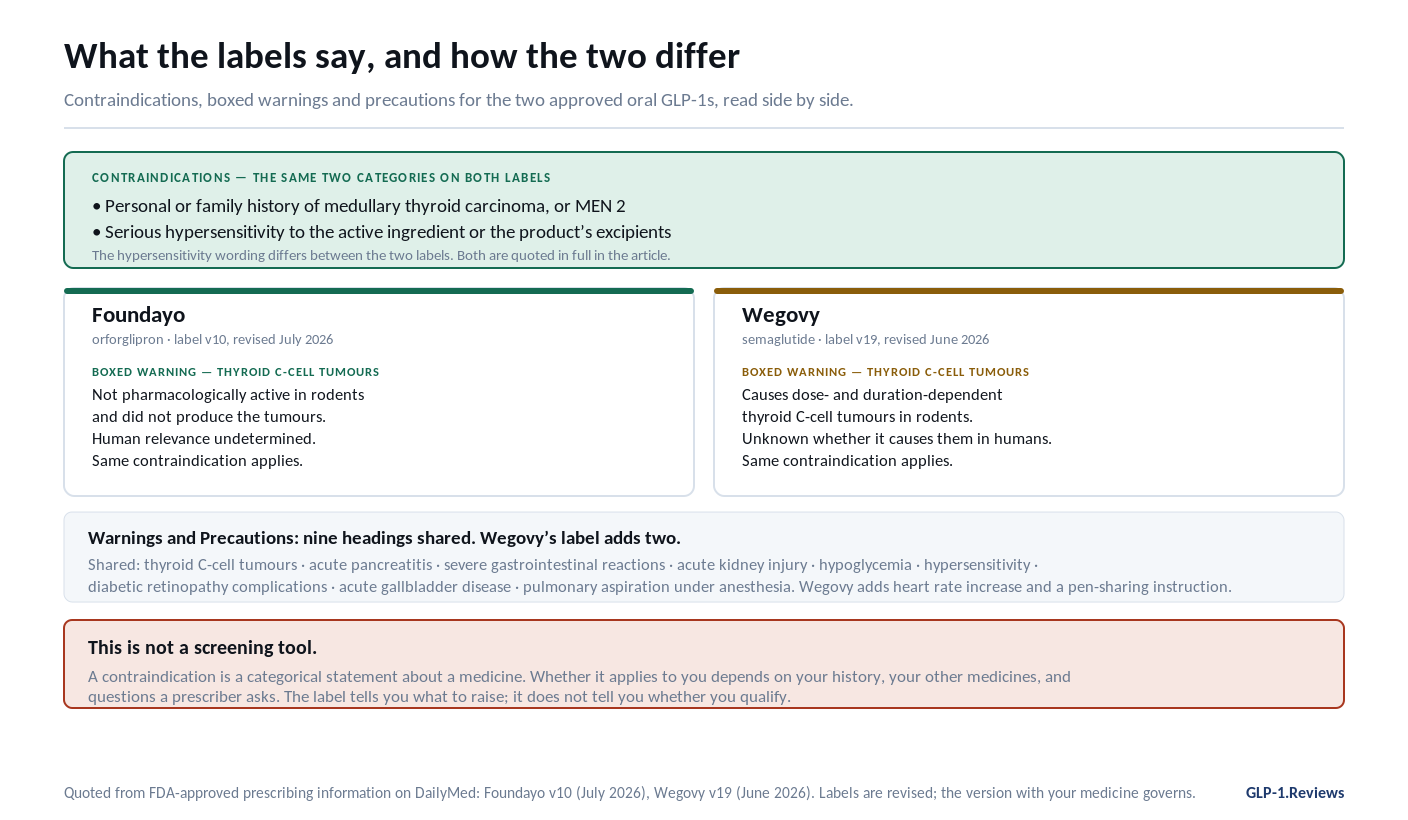
In products with glucagon-like peptide-1 (GLP-1) receptor agonist activity that are pharmacologically active in rats and mice, rodent thyroid C-cell tumors (adenomas and carcinomas) have been observed at clinically relevant exposures and are considered GLP-1 receptor-dependent effects in rodents. Orforglipron is not pharmacologically active in rats or mice and did not produce tumors in rodents. While orforglipron is pharmacologically active at the human GLP-1 receptor, the human relevance of GLP-1 receptor-dependent thyroid C-cell tumors observed in rodents has not been determined. FOUNDAYO is contraindicated in patients with a personal or family history of medullary thyroid carcinoma (MTC) or in patients with Multiple Endocrine Neoplasia syndrome type 2 (MEN 2). Counsel patients regarding the potential risk for MTC with the use of FOUNDAYO and inform them of symptoms of thyroid tumors (e.g., a mass in the neck, dysphagia, dyspnea, persistent hoarseness). Routine monitoring of serum calcitonin or using thyroid ultrasound is of uncertain value for early detection of MTC in patients treated with FOUNDAYO.
Section 4, Contraindications, in full:
FOUNDAYO is contraindicated in patients with: A personal or family history of MTC or in patients with MEN 2. Known serious hypersensitivity to orforglipron or any of the excipients in FOUNDAYO. Serious hypersensitivity reactions, including anaphylaxis and angioedema, have been reported with GLP-1 receptor agonists.
Section 5, Warnings and Precautions, has nine headings. They are listed here, not reproduced; each is a page of its own on the label:
- 5.1 Risk of Thyroid C-Cell Tumors
- 5.2 Acute Pancreatitis
- 5.3 Severe Gastrointestinal Reactions
- 5.4 Acute Kidney Injury Due to Volume Depletion
- 5.5 Hypoglycemia
- 5.6 Hypersensitivity Reactions
- 5.7 Diabetic Retinopathy Complications in Patients with Type 2 Diabetes
- 5.8 Acute Gallbladder Disease
- 5.9 Pulmonary Aspiration During General Anesthesia or Deep Sedation
The Wegovy pill (semaglutide tablets)
Novo Nordisk publishes one label for Wegovy injection and Wegovy tablets. Its safety sections apply to both presentations except where a sentence names one. From the WEGOVY prescribing information, version 19, revised June 2026, published on DailyMed 30 June 2026. Boxed warning first, cross-references omitted as above:
WARNING: RISK OF THYROID C-CELL TUMORS
• In rodents, semaglutide causes dose-dependent and treatment-duration-dependent thyroid C-cell tumors at clinically relevant exposures. It is unknown whether WEGOVY causes thyroid C-cell tumors, including medullary thyroid carcinoma (MTC), in humans as human relevance of semaglutide-induced rodent thyroid C-cell tumors has not been determined. • WEGOVY is contraindicated in patients with a personal or family history of MTC or in patients with Multiple Endocrine Neoplasia syndrome type 2 (MEN 2). Counsel patients regarding the potential risk for MTC with the use of WEGOVY and inform them of symptoms of thyroid tumors (e.g., a mass in the neck, dysphagia, dyspnea, persistent hoarseness). Routine monitoring of serum calcitonin or using thyroid ultrasound is of uncertain value for early detection of MTC in patients treated with WEGOVY.
Section 4, Contraindications, in full:
WEGOVY is contraindicated in the following conditions: • a personal or family history of MTC or in patients with MEN 2. • a prior serious hypersensitivity reaction to semaglutide or to any of the excipients in WEGOVY injection or WEGOVY tablet. Serious hypersensitivity reactions, including anaphylaxis and angioedema, have been reported with WEGOVY.
Section 5, Warnings and Precautions, has eleven headings on the label:
- 5.1 Risk of Thyroid C-Cell Tumors
- 5.2 Acute Pancreatitis
- 5.3 Acute Gallbladder Disease
- 5.4 Hypoglycemia
- 5.5 Acute Kidney Injury Due to Volume Depletion
- 5.6 Severe Gastrointestinal Adverse Reactions
- 5.7 Hypersensitivity Reactions
- 5.8 Diabetic Retinopathy Complications in Patients with Type 2 Diabetes
- 5.9 Heart Rate Increase
- 5.10 Pulmonary Aspiration During General Anesthesia or Deep Sedation
- 5.11 Never Share WEGOVY FlexTouch Between Patients
What the two labels share, and where they differ
We checked them side by side rather than assuming. On the versions cited, the Contraindications sections list the same two categories: a personal or family history of medullary thyroid carcinoma or Multiple Endocrine Neoplasia syndrome type 2, and a prior serious hypersensitivity reaction to the drug or its excipients. Both carry a boxed warning on thyroid C-cell tumors, but the evidence sentence differs: the Wegovy label says semaglutide causes these tumors in rodents; the Foundayo label says orforglipron is not pharmacologically active in rodents and did not produce them, and that the human relevance is undetermined for both. The Warnings and Precautions headings overlap on nine topics, in a different order and with slightly different titles. The Wegovy label carries two headings the Foundayo label does not: Heart Rate Increase, and a device instruction about the injection pen that does not apply to the tablet. Nothing on the Foundayo list is absent from the Wegovy list.
Two things to notice when you read them.
The two labels are not interchangeable, even where they agree. These are different molecules from different manufacturers approved four months apart, and their safety sections were written separately. That they match on contraindications today was checked, not assumed; either label can be revised without the other, which is why each is cited by version and date.
Family history appears alongside personal history. Where a label asks about a family history, it is asking about relatives, and it is a question people frequently answer from incomplete knowledge. If you do not know, that is worth saying rather than guessing.
Where the evidence is thinner than the label
A label describes what was studied. Several groups are not well represented in the trial evidence for these medicines, which is different from being contraindicated.
People with a history of eating disorders. Medications that suppress appetite interact with disordered eating in ways trials designed around weight endpoints do not capture well. This is a topic to raise directly, and a prescriber who does not ask is not screening thoroughly.
People taking multiple oral medications. The Wegovy pill’s protocol restricts other oral medicines during its absorption window, which is a practical scheduling problem rather than a safety prohibition — but it is a real one for anyone on several daily drugs.
Older adults and those with reduced muscle mass. Loss of lean mass alongside fat during rapid weight reduction is an active area of study across this drug class, and the population most affected is under-represented in trials.
None of these is a reason not to treat. All of them are reasons for a conversation that a fourteen-screen intake form does not have.
The practical disqualifier a label cannot state
The Wegovy pill must be taken in the morning on an empty stomach, with a small amount of plain water, followed by a wait before eating, drinking or taking other oral medicines. That is a label instruction, not a contraindication.
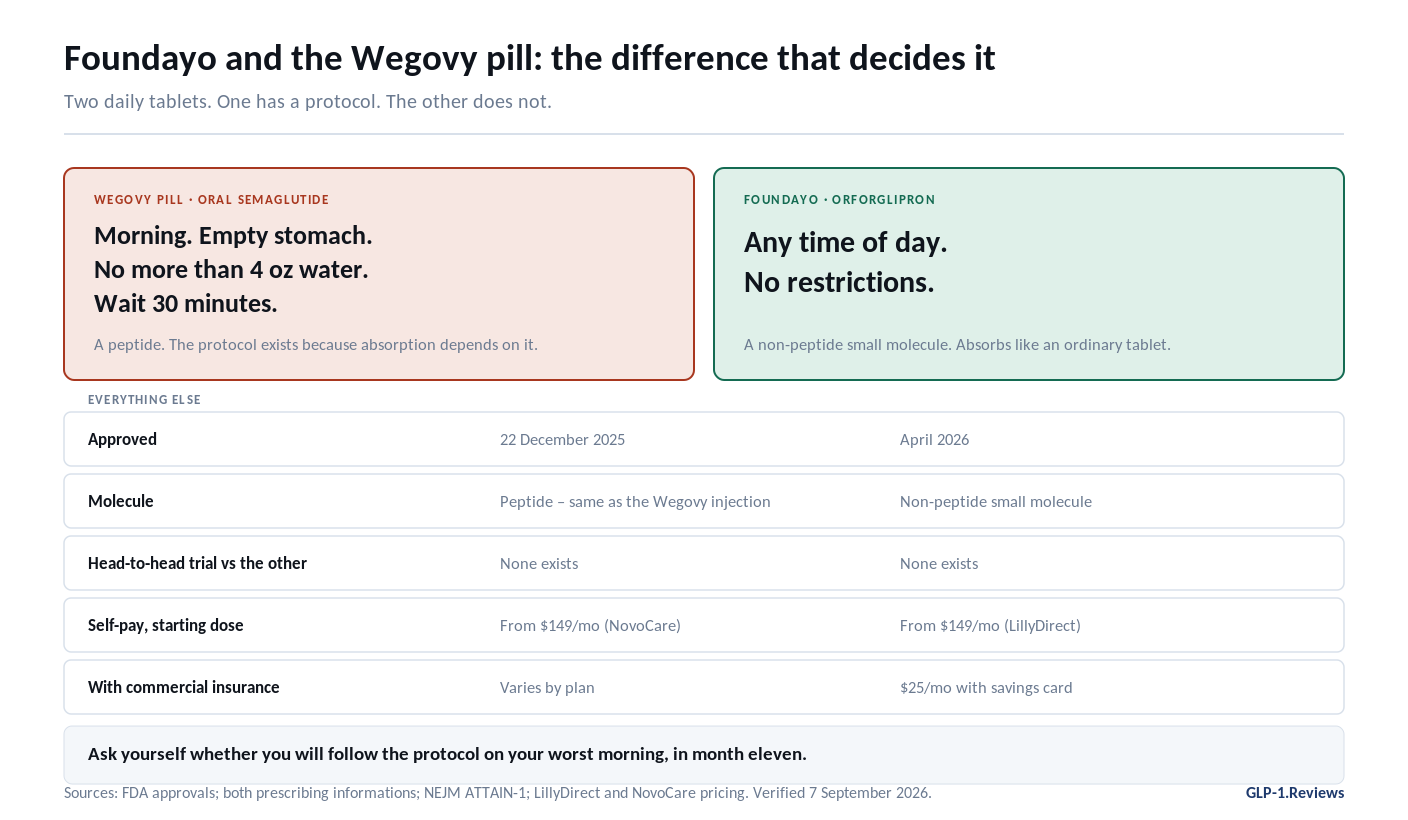
But a medicine whose absorption depends on a protocol you cannot reliably follow is a medicine that will not work as intended, and nothing on a label says “not suitable for people with unpredictable mornings.”
If shift work, caregiving, travel or simply the way your mornings go make that routine unrealistic, that is legitimate clinical information. It belongs in the conversation with your prescriber — and Foundayo, which has no food or water restriction, exists partly as an answer to it.
What to bring to the conversation
Whichever provider you use, and not all of them carry the pills, the questions below are yours to raise if the intake form does not. Ro and Found both prescribe both pills; the directory lists the rest. Whether an oral is the right form at all is a separate question, and so is how much to expect from it.
Rather than trying to clear yourself against a list, bring the things a prescriber needs in order to decide.
Your full medical history including conditions you consider resolved. Your family history, particularly where a label asks about it, and an honest “I don’t know” where that is the truth. Every medication and supplement you take, including the ones that feel irrelevant. Any history of disordered eating. Whether you are pregnant, breastfeeding or planning a pregnancy. And a realistic account of your mornings, if the Wegovy pill is on the table.
A prescriber who asks about all of that is doing the job. One who does not is not, and that is worth noticing about a provider.
It is not a screening tool and it will not tell you whether you can take these medicines. It reproduces what the labels say so that you know what to raise.
It is also not a reason to stop a medicine you are taking. If something here concerns you, that is a call to your prescriber, not a decision to make alone — stopping a GLP-1 has its own consequences.
And it does not cover compounded preparations, which do not carry FDA-approved labels and for which no equivalent authoritative safety section exists.
Frequently asked questions
Are the contraindications the same for both oral GLP-1s?
On the label versions cited above, yes: both list the same two categories. That was checked rather than assumed, and it can change with either label’s next revision. They are different molecules from different manufacturers, approved four months apart, and each carries its own label written separately. Read the one for the medicine you are considering rather than assuming they match.
Does a warning on the label mean I can’t take it?
No, and this is the most common misreading. A contraindication says the medicine should not be used. A warning or precaution says something needs attention, monitoring, or a judgment about whether the benefit outweighs the risk for you. Only the first is categorical.
What if I don’t know my family medical history?
Say so. Where a label asks about family history it is asking a real question, and “I don’t know” is a more useful answer than a guess. Your prescriber can decide what to do with the uncertainty — that is part of their job.
I have a history of an eating disorder. Should I mention it?
Yes, and to the prescriber directly rather than only on a form. Appetite-suppressing medication interacts with disordered eating in ways that need a clinician’s judgment. A provider that does not ask about it is not screening thoroughly, which is itself worth knowing.
Can I take an oral GLP-1 with my other medications?
That is a question for your prescriber and pharmacist, who can check interactions against everything you take. Note separately that the Wegovy pill’s protocol restricts other oral medicines during its absorption window — a scheduling issue distinct from any interaction, and one worth raising if you take several daily medicines.
The label tells you what to ask, not whether you qualify
The contraindications are short, specific and authoritative, and everyone considering one of these medicines should read the one that applies to them.
What a label cannot do is know your history, your other medications, or your mornings. It states categories; a prescriber applies them to a person.
Read it so you know what to raise. Then raise it — including the things a form did not ask about, because the gaps in an intake are where these conversations usually go wrong.
Sources
- Novo Nordisk — WEGOVY (semaglutide) tablets, FDA-approved prescribing information, DailyMed, version and date as cited in text.
- Eli Lilly and Company — Foundayo (orforglipron), FDA-approved prescribing information, DailyMed, version and date as cited in text.
- U.S. Food and Drug Administration — approvals of oral semaglutide (Dec 2025) and orforglipron (Apr 2026).
- American Diabetes Association — Standards of Care in Diabetes 2026, obesity management section.
- Peer-reviewed literature on GLP-1 use and disordered eating, and on lean-mass change during pharmacological weight reduction.
Medical disclaimer. This article reproduces and explains sections of FDA-approved labels. It is not medical advice and it is not a screening tool. It cannot tell you whether a medication is appropriate for you. That determination requires a licensed prescriber with your full medical history. Do not start, stop or change any medication based on this article.
Note. Label content quoted from the versions cited, current as of 8 September 2026. Labels are revised; the version supplied with your medication governs.
Keep exploring our GLP-1 resources:



