
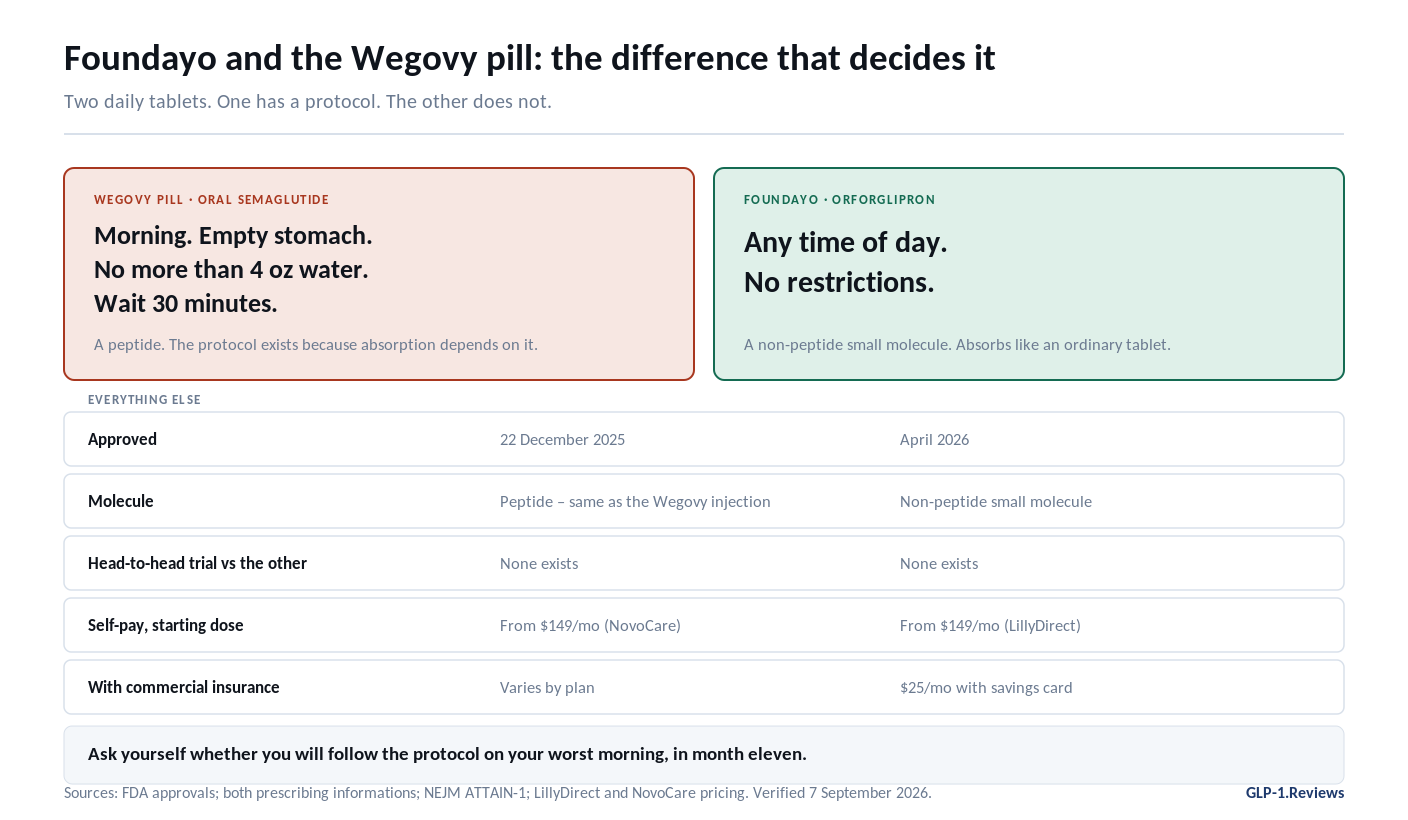
Nothing new is approved. Two oral GLP-1s are available in the United States — the Wegovy pill, approved 22 December 2025, and Foundayo, approved April 2026. Everything else discussed as “coming next” is investigational.
Two candidates are furthest along, at different stages.
CagriSema — cagrilintide with semaglutide, from Novo Nordisk. The new drug application was submitted on 18 December 2025, and Novo has said it expects a regulatory decision by late 2026. That decision could arrive within weeks of this page being read.
Retatrutide — Eli Lilly’s triple-receptor molecule. On 23 July 2026 Lilly said it now intends to submit in the first quarter of 2027, later than previously guided, in order to gather additional manufacturing and quality data.
Not approved. Not available. Not compoundable.
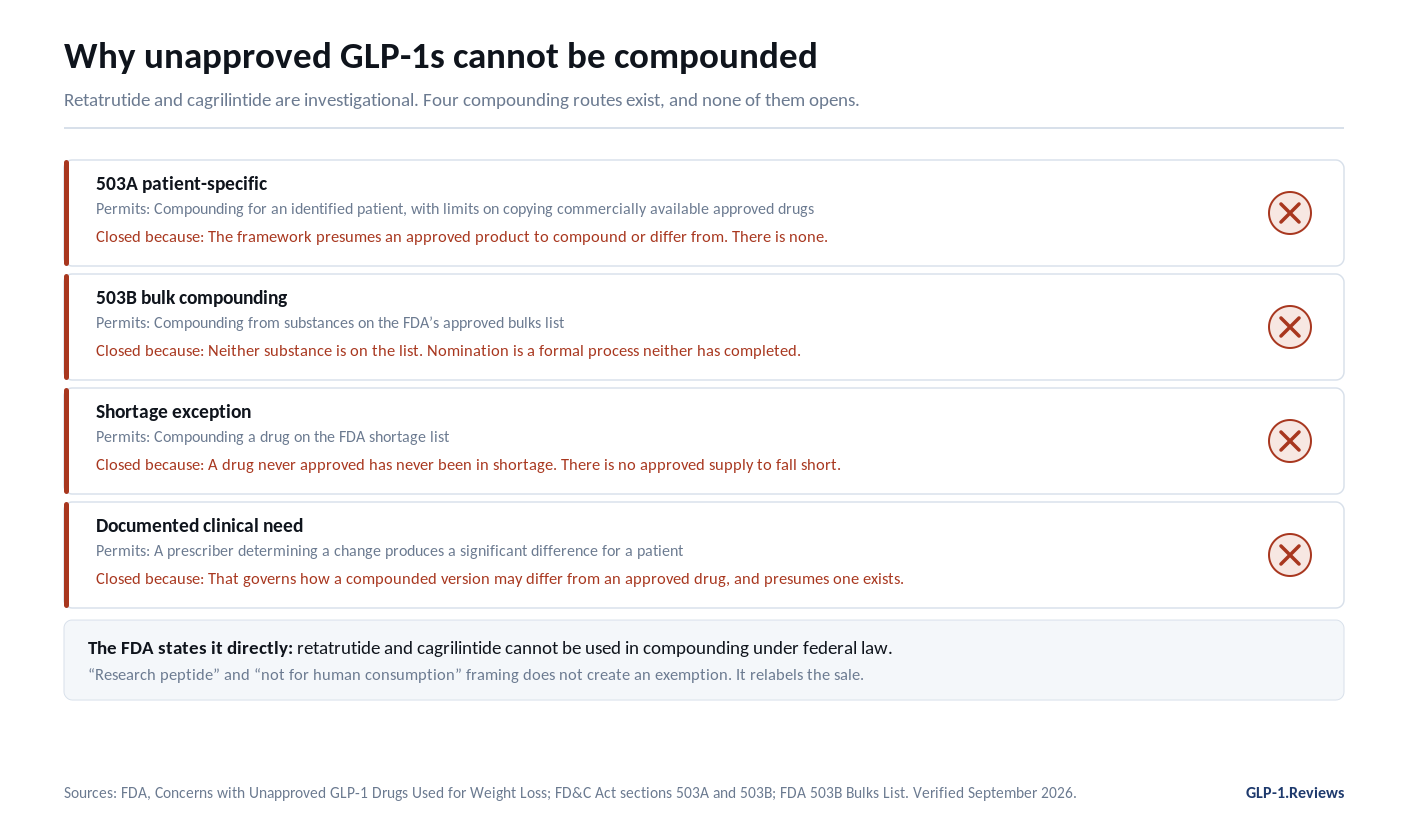
That last point is worth stating flatly because it is where readers get hurt. The FDA’s own guidance says retatrutide and cagrilintide cannot be used in compounding under federal law. A submission is a request, not a permission, and neither drug can lawfully be sold for use until a review concludes in approval.
Automated checks of the sources run every week and flag any change; the date above is when we last re-read them ourselves.
Where each candidate actually stands
| Candidate | Route | Company | Status | Next milestone | Available? |
|---|---|---|---|---|---|
| Wegovy pill oral semaglutide |
Oral tablet | Novo Nordisk | Approved 22 Dec 2025 | — | Yes |
| Foundayo orforglipron |
Oral tablet | Eli Lilly | Approved April 2026 | — | Yes |
| CagriSema cagrilintide + semaglutide |
Weekly injection | Novo Nordisk | NDA submitted 18 Dec 2025 | Decision expected late 2026 | No |
| Retatrutide | Weekly injection | Eli Lilly | Investigational | Submission guided to Q1 2027 | No |
What each status means
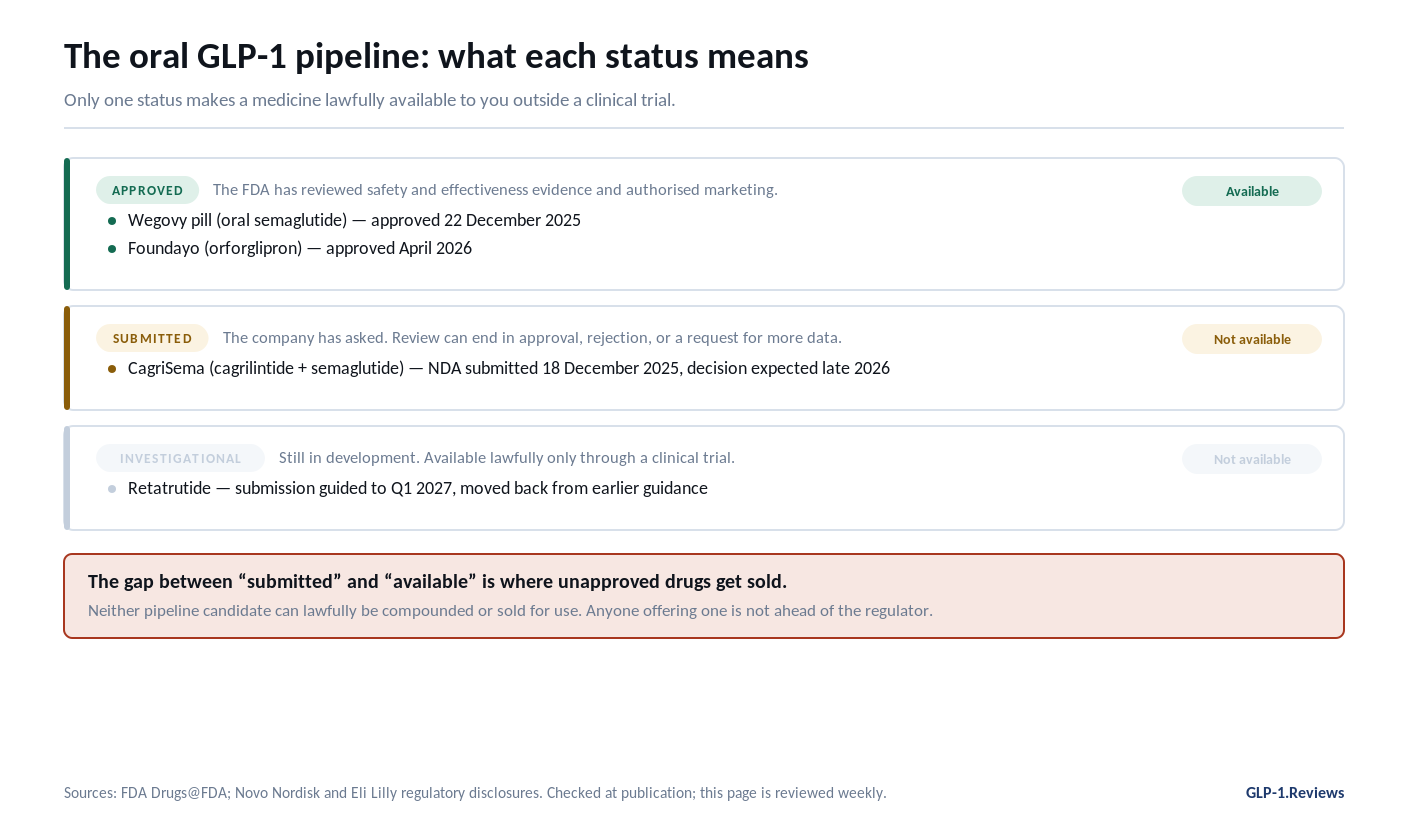
Approved means the FDA has reviewed the safety and effectiveness evidence and authorised marketing for a specific use. It is the only status that makes a medicine lawfully available to you outside a trial.
Submitted means the company has asked. A review takes months, and it can end in approval, in rejection, or in a request for more data. Companies announce submissions because they are genuine milestones for investors; they are frequently reported in ways that blur into availability.
Investigational means the drug is still in development. Retatrutide’s status is a useful illustration of why timelines are not promises — Lilly moved its own submission target back to gather more manufacturing and quality data, which is an ordinary thing to happen and an unpredictable one.
Why this page exists
The gap shows up on provider menus too. In our September read of all 76 directory sites, Gala listed the Wegovy pill as “coming soon” with a waitlist, and SkinnyRx listed both pills marked “Unavailable”; who actually carries them is its own maintained page, and the directory holds the rest.
Because the gap between “submitted” and “available” is where people get sold things.
Coverage of a submission produces search interest. Search interest produces sellers. And unapproved GLP-1 molecules are sold — typically framed as research peptides, with a disclaimer saying they are not for human consumption, at consumer doses, to consumers.
That framing does not create a legal route. There is no compounding pathway for an unapproved drug: no shortage exception, because a drug never approved has never been in shortage; no bulks-list route, because neither substance is on the list; and no clinical-need provision, because that governs how a compounded version may differ from an approved product and presumes one exists.
We checked our own directory in September 2026 — all 76 providers, read in a browser with JavaScript running — and found none offering retatrutide, cagrilintide, survodutide or mazdutide. That is reassuring about this directory and says nothing about the wider market.
What a CagriSema approval would change
Worth thinking through now, because the decision may be close.
If CagriSema is approved, it becomes an available prescription medicine and moves into exactly the position semaglutide occupies today — including under the compounding rules. A newly approved, commercially available drug is precisely what the essentially-a-copy prohibition is written about, and it would not appear on the 503B bulks list without going through the nomination process.
So an approval would not open a compounding route. If anything it closes the argument, by replacing an unapproved substance with an approved one that cannot be copied.
What it would change for patients is choice. It would also, on the pattern of the last twelve months, change pricing — every approval in this category since December 2025 has been accompanied by a cash-price announcement, and competition among manufacturers has moved prices down rather than up.
What to do while waiting
The two approved pills are the choice that exists today; how they differ, what the trials showed and where the injections still lead are the questions worth the wait. What is not a choice is buying either candidate early: neither can be compounded, and nothing sold as either is what it claims.
If you are considering treatment now, the two approved oral GLP-1s are available and a third candidate’s timeline is not a reason to wait. Both are real medicines with published trial results, and a decision expected “late 2026” has been known to become 2027.
If you are interested in an investigational drug specifically, the lawful route is a clinical trial. Trials are listed publicly on ClinicalTrials.gov, participation is free of charge, and it comes with a protocol, monitoring and informed consent — none of which a research-peptide seller provides.
And if you encounter a provider offering retatrutide or cagrilintide for sale, that is not an early-access opportunity. It is a company selling an unapproved drug, and what it tells you about that company’s judgment applies to everything else it sells.
If you are enrolled in a clinical trial of either candidate, this page does not concern you. Trial participation is the lawful route and it operates under a protocol with clinical oversight.
This page tracks United States regulatory status. Approvals and timelines differ in other jurisdictions.
And nothing here is a reason to delay treatment. A pipeline is not a plan.
Frequently asked questions
When will CagriSema be approved?
Novo Nordisk submitted its application on 18 December 2025 and has said it expects a decision by late 2026. That is the company’s expectation, not a scheduled date, and a review can end in approval, rejection or a request for more data. Automated checks run every week, and we will update this page when a decision publishes.
Can I get retatrutide now?
Not lawfully outside a clinical trial. It is not approved, it cannot be compounded — the FDA states directly that retatrutide and cagrilintide cannot be used in compounding under federal law — and it cannot be sold for human use. Products offered as research peptides are unapproved drugs with a disclaimer attached.
Is retatrutide more effective than what’s available now?
Trial results have been striking, and trial results are not approvals. Efficacy in a controlled study does not establish the safety profile, the labelling, or the dosing that a review determines. Until a review concludes, the honest position is that it looks promising and is not available.
Should I wait for something better before starting?
That is a clinical decision for you and your prescriber, but the timelines argue against it. Retatrutide’s submission has already moved back once, and a submission in Q1 2027 would mean a decision well after that. Two approved oral GLP-1s exist now.
How often is this page updated?
Automated checks of FDA approval records and the companies’ SEC filings run every week and flag any change. The date at the top is the last time a person re-read the sources, so it moves only when we have actually checked. If it shows a date and reports no approval, that means we checked on that date and there was none.
Submitted is not available, and the gap is where the risk lives
Two oral GLP-1s are approved and on the market. Two more candidates are somewhere behind them — one awaiting a decision that may come soon, one still a year from asking.
The distance between those states is short in a headline and long in practice, and it is the distance in which unapproved drugs get sold to people who read the headline.
The status on this page is the whole answer. If it says approved, it is available. If it says anything else, anyone offering to sell it to you is not ahead of the regulator.
Sources
- U.S. Food and Drug Administration — Drugs@FDA approval records, checked 14 September 2026.
- U.S. Food and Drug Administration — FDA’s Concerns with Unapproved GLP-1 Drugs Used for Weight Loss, including the statement that retatrutide and cagrilintide cannot be used in compounding under federal law.
- Novo Nordisk — CagriSema regulatory submission announcement, 18 December 2025, and subsequent guidance.
- Eli Lilly and Company — retatrutide regulatory guidance, 23 July 2026.
- ClinicalTrials.gov — retatrutide and CagriSema trial records.
- U.S. Food and Drug Administration — approvals of oral semaglutide (Dec 2025) and orforglipron (Apr 2026).
- GLP-1 Reviews — browser-rendered sweep of 76 provider websites for unapproved GLP-1 molecules, September 2026.
Medical disclaimer. This page reports regulatory status. It is not medical advice, does not recommend any medication, and does not address dosing. Investigational medicines are available lawfully only through clinical trials. Do not delay or change treatment based on a pipeline expectation.
Status note. Checked against FDA records and company disclosures on 14 September 2026. Neither CagriSema nor retatrutide was approved as of that date. Automated checks of FDA approval records and the companies’ SEC filings run every week and flag any change; the date above is when we last re-read the sources ourselves. Lilly announcements made only by press release can take up to about two weeks to appear in its SEC filings, so a quiet week here does not rule out recent Lilly news.
Keep exploring our GLP-1 resources:



