
Predominantly gastrointestinal, and most common while the dose is going up.
Nausea, diarrhoea, vomiting, constipation and abdominal pain lead the reported reactions for both approved oral products. The two labels do not report this the same way: one publishes a frequency table for its tablet and one does not, which is why the sections below are shaped differently rather than presented as a matched pair. Discontinuation because of adverse events occurred in a minority of trial participants in both programmes.
Two things this article does differently from most coverage. It quotes each label separately rather than merging them into one combined table — the trials enrolled different populations over different durations, and a merged figure would be an average of things that were never measured together. And it does not tell you what to do about any of it. The escalation section is written as when to contact your prescriber, because whether a symptom in your body is the expected kind or the other kind is not a judgement a web page can make for you.
Both labels also carry a boxed warning about thyroid C-cell tumours, and both list a set of serious adverse reactions that occur far less often than the gastrointestinal ones. Those are in the labels in full and summarised below.
Why these numbers are quoted separately
Which of the two you are taking matters more than any figure below, and the two pills differ in more than their side-effect reporting. If you are still choosing, not every provider carries both: among those in our directory that do, Ro, LifeMD, Found and Ivim Health list both.
Almost every article comparing GLP-1 side effects builds one table with both products in it. It reads well and it is close to meaningless.
Adverse reaction rates come from specific trials, with specific enrolment criteria, specific durations, specific titration schedules and specific definitions of what counted as an event. Two trials that both report “nausea” are not necessarily counting the same thing over the same period in comparable people.
Placing those percentages in adjacent columns invites a comparison the underlying data does not support. So below, each product’s reported reactions appear in their own table, with the label version and date attached, and nothing is subtracted from anything else.
What each figure is
| Term | What it means here |
|---|---|
| Adverse reaction | An event reported during the trial in participants taking the drug. Not necessarily caused by it. |
| Placebo rate | The same event in participants taking placebo. The gap between the two is the more informative number, and it is why placebo columns are included. |
| Reporting threshold | Labels list reactions above a stated frequency cut-off. A reaction not in the table is not absent — it fell below the threshold. |
Foundayo (orforglipron): reported adverse reactions
| Adverse reaction | Placebo N=1,576 |
Lower dosage N=1,051 |
Middle dosage N=1,055 |
Highest dosage N=1,049 |
|---|---|---|---|---|
| Nausea | 10% | 26% | 34% | 35% |
| Constipation | 9% | 20% | 27% | 24% |
| Diarrhea | 11% | 21% | 23% | 25% |
| Vomiting | 4% | 13% | 21% | 24% |
| Dyspepsia | 4% | 12% | 16% | 13% |
| Abdominal pain | 7% | 13% | 14% | 14% |
| Headache | 7% | 8% | 9% | 9% |
| Abdominal distension | 3% | 7% | 9% | 8% |
| Fatigue | 4% | 6% | 7% | 9% |
| Eructation | 1% | 6% | 8% | 8% |
| Gastroesophageal reflux disease | 2% | 6% | 6% | 7% |
| Flatulence | 2% | 5% | 6% | 6% |
| Hair loss | 2% | 4% | 4% | 5% |
Source: FOUNDAYO (orforglipron) prescribing information, version 10, revised July 2026, on DailyMed. The label’s Table 1, “Adverse Reactions Reported in ≥5% of FOUNDAYO-treated Adult Patients with Obesity or Overweight (With or Without Type 2 Diabetes) in Pool of Placebo-Controlled Trials (Trials 1 and 2)”. Threshold: reactions reported in at least 5% of treated patients, and more commonly than placebo. The label reports three dosage columns; they are labelled here by position rather than by strength, because this article carries no dosing information. Abdominal pain, fatigue and hair loss each include related terms, as the label notes.
Two figures from the same section sit outside that table. Gastrointestinal reactions of any kind occurred in 60%, 68% and 69% of treated patients across the three dosages against 37% on placebo. Discontinuation because of a gastrointestinal reaction occurred in 3%, 6% and 6% of treated patients against 0.7% on placebo. Of treated patients reporting a gastrointestinal reaction, the label characterises 60% as mild, 36% as moderate and 4% as severe.
The Wegovy pill (semaglutide tablets): what the label reports
| What the label reports for the tablet | WEGOVY tablet | Placebo |
|---|---|---|
| Discontinued treatment because of an adverse reaction | 6.9% | 5.9% |
| Discontinued because of a gastrointestinal adverse reaction | 3.4% | 2% |
| Severe gastrointestinal adverse reactions | 2% | 0% |
| Cholelithiasis (gallstones) | 2.5% | 1% |
Source: WEGOVY (semaglutide) prescribing information, version 19, revised June 2026, on DailyMed. Figures from the tablet’s own placebo-controlled trial: 204 adults, up to 64 weeks, patients with type 2 diabetes excluded. Threshold: none applies, because the label publishes no per-reaction frequency table for the tablet.
The label does not give the tablet its own frequency table, and that is the honest answer to this section. Novo Nordisk publishes one prescribing information covering the injection and the tablet. Its adverse-reaction tables report the injection: a 2.4 mg weekly injection table at a threshold of 2% or greater, a higher-dose injection table, and a paediatric injection table. For the tablet the label states that in its trial “the types and frequency of common adverse reactions were similar to those listed in Table 3” — Table 3 being the weekly injection. That is the manufacturer’s comparison, made inside its own label, and it is not the same thing as a measured tablet rate.
So the tablet’s numbers above are the ones the label actually reports for the tablet. We have not copied the injection percentages into this section, because a figure measured in 2,116 people on a weekly injection is not a figure about a daily pill, however reasonable the manufacturer’s read-across may be. If you want the injection table, it is in the label at the link above, clearly marked as the injection.
Only one of the two labels gives you a tablet table
Populating the two tables above turned up something worth stating on its own, because it is not a limitation of this article — it is a difference between the two products’ labels.
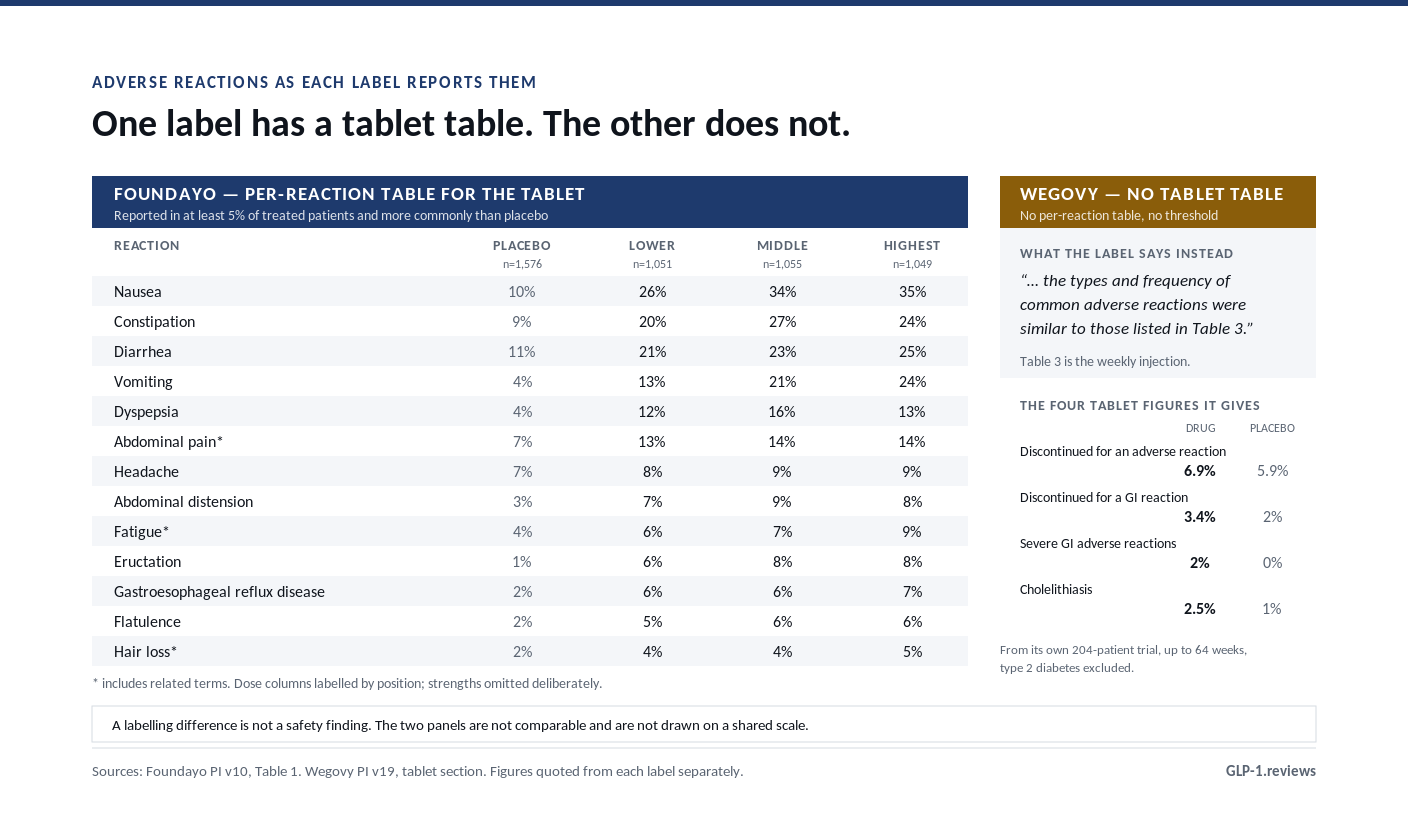
Foundayo’s prescribing information publishes a per-reaction adverse table for the tablet, with placebo comparison, at its own stated threshold. You can read down it and see what was reported and how often.
Wegovy’s prescribing information publishes no equivalent table for its tablet. Its adverse reaction tables are for the once-weekly injection. On the tablet, the label says the types and frequency of common adverse reactions were similar to those listed in Table 3
— Table 3 being the injection’s table, at a different reporting threshold.
So a patient comparing the two products is not comparing two tables. They are comparing one table against a cross-reference to a different product’s table.
| Foundayo label | Wegovy label | |
|---|---|---|
| Per-reaction table for the tablet | Yes | No |
| Placebo comparison for the tablet | Yes | Not in table form |
| What the tablet section gives instead | — | A statement of similarity to the injection’s table, plus a small number of tablet-specific figures |
Two things this does not mean. It does not mean the Wegovy tablet is less studied or less safe — a labelling choice is not a safety finding, and we have no basis to read one as the other. And it does not mean the similarity statement is uninformative; it is a statement the manufacturer made to the FDA and it carries the weight of the label.
What it does mean is narrower and still worth knowing. If you want to see the reported frequency of a specific reaction for the tablet you are being prescribed, one label will show you and the other will send you to a table for a different formulation. That is a real difference in what is available to read, and it is the reason the two sections above look so different from each other.
The pattern both sets share
Read separately, the two labels tell a similar story, and the shape of it is worth stating even though the numbers are not interchangeable and only one of the two publishes a frequency table for its pill.
Gastrointestinal reactions dominate. Nausea, diarrhoea, vomiting, constipation and abdominal pain occupy the top of the Foundayo table by a wide margin, and gastrointestinal events are the reaction type the Wegovy label reports for its tablet. This is a class characteristic, not a property of the tablet formulation — the injectables report the same category leading their tables.
They cluster around dose increases. Both trial programmes titrated upward over weeks, and both report that gastrointestinal events were most frequent during that period rather than distributed evenly. This is also why both labels prescribe a titration schedule rather than starting at the maintenance dose, and why the daily administration protocol one of them carries has to hold through that period.
Most were characterised as mild to moderate. Both trial reports use that framing. It is the trial investigators’ characterisation, not a promise about your experience, and it sat alongside a discontinuation rate that was small but not zero.
The placebo column is not empty. In the Foundayo table nausea was reported by 10% of placebo participants, headache by 7% and fatigue by 4%; in the Wegovy tablet trial 5.9% of placebo participants stopped treatment because of an adverse reaction. The gap between the columns is the drug-attributable part, and it is smaller than the treated column alone suggests.
The serious reactions in both labels
Below the frequency tables, both prescribing informations carry warnings and precautions covering reactions that are uncommon and clinically significant. Both list, among others: pancreatitis, gallbladder disease, acute kidney injury associated with dehydration from severe gastrointestinal reactions, hypersensitivity reactions, diabetic retinopathy complications in patients with type 2 diabetes, and hypoglycaemia when used alongside insulin or an insulin secretagogue.
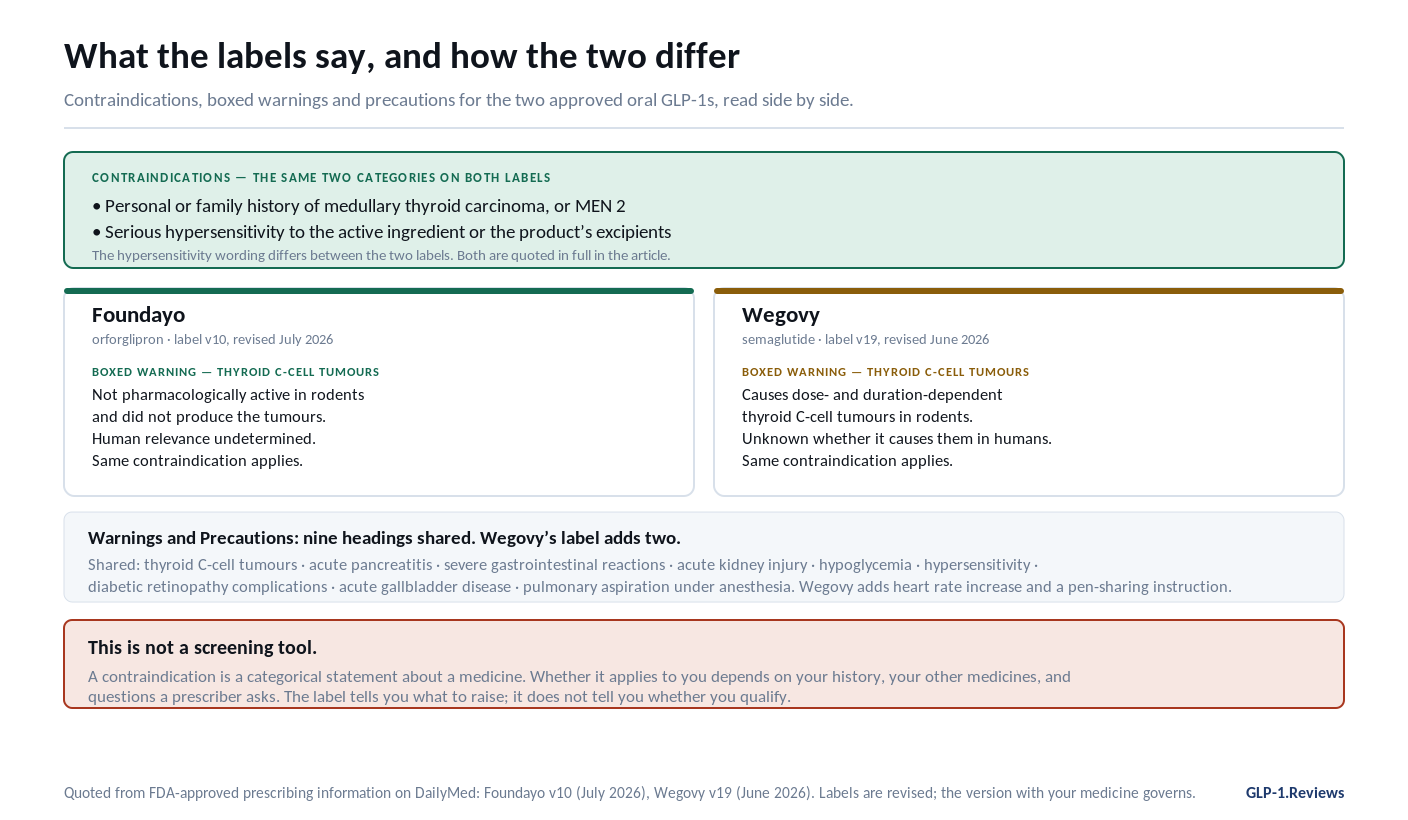
Both also carry a boxed warning — the FDA’s most prominent warning category — concerning thyroid C-cell tumours observed in rodents, with the human relevance not determined. This is the basis of the contraindications for personal or family history of medullary thyroid carcinoma and for MEN 2.
Before any of this, what the labels say about who should not take these at all comes first, and the boxed warnings sit there in full. The lists are not identical. The Wegovy label carries a heart-rate increase warning and a device instruction that the Foundayo label does not; both carry severe gastrointestinal reactions and pulmonary aspiration under anaesthesia. The two labels’ safety sections read side by side sets out the full comparison.
The full text of these sections is in the labels themselves, and this summary is not a substitute for reading them. What matters here is that they exist in both, and that they are the sections your prescriber is working from when they ask about your history.
When to contact your prescriber
This section is not a triage tool. It does not tell you which symptoms are serious, because that determination depends on your history, your other medicines and your examination — none of which are available to an article.
What both labels do is instruct patients to contact their healthcare provider under certain circumstances. Those instructions are reproduced below as what they are: reasons to make contact, not thresholds you assess and clear on your own.
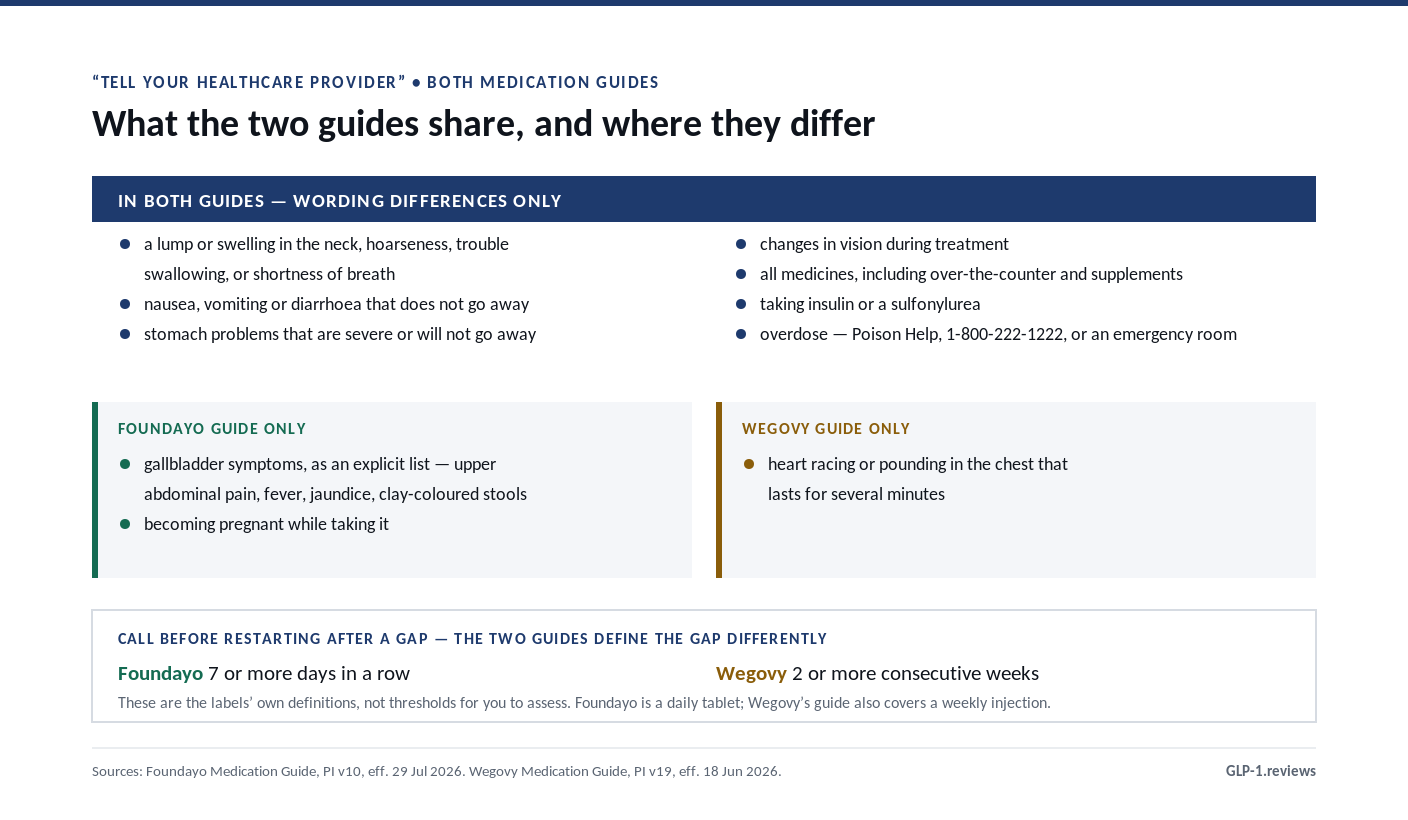
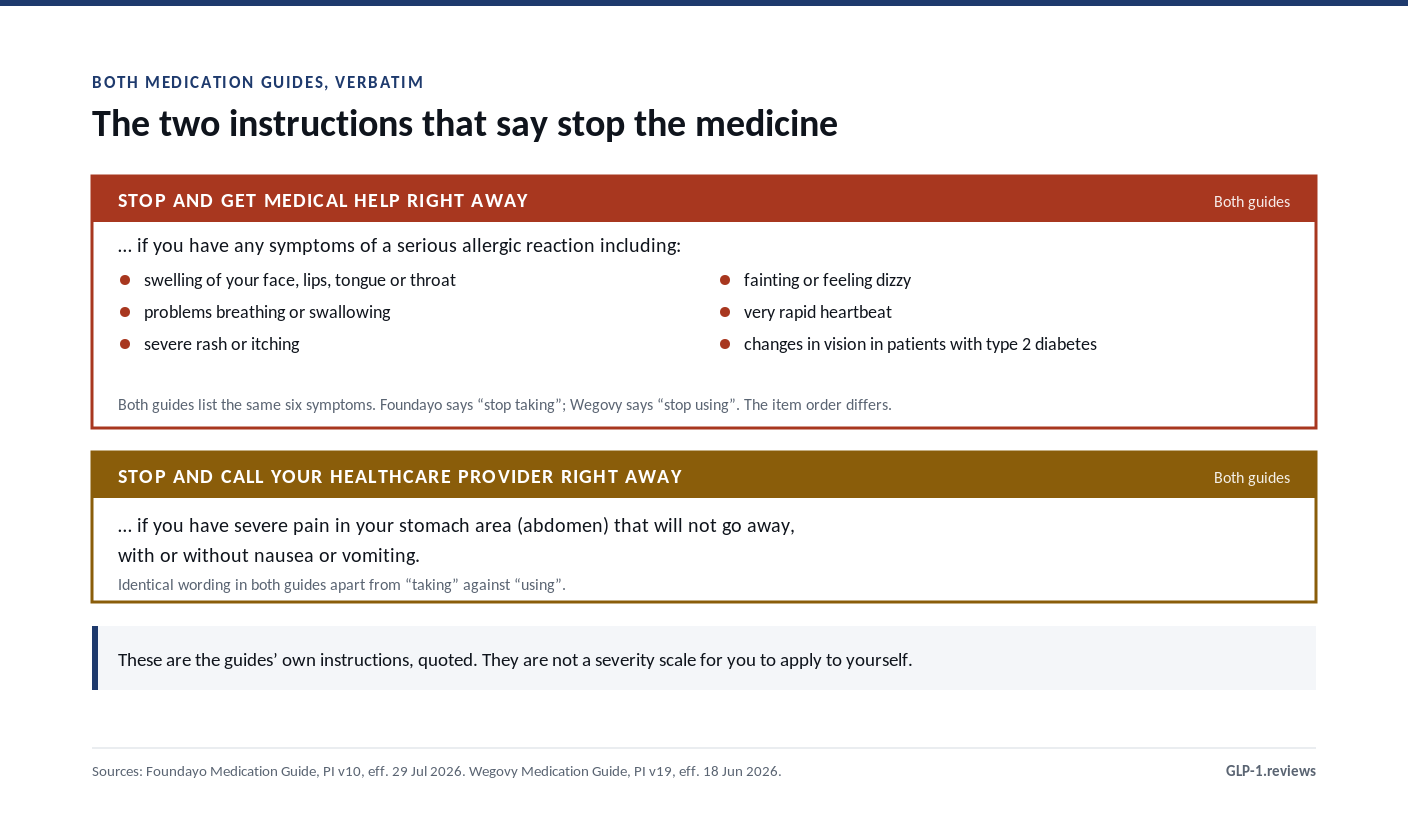
Both Medication Guides tell patients to stop the medicine and get help in two situations, in this language:
- Stop taking it and call your healthcare provider right away if you have “severe pain in your stomach area (abdomen) that will not go away, with or without nausea or vomiting.”
- Stop taking it and get medical help right away if you have any symptoms of a serious allergic reaction, which both guides list as “swelling of your face, lips, tongue, or throat”, “problems breathing or swallowing”, “severe rash or itching”, “fainting or feeling dizzy” and “very rapid heartbeat.”
Both also tell patients to contact their healthcare provider, without stopping the medicine, in these:
- “Tell your healthcare provider if you get a lump or swelling in your neck, hoarseness, trouble swallowing, or shortness of breath.”
- “Tell your healthcare provider right away if you have nausea, vomiting, or diarrhea that does not go away.”
- “Tell your healthcare provider if you have stomach problems that are severe or will not go away.”
- “Tell your healthcare provider if you have changes in vision during treatment.”
- Both guides note that diarrhoea, nausea and vomiting “may cause a loss of fluids (dehydration) which may cause kidney problems”, and both list kidney problems among the serious side effects to raise.
- Both tell patients who have stopped taking the medicine for a period to call before restarting. The two labels define that period differently, so the one on your label is the one that applies.
One instruction appears in the Wegovy guide and not in Foundayo’s: “Tell your healthcare provider if you feel your heart racing or pounding in your chest and it lasts for several minutes.” The Wegovy label carries a heart-rate warning that the Foundayo label does not, which is the kind of difference that disappears if you read one label and assume the other matches.
On too much of either: both guides say to “call your healthcare provider or Poison Help line at 1-800-222-1222 or go to the nearest hospital emergency room right away.”
Three points about those lists. They are quoted from the two Medication Guides and they are not exhaustive — the guides are, and they are short. Where a guide says “stop taking” we have kept that, because it is stronger than contact and we are not in a position to soften it. And “tell your healthcare provider” means exactly that; it does not mean assess the severity yourself first and contact them only if it clears a bar.
Both labels also state that symptoms suggesting a medical emergency warrant emergency care rather than a call. If you believe you are having one, that is not a question for a website.
This article reports what two prescribing informations and their pivotal trials say. It does not tell you whether a symptom you are experiencing is expected, tolerable, or a reason for concern — that is a clinical judgement requiring your history and an examination.
It is not a substitute for the labels, which are longer, more specific, and freely available.
It also does not cover compounded oral products, which carry no FDA-approved label and so have no adverse-reaction table of this kind at all. When a compounded product is and is not a reasonable choice is a separate question with a separate answer.
Trial populations are not the general population. Enrolment criteria excluded people with various conditions, and reported rates in a selected population may not describe what happens outside it.
Frequently asked questions
What are the most common side effects of oral GLP-1s?
Gastrointestinal reactions lead the adverse reaction tables in both approved products’ prescribing information — nausea, diarrhoea, vomiting, constipation and abdominal pain. Specific rates differ between the two labels and are quoted separately above, because the trials were not designed to be compared against each other.
Are oral GLP-1 side effects worse than the injections?
Both routes report the same category of reactions dominating, which is expected for the drug class. A rate-by-rate comparison across products is not supported by the trial designs, so this article does not make one. Whether one is likely to suit you better is a question for your prescriber.
Do the side effects go away?
Both trial programmes report that gastrointestinal events were most frequent during dose escalation rather than spread evenly through the trial, and both labels prescribe a titration schedule for that reason. What happens for any individual is not something a reported average predicts. If symptoms persist, that is a reason to contact your prescriber.
What is the boxed warning about?
Both labels carry a boxed warning concerning thyroid C-cell tumours observed in rodent studies, with human relevance not determined. It is the basis for the contraindications covering personal or family history of medullary thyroid carcinoma and MEN 2. The full text is in each label.
When should I call my prescriber?
Both labels direct patients to make contact for severe or persistent abdominal pain, persistent vomiting or diarrhoea, signs of an allergic reaction, neck lumps or swallowing difficulty, vision changes in type 2 diabetes, and signs of dehydration. That list is not exhaustive and is not a severity scale — it is a set of reasons to get in touch, not a bar to clear first.
The labels are the document
Everything above is a summary of two prescribing informations and the trials behind them. Summaries lose things, and the things a side-effect summary loses are exactly the ones that matter when a symptom is happening to you.
Both labels are published, free, and searchable. If you are taking one of these medicines or considering it, the Adverse Reactions and Warnings sections of your own product’s label are worth twenty minutes — and they are the document your prescriber is working from.
Sources
- Eli Lilly and Company — FOUNDAYO (orforglipron) prescribing information, version 10, revised July 2026, published on DailyMed 13 August 2026. Adverse Reactions (Table 1), Warnings and Precautions, boxed warning, Medication Guide.
- Novo Nordisk — WEGOVY (semaglutide) prescribing information, version 19, revised June 2026, published on DailyMed 30 June 2026. Adverse Reactions (tablet trial, Study 7), Warnings and Precautions, boxed warning, Medication Guide.
- Published pivotal trial results for each oral GLP-1 programme, peer-reviewed, including reported discontinuation rates due to adverse events.
- U.S. Food and Drug Administration — guidance on boxed warnings and labelling content.
Medical disclaimer. This article reports adverse reactions as published in FDA prescribing information and peer-reviewed trial results. It is not medical advice, does not assess symptoms, and does not tell you when a symptom is serious. If you are experiencing side effects, contact your prescriber. If you believe you are having a medical emergency, seek emergency care.
Reporting note. Rates are quoted from each label separately and are not comparable across products. Labels are revised; versions and dates are stated above, and the current version on the FDA label repository supersedes this summary.
Keep exploring our GLP-1 resources:



