
Compounded semaglutide remains lawful and appropriate when a prescriber determines that a change from the FDA-approved product produces a significant difference for that individual patient, and documents that determination on the prescription.
That is not a paraphrase. It is close to the statutory language. Federal law prohibits compounding a drug that is essentially a copy of a commercially available approved product — but the prohibition explicitly excludes a preparation containing a change, made for an identified individual patient, which produces for that patient a significant difference, as determined by the prescribing practitioner.
Two things follow, and they matter more than most coverage of this subject admits.
The clinical bar is not especially high, and the FDA does not second-guess it. The agency has said it generally does not intend to question a prescriber’s determination of clinical difference. What it investigates is whether the determination was made and documented at all.
Not a loophole. Not a technicality. Not something only unscrupulous operators rely on.
Which means the honest reason the lawful category is narrow is not that patients rarely qualify. It is that the determination has to be made per patient, by a prescriber, and written down — and a business selling one standardised product at one price to everyone who fills in a form is not doing that, whatever its intake process looks like.
The standard, stated exactly
Most writing about compounded GLP-1s — including a good deal of ours — spends its time on what is not allowed. It is worth spending a while on what is, because the rule is more specific and more interesting than the summaries suggest.
One option that did not exist when most of this guidance was written: an approved oral GLP-1. If a pill is on the table at all, the oral-versus-injection comparison is a different set of trade-offs from the compounded-versus-branded one.
Section 503A of the Federal Food, Drug, and Cosmetic Act prohibits a compounding pharmacy from producing a drug that is “essentially a copy of a commercially available drug product.” That is the prohibition that ended mass-market compounded semaglutide when the shortages resolved, because once the branded products were commercially available again, a copy of them was exactly what most compounders were making.
But the statute defines its own exception. A compounded preparation is not essentially a copy where there is a change, made for an identified individual patient, which produces for that patient a significant difference — as determined by the prescribing practitioner — between the compounded drug and the comparable commercially available product.
Read the clause slowly, because four separate conditions are packed into it.
| Condition | What it requires | Where it usually fails |
|---|---|---|
| There is a change | The compounded preparation differs from the approved product in some identifiable way | An identical formulation at a different price is not a change |
| Made for an identified individual patient | The change is for you, not for a product line | A standard formulation offered to everyone is made for a market |
| Produces a significant difference for that patient | The change matters clinically for you specifically | Cost, convenience and preference are not clinical differences |
| As determined by the prescribing practitioner | A prescriber makes the call and records it on the prescription | No determination is documented, or the pharmacy made it rather than the prescriber |
What actually meets the standard
Real cases exist, and they are more ordinary than the regulatory language makes them sound.
An allergy or intolerance to an inactive ingredient
Approved products contain excipients — preservatives, buffers, stabilisers — alongside the active molecule. A patient with a documented reaction to one of them cannot use the commercial formulation, and a compounded preparation omitting or substituting it produces a significant difference for that patient. This is the cleanest example in the category and the one FDA guidance most directly contemplates.
A dose the commercial product does not supply
Approved GLP-1s come in fixed strengths on a fixed titration ladder. A patient who cannot tolerate the next step up, or who needs to hold at an intermediate dose their prescriber judges clinically necessary, is asking for something the commercial product does not offer. Whether a given intermediate dose clears the bar is a clinical judgment, and it is the prescriber’s to make.
A formulation change a prescriber judges necessary
Concentration, delivery format or presentation can matter for particular patients — someone with a dexterity limitation, for instance, for whom a specific presentation is materially easier to use correctly. The determination has to be clinical and it has to be about that person, but the category is real.
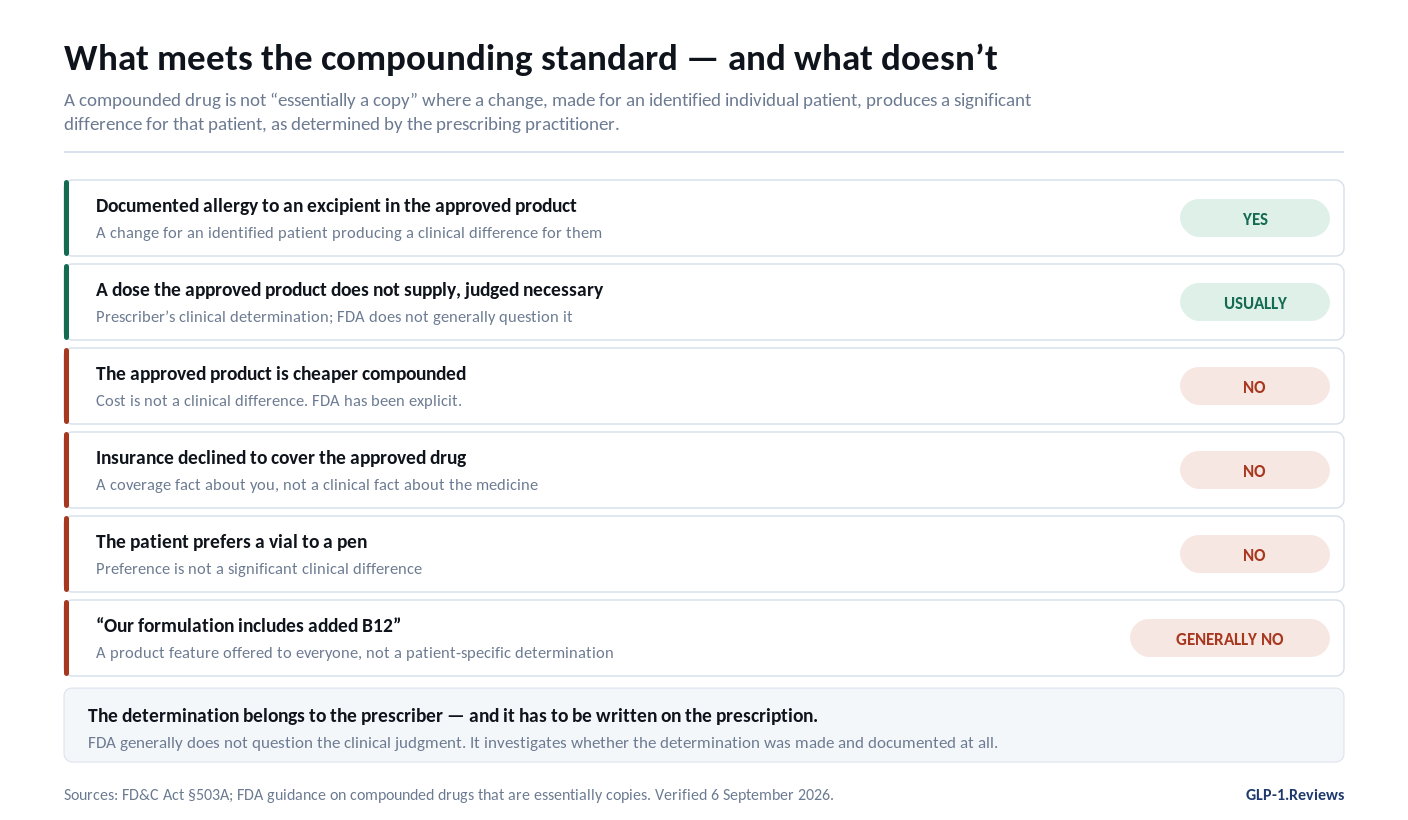
| Reason offered | Meets the standard? | Why |
|---|---|---|
| Documented allergy to an excipient in the approved product | Yes | A change for an identified patient producing a clinical difference for them |
| A dose the approved product does not supply, judged necessary | Usually | Prescriber’s clinical determination; FDA does not generally question it |
| The approved product is cheaper compounded | No | Cost is not a clinical difference. FDA has been explicit. |
| Insurance declined to cover the approved drug | No | A coverage fact about you, not a clinical fact about the medicine |
| The patient prefers a vial to a pen | No | Preference is not a significant clinical difference |
| “Our formulation includes added vitamin B12” | Generally no | An addition offered to every customer is a product feature, not a patient-specific determination |
That last row deserves a note, because combination formulations are widely marketed. Adding a substance to every unit sold is a decision about a product line. It may still be a change, but it is not a change made for an identified individual patient, and the prescriber has not determined it produces a significant difference for you specifically — the formulation existed before you did.
Who makes the determination, and where it lives
This is the part that decides most real cases, and it is almost never discussed.
The determination belongs to the prescribing practitioner. Not the pharmacy, not the telehealth platform, not an intake questionnaire. A clinician has to conclude that a change produces a significant difference for you, and that conclusion has to be documented on the prescription.
The FDA’s guidance is unusually explicit about the mechanics. A compounder relying on such a determination should ensure it is documented on the prescription. Where a prescription does not make clear that the prescriber made the determination, the compounder can contact the prescriber, and if the prescriber confirms it, note it on the prescription.
And the enforcement posture follows from that. The FDA has said it generally does not intend to question a prescriber’s determination of clinical difference. What it will investigate is whether sufficient documentation of that determination exists.
So the agency is deferential about the medicine and strict about the paperwork. That is a coherent position: regulators are poorly placed to second-guess an individual clinical judgment, but well placed to check whether anyone made one.
Why the mass-market model fails this test
Now the pieces fit together, and the picture is less about villainy than about arithmetic.
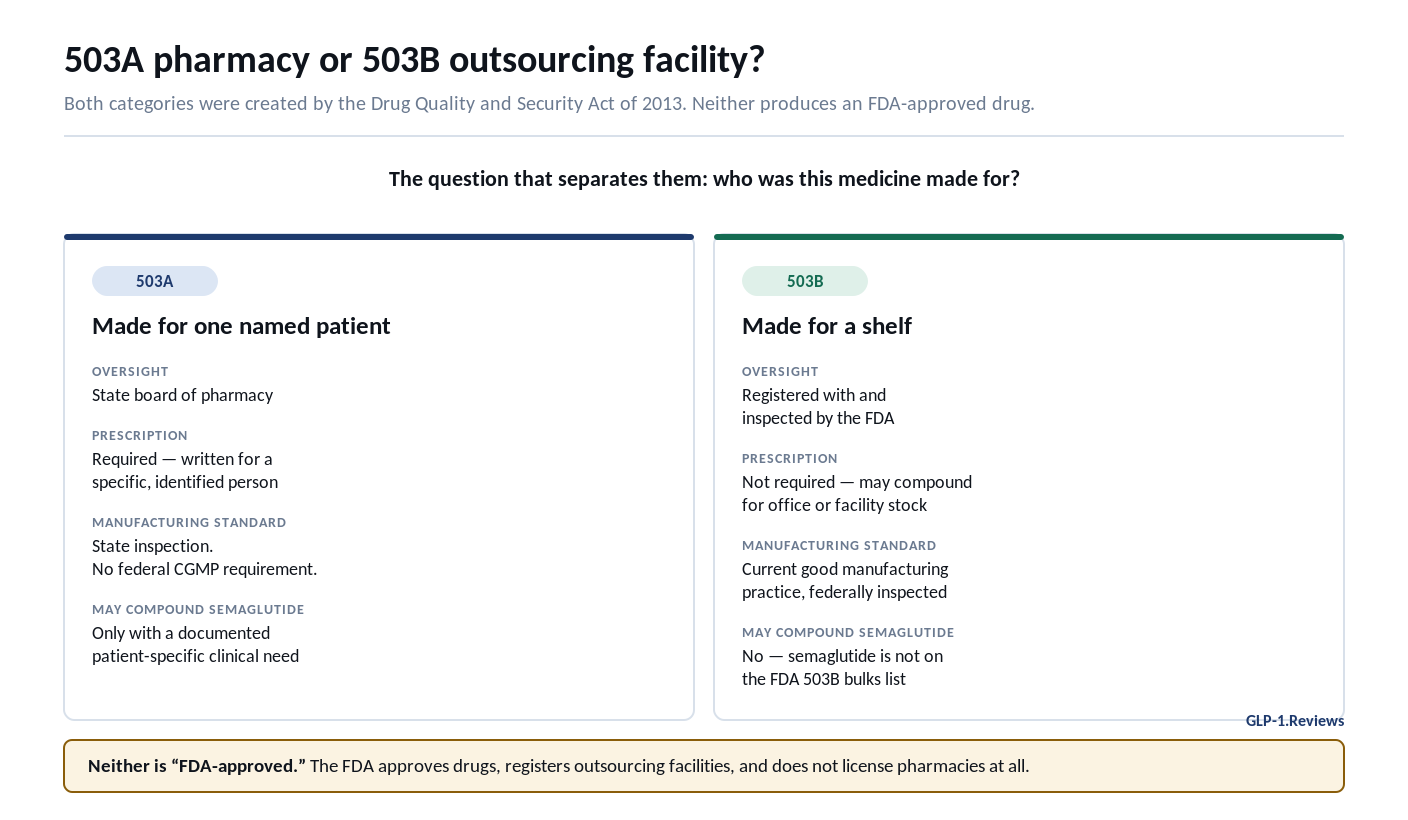
A platform offering compounded semaglutide at a flat monthly price, in a standard formulation, to everyone who completes an intake form, is selling one product to a market. For that to satisfy 503A, a prescriber would have to determine — individually, for each patient, and record it — that a change from the approved product produces a significant difference for that person.
Occasionally that will be true. It cannot be true for everyone who happens to click through, and the business does not depend on it being true, because the same preparation ships either way. The determination is not doing any work in the transaction. That is what makes it a copy.
Compare a genuine 503A case. A prescriber sees a patient who reacts to an excipient, concludes the commercial product is unsuitable, writes a prescription recording that, and a named pharmacy compounds against it. Different patient, potentially different preparation. The determination is doing real work, and there is a document that says so.
The two look similar from a website. They are not remotely the same transaction.
How to tell which one you have
Three questions, in ascending order of usefulness.
Our provider reviews record, for each platform, whether it names its compounding pharmacy and whether it also prescribes FDA-approved medication; the Mochi Health and Ivim Health reviews are two examples of what that record looks like.
Can you state your own clinical reason?
If a prescriber determined that a change produces a significant difference for you, you can probably say what it was — an ingredient you react to, a dose you needed. If you cannot, ask. It should be in your record.
Would the formulation be different for someone else?
Genuine patient-specific compounding produces patient-specific preparations. If everyone on the programme receives the same thing at the same price, the preparation was not made for you individually, whatever the intake form implied.
Did a prescriber make the call, or did an algorithm route you?
An intake questionnaire that ends in a standard prescription is a screening tool. A prescriber concluding something about your case is a determination. Both can be legitimate care; only the second satisfies the exception.
If you take an FDA-approved GLP-1, none of this concerns you. The essentially-a-copy rule governs compounding, and there is nothing to compound.
This also is not a test you should administer to your own prescription and act on alone. If you think your compounded prescription may not rest on a documented determination, the useful step is to ask your prescriber what the clinical basis was — not to stop treatment. Discontinuing a medication because of a regulatory concern is a decision to make with a clinician, not a website.
And nothing here says compounded medication is unsafe. The essentially-a-copy provision is about whether a preparation may lawfully be made, not about whether any particular vial is contaminated.
Frequently asked questions
Is compounded semaglutide legal for me if my insurance won’t cover Wegovy?
No, not on that basis. Cost and coverage are not clinical differences, and the FDA has been explicit that a compounded drug cannot avoid the essentially-a-copy prohibition because the approved product is expensive or uncovered. That may feel unjust — it is often the reason people seek compounded medication — but it is not what the statute asks about.
What can qualify is a clinical reason the approved product is unsuitable for you specifically. Those are different questions with different answers.
Who decides whether my case qualifies?
Your prescriber, and the determination has to be documented on the prescription. Not the pharmacy, not the telehealth platform. The FDA has said it generally does not intend to question a prescriber’s clinical judgment on this — but it does check whether the determination exists.
Does a longer intake questionnaire make a programme compliant?
No. Length is not the variable. A fourteen-screen intake that produces the same standard formulation for everyone has gathered more information without a prescriber determining that a change produces a significant difference for any particular person. The question is whether an individual determination was made and recorded, not how much data was collected first.
Are combination formulations — semaglutide with B12, for example — patient-specific?
Generally not, when the combination is offered as a standard product. The change exists, but it was not made for an identified individual patient; it was made for a product line before that patient existed. A prescriber could determine that such a combination produces a significant difference for a specific person, but that determination has to be about them.
If my prescription does qualify, is my supply safe from the FDA’s pending decision?
More so than a bulk-compounded supply. The FDA’s proposal concerns the 503B bulks list, which governs bulk compounding by outsourcing facilities. Patient-specific 503A compounding operates under a different provision and would not be directly changed. That said, if the pharmacy serving you exits the category commercially, the legal position will not keep your supply running — which is worth asking about.
The narrow category is real, and it is worth defending
It would be easier to write about compounded semaglutide as though the lawful version were a fiction. It is not. Patients react to excipients. Prescribers sometimes need a dose the commercial ladder does not offer. Compounding pharmacies exist to solve exactly these problems and have done so, uncontroversially, for a very long time.
What changed was not the legitimacy of compounding. It was that a shortage briefly made mass production of copies lawful, an industry formed around that permission, and the permission closed while the industry did not.
The test is the same one the statute has always applied. Did a prescriber decide that a change makes a significant difference for you — and is it written down?
If yes, you are in the category the law was written to protect. If nobody can point to it, the price was never the thing that made it a copy.
Sources
- Federal Food, Drug, and Cosmetic Act, section 503A — compounding by licensed pharmacists and physicians.
- U.S. Food and Drug Administration. Compounded Drug Products That Are Essentially Copies of a Commercially Available Drug Product Under Section 503A — guidance for industry. fda.gov.
- U.S. Food and Drug Administration. Human Drug Compounding — regulatory hub. fda.gov, accessed 6 Sep 2026.
- U.S. Food and Drug Administration. Compounding Laws and Policies. fda.gov.
- U.S. Food and Drug Administration. FDA clarifies policies for compounders as national GLP-1 supply begins to stabilize. fda.gov.
- U.S. Food and Drug Administration. FDA’s Concerns with Unapproved GLP-1 Drugs Used for Weight Loss. fda.gov.
- U.S. Food and Drug Administration. FDA Proposes to Exclude Semaglutide, Tirzepatide, and Liraglutide on 503B Bulks List. 30 Apr 2026.
- Drug Quality and Security Act of 2013, Pub. L. 113-54.
- Wegovy and Ozempic prescribing information — excipient listings. Novo Nordisk.
Medical disclaimer. This article explains a legal standard governing pharmacy compounding. It is not medical advice, does not recommend or discourage any medication, and does not address dosing. Whether compounded medication is appropriate for you is a decision for a licensed prescriber who knows your medical history. Do not start or stop any medication based on this article.
Regulatory status note. Verified against the FD&C Act and FDA guidance on 6 September 2026. The FDA’s 503B bulks list determination was pending as of that date.
Keep exploring our GLP-1 resources:



