
There is no such thing as an FDA-approved pharmacy. The phrase describes a category that does not exist.
The FDA approves drugs, after reviewing safety and effectiveness data for a specific product. It registers outsourcing facilities, which means those facilities have identified themselves and accepted federal inspection. State boards of pharmacy license pharmacies. Three different actions by three different bodies, and only the first one is about the medicine.
A telehealth company describing its pharmacy as FDA-approved is either unaware of a distinction central to its own regulatory obligations, or aware of it and using the phrase anyway.
Not a semantic quibble. Not industry shorthand. Not a claim the FDA has quietly tolerated.
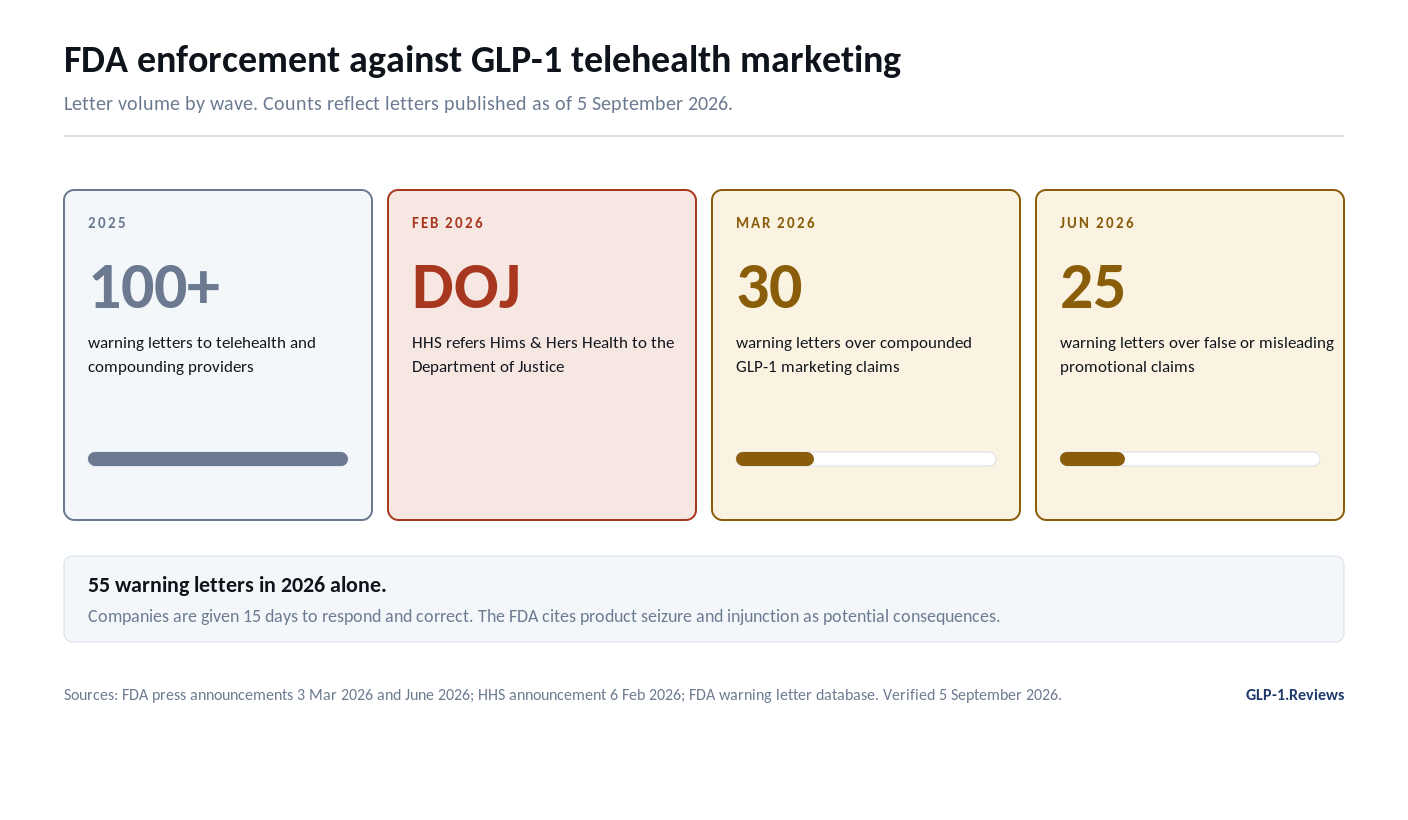
It is one of six recurring claim types the agency cited when it wrote to telehealth companies marketing compounded GLP-1 products. The FDA issued 55 such warning letters in 2026 alone — 30 in March and 25 in June — following more than 100 in 2025.
The deeper point is how the agency evaluates these claims. The FDA assesses the overall net impression a company’s marketing leaves, not individual sentences in isolation. A page can be built entirely from technically defensible statements and still be found misbranding, if what it communicates as a whole is that a compounded product is equivalent to an approved one.
What the FDA actually approves, registers and licenses
Three verbs get used interchangeably in telehealth marketing, and they mean entirely different things.
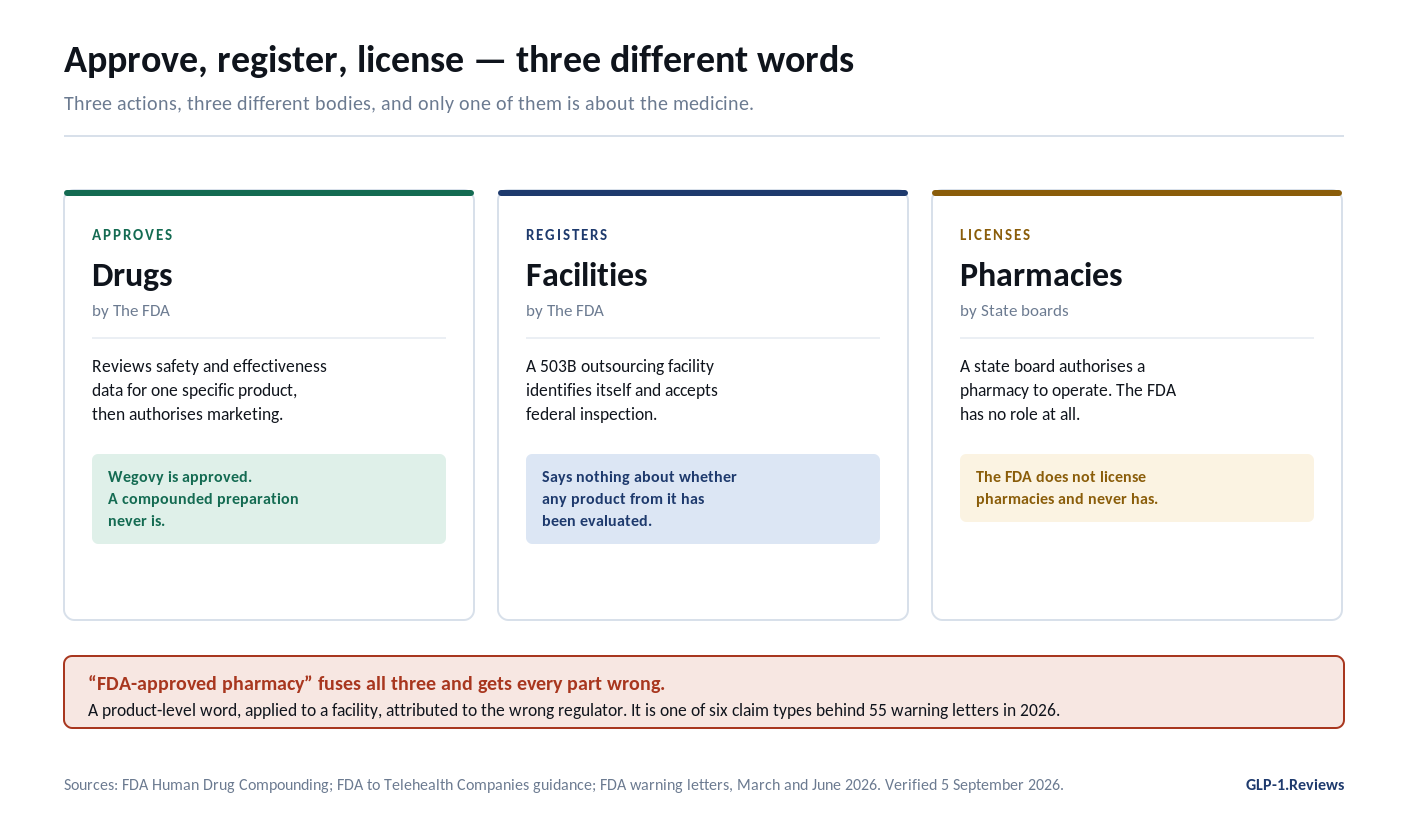
Approval applies to drugs. A manufacturer submits safety and effectiveness data for a specific product at specific doses for a specific indication. The FDA reviews it and either authorises marketing or does not. Wegovy is approved. Zepbound is approved. A compounded preparation is not, and cannot be, because approval is a product-level determination that compounded drugs never undergo.
Registration applies to facilities. A 503B outsourcing facility registers with the FDA, reports what it produces, and accepts inspection under current good manufacturing practice. That is meaningful federal oversight of how the facility operates. It says nothing about whether any particular product from that facility has been evaluated.
Licensure applies to pharmacies and is issued by state boards, not the federal government. A 503A compounding pharmacy holds a state license. The FDA does not license pharmacies and never has.
So “FDA-approved pharmacy” fuses a product-level word with a facility-level object and attributes it to the wrong regulator. Every part of the phrase is wrong.
Why the confusion is useful to a seller
Because approval is the word buyers understand. A patient comparing a $1,349 list-price branded drug against a $199 compounded alternative wants reassurance that the cheaper option has been checked by someone. “FDA-approved” supplies that reassurance without the seller having to earn it.
That is precisely why the FDA treats it as a misbranding issue rather than sloppy copywriting. The phrase transfers the authority of a review process the product never went through.
The six claim types behind the 2026 warning letters
Across the 55 warning letters the FDA issued to telehealth companies in 2026, six claim patterns recur. Each is a phrase you can look for on any provider’s site today.
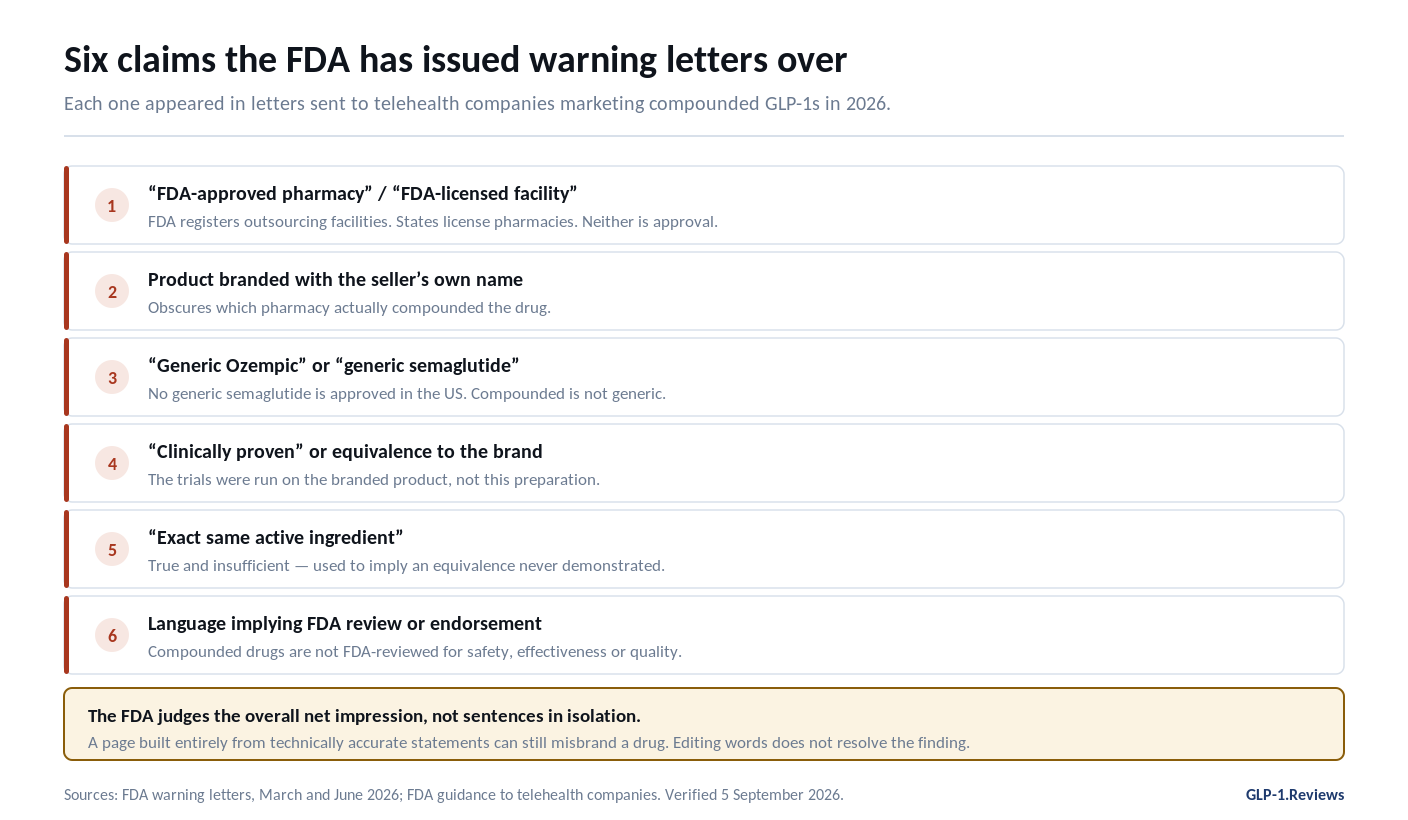
| Claim on the provider’s site | Why the FDA objects | What is actually true | What to ask instead |
|---|---|---|---|
| “FDA-approved pharmacy” / “FDA-licensed facility” | Attributes a product-level approval to a facility, and to the wrong regulator | FDA registers outsourcing facilities; states license pharmacies | “Are you 503A or 503B, and can I see the registration or license?” |
| Product branded with the telehealth company’s own name | Obscures who compounded the drug and implies the seller manufactured it | A separate licensed pharmacy compounded it | “Which pharmacy compounds this, and in which state?” |
| “Generic Ozempic” / “generic semaglutide” | No generic semaglutide is approved in the United States | Compounded is not generic. Generics are approved products. | “Is this an FDA-approved product or a compounded preparation?” |
| “Clinically proven” or equivalence to the brand | Compounded products have not undergone the trials supporting the approved drug | The trials were run on the branded product, not this preparation | “What clinical data exists for this specific preparation?” |
| “Exact same active ingredient” | Technically true, used to imply an equivalence not demonstrated | Same molecule; different manufacturing controls, stability testing and formulation | “Where is the active ingredient sourced, and is there a batch Certificate of Analysis?” |
| Language implying FDA review or endorsement | The FDA has not reviewed the product for safety, effectiveness or quality | Compounded drugs are not FDA-reviewed in any form | “Has the FDA reviewed this product?” — the answer is no |
These letters did not arrive in isolation. In February 2026 the Department of Health and Human Services announced it had referred Hims & Hers Health to the Department of Justice for investigation. The March warning letters followed weeks later. Companies receiving a letter are given 15 days to respond and correct, with product seizure and injunction cited as potential consequences.
Why “net impression” is the part that matters
The single most useful thing to understand about this enforcement is that the FDA does not read marketing sentence by sentence.
The agency evaluates the overall impression a reasonable consumer takes from the whole presentation — headline, imagery, comparison tables, disclaimers, and what the disclaimers are placed near. A page can consist entirely of individually accurate statements and still be found to misbrand a drug, because the arrangement communicates something the statements do not literally say.
This is why several companies that responded to warning letters by editing individual words did not resolve the underlying finding. Removing “FDA-approved” while keeping a page architecture built around implied equivalence changes the sentences, not the impression.
What a compliant presentation looks like
Providers who have adjusted meaningfully tend to share a few characteristics. They name the compounding pharmacy rather than branding the drug as their own. They state plainly that compounded preparations are not FDA-approved. They avoid comparative efficacy claims entirely, because they have no trial data of their own to support one. And they place that disclosure near the product claim rather than in a footer.
Our provider reviews record whether each platform names its compounding pharmacy and how it describes the product; the Mochi Health and Ivim Health reviews show what that disclosure looks like when it is done.
None of that is difficult. That it remains uncommon is the finding.
How to check any provider in about ten minutes
Search the FDA warning letter database
The FDA publishes warning letters in a public, searchable database. Given 55 letters to telehealth companies in 2026 and more than 100 in 2025, this is not a remote possibility — it is a realistic check on any company selling compounded GLP-1s. A letter is not proof a company is unsafe. It is a record of what the FDA found, and whether the company changed anything afterwards is visible in its current marketing.
Read the page for the six phrases
Work through the table above against the provider’s own site. Finding one of these phrases does not mean the company has been sanctioned. It means the company is making a claim the FDA has repeatedly cited others for making.
Ask the sourcing question in writing
“Which licensed pharmacy compounds this medication, in which state, and are they a 503A pharmacy or a registered 503B outsourcing facility?” Ask by email so you have the answer in writing. A company confident in its supply chain answers in one line.
Check the answer against the FDA’s list
If the answer names a 503B facility, it should appear on the FDA’s registered outsourcing facility list. If it names a 503A pharmacy, the state board’s licensure lookup should show it. Claims that cannot be verified against a public register are claims, not facts.
This concerns marketing claims about compounded medications. It has no bearing on FDA-approved products — Ozempic, Wegovy, Mounjaro, Zepbound and the approved oral formulations are genuinely FDA-approved, and a provider dispensing them is describing them accurately.
It also does not mean every company using imprecise language is acting in bad faith. Some of this vocabulary has spread through the industry as sloppy convention. The FDA’s position is that intent does not determine whether a claim misbrands a drug — the impression it creates does.
And a warning letter is not a finding of harm. It is a finding about claims. Companies can and do correct them.
Frequently asked questions
Is any pharmacy FDA-approved?
No. Not one, anywhere in the United States. The FDA has no pharmacy approval programme, so no pharmacy can hold a designation that does not exist. Outsourcing facilities can be FDA-registered and pharmacies can be state-licensed, and providers sometimes compress those into “FDA-approved” — but the compressed version claims something neither status confers.
If a pharmacy is FDA-registered, is the medication FDA-approved?
No, and this is the substitution that does the most work in telehealth marketing. Registration is about the facility: it has identified itself to the FDA and accepted inspection. Approval is about a specific drug: the FDA has reviewed its safety and effectiveness data. A registered outsourcing facility produces unapproved drugs under federal oversight of its processes. The oversight is real; the approval is not there.
Does a warning letter mean the medication is dangerous?
Not necessarily. Most of the 2026 letters concern marketing claims — how a product was described — rather than findings of contamination or patient harm. That said, the claims at issue are the ones that lead people to believe a compounded product has been vetted the way an approved drug has, and that belief affects real decisions.
My provider removed the phrase after I asked. Is that enough?
It depends on whether anything else changed. The FDA evaluates overall net impression, so a page that drops “FDA-approved” while keeping an architecture built around implied equivalence to the brand has changed its wording and not its meaning. Look at whether the provider now names its pharmacy, states plainly that the preparation is not FDA-approved, and has stopped making comparative efficacy claims.
Is it illegal for me to buy from a company that received a warning letter?
No. Enforcement in this area is directed at companies, not patients. You face no legal exposure for having filled a prescription. The practical risk is different: a company under enforcement pressure may have to change or stop its offering, and patients tend to discover that mid-treatment.
The phrase is a tell, not a technicality
Nobody needs to understand the difference between approval, registration and licensure to buy a medication safely. But a company selling a prescription drug does need to understand it, because those three words define its regulatory obligations.
When a provider gets them wrong on its own homepage, the useful question is not whether the copywriter was careless. It is what else the company has not examined closely — and whether a business that has not read the FDA’s guidance on describing its own product has read the guidance on making it.
Fifty-five letters went out in 2026. The phrases are published. Checking takes ten minutes.
Sources
- U.S. Food and Drug Administration. FDA to Telehealth Companies: What to Know When Promoting Compounded Drugs. fda.gov, accessed 5 Sep 2026.
- U.S. Food and Drug Administration. FDA warns 30 telehealth companies against illegal marketing of compounded GLP-1s. Press announcement, 3 Mar 2026.
- U.S. Food and Drug Administration. Warning Letters — public searchable database. fda.gov.
- U.S. Food and Drug Administration. FDA’s Concerns with Unapproved GLP-1 Drugs Used for Weight Loss. fda.gov.
- U.S. Food and Drug Administration. Human Drug Compounding and Registered Outsourcing Facilities. fda.gov.
- Foley & Lardner LLP. GLP-1 Compliance: FDA Targets Telehealth Marketing in 30 New Warning Letters. March 2026.
- Sheppard Mullin. FDA’s Focus Returns to Compounding and Telehealth: Another Wave of Warning Letters. June 2026.
- U.S. Department of Health and Human Services. Announcement of DOJ referral, 6 Feb 2026.
- U.S. Food and Drug Administration. Compounding Laws and Policies — FD&C Act sections 503A and 503B. fda.gov.
Medical disclaimer. This article reports FDA statements and public enforcement records about marketing claims. It is not medical advice, does not recommend or discourage any medication or provider, and does not address dosing. Treatment decisions belong with a licensed healthcare provider who knows your medical history.
Regulatory status note. Verified against FDA and HHS sources on 5 September 2026. Warning letter counts reflect letters published as of that date; the FDA issues these in batches and totals change.
Keep exploring our GLP-1 resources:



