
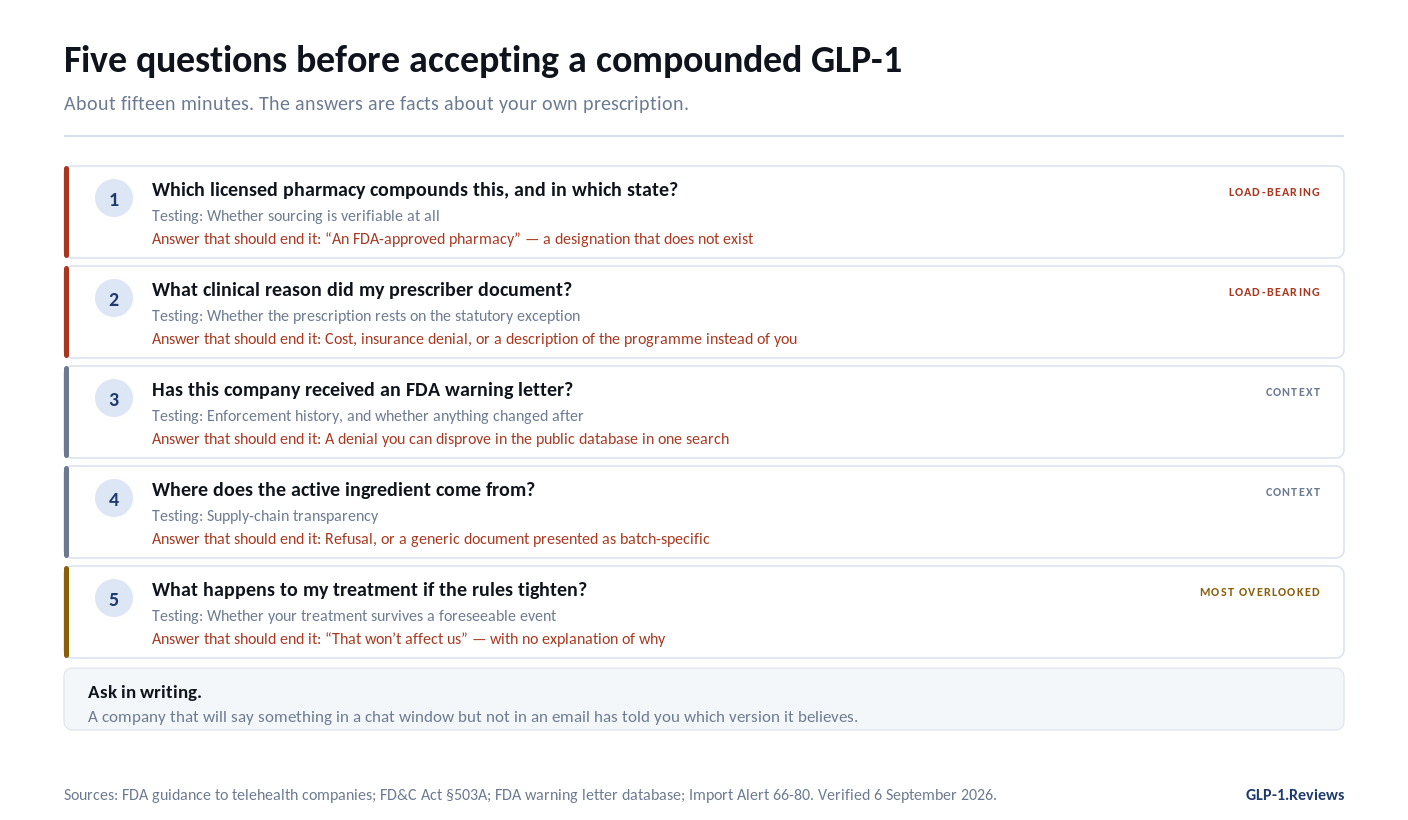
Five questions, answerable in about fifteen minutes, that establish whether a compounded GLP-1 prescription rests on anything.
Which licensed pharmacy compounds this, and in which state. What clinical reason my prescriber documented for compounding rather than prescribing the approved product. Has this company received an FDA warning letter. Where does the active ingredient come from, and is there a batch Certificate of Analysis. And what happens to my treatment if the rules tighten.
Not a hostile interrogation. Not questions a legitimate operator finds awkward. Not a substitute for talking to a clinician.
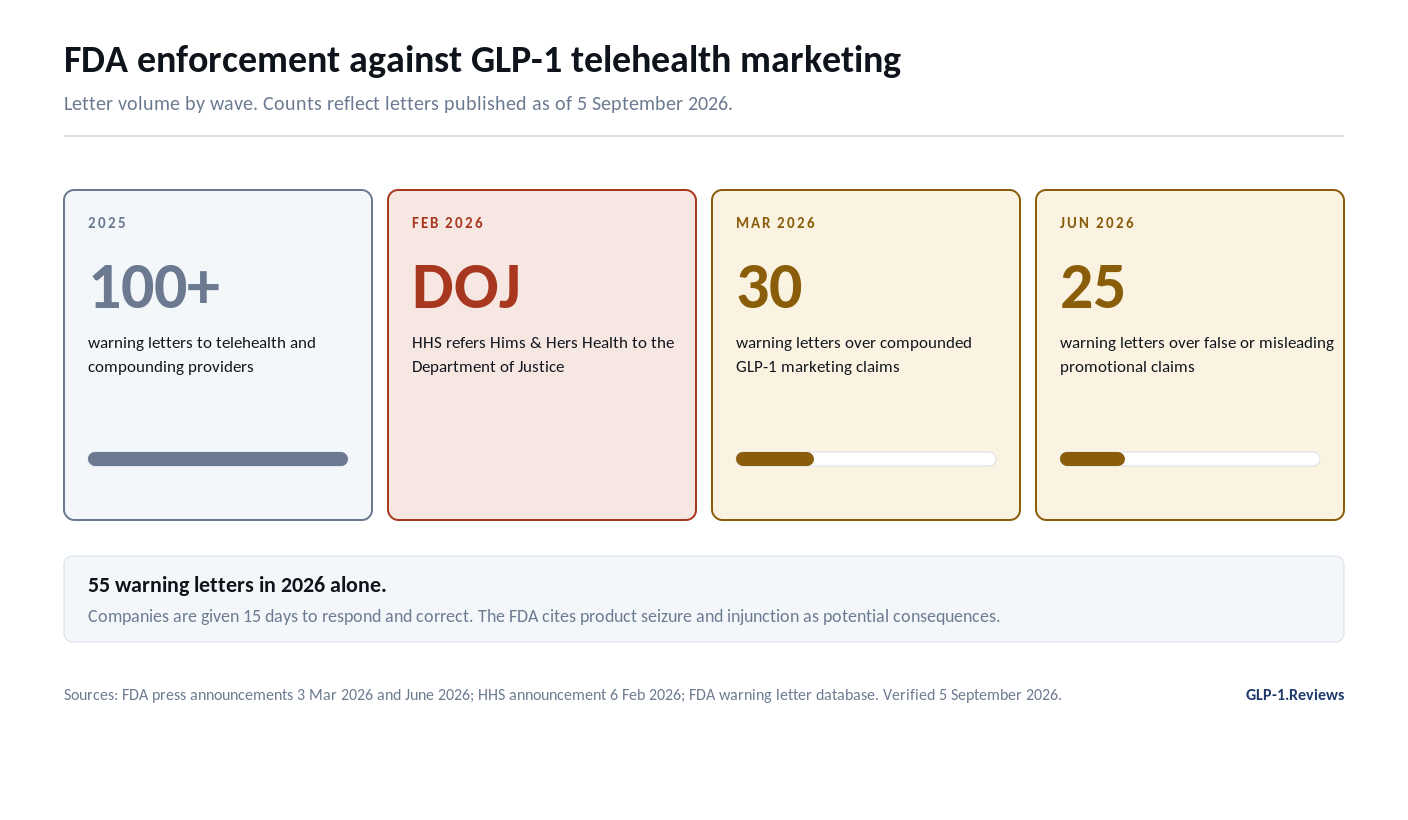
The last one matters most and is asked least. The FDA issued 55 warning letters to telehealth companies in 2026 and has proposed permanently excluding semaglutide, tirzepatide and liraglutide from the 503B bulks list. A provider without a plan for that does not have a supply problem yet. It has one scheduled.
What you are really testing is not any single answer. It is whether the company can answer at all — and whether the answers are about you specifically or about its product in general. A prescription that exists because a prescriber concluded something about your case is a different object from one that exists because you completed a form.
Why these questions, and why now
Two years ago most of this would have been unnecessary. Semaglutide and tirzepatide were on the FDA’s shortage list, compounding them was lawful on that basis, and the main question worth asking a provider was what it cost.
Start with the question most providers cannot be made to answer on their website: which pharmacy makes it. Only 13 of 58 compounding providers name their pharmacy before checkout, most of them in a collapsed FAQ or fine print; for the rest you will have to look further, or ask.
That basis is gone. The tirzepatide shortage was declared resolved in December 2024 and semaglutide in February 2025, enforcement discretion ended in March and May 2025, and a federal court upheld the FDA in May 2025. Compounded GLP-1s did not become illegal — but the route that made them lawful at volume closed, and what remains is narrow and patient-specific.
Which means the questions changed. It is no longer enough to know what a programme costs. You need to know what it rests on.
1. Which licensed pharmacy compounds this, and in which state?
Ask for a business name and a state, in writing.
Most platforms brand the medication with their own name and never identify the pharmacy in the purchase flow. That practice is one of six claim types the FDA cited in its 2026 warning letters, because it obscures who actually made the drug.
Once you have a name, it takes minutes to check. Registered 503B outsourcing facilities appear in the FDA’s public register. 503A pharmacies appear in state board licensure lookups. A pharmacy that cannot be found under the name you were given is the answer.
What a good answer sounds like: a specific pharmacy, a named state, and whether it operates as 503A or 503B.
What a poor answer sounds like: “our network of licensed pharmacy partners,” the platform’s own brand name, or “an FDA-approved pharmacy” — a designation that does not exist.
2. What clinical reason did my prescriber document?
This is the question that separates a lawful prescription from a copy, and almost nobody asks it.
Federal law prohibits compounding a drug that is essentially a copy of a commercially available approved product. The exception is a change, made for an identified individual patient, that produces for that patient a significant difference — as determined by the prescribing practitioner, and documented on the prescription.
So there should be a recorded clinical reason the approved product is unsuitable for you specifically. A documented reaction to an excipient. A dose the commercial product does not supply. Something about your case.
Ask what yours was. It should be in your record and someone should be able to state it.
What a good answer sounds like: a specific clinical reason attributable to your prescriber.
What a poor answer sounds like: “compounded is more affordable,” “your insurance denied coverage,” or a description of the programme rather than of you. Cost and coverage are not clinical differences, and the FDA has been explicit about that.
3. Has this company received an FDA warning letter?
Search the FDA’s warning letter database. It is public and searchable, and with 55 letters to telehealth firms in 2026 plus more than 100 in 2025, the base rate makes this a routine check rather than a suspicious one.
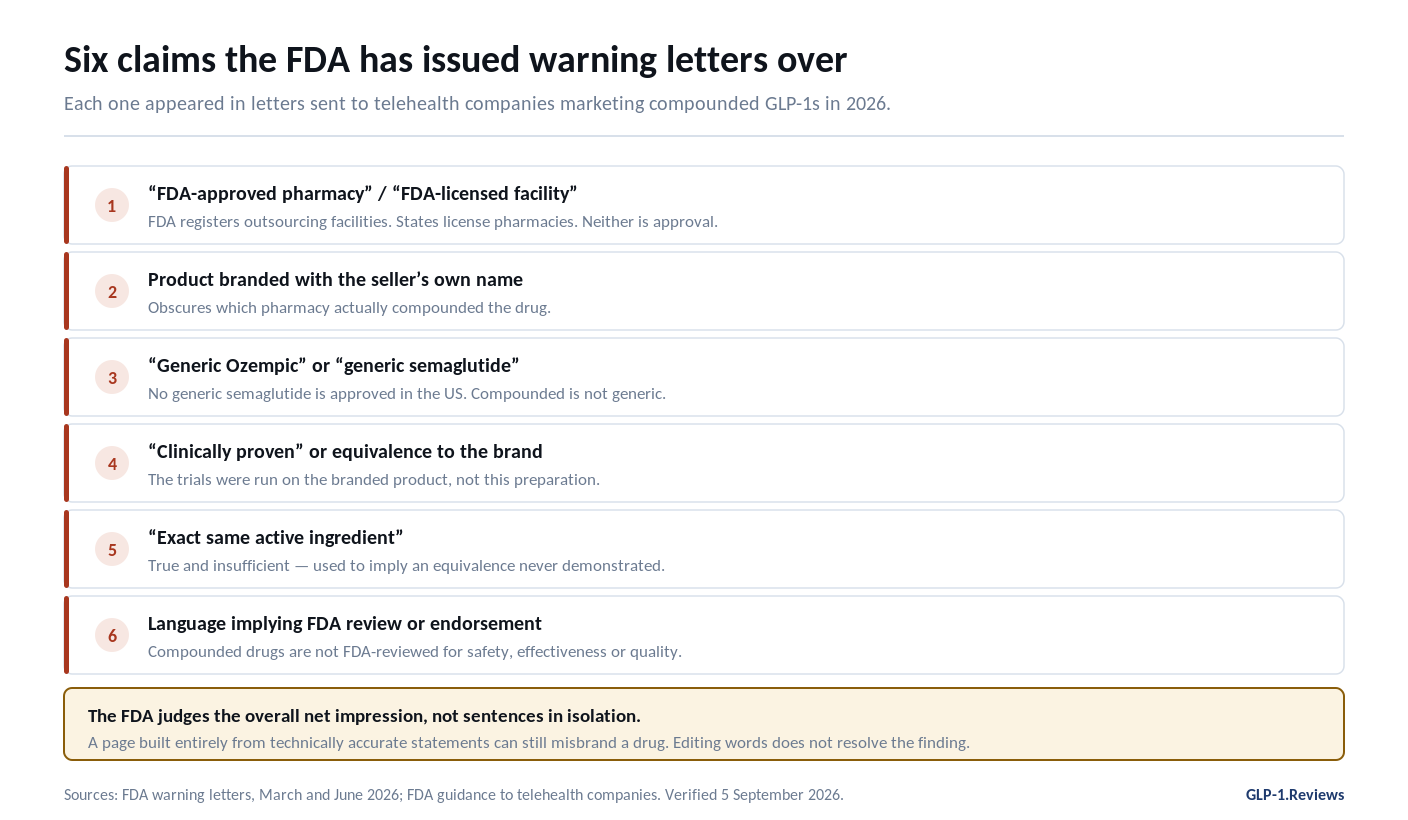
Read what you find carefully. Most 2026 letters concern how products were described — claims of equivalence to approved drugs, “generic semaglutide,” implied FDA approval — rather than findings of contamination or patient harm. A letter is a record of what the FDA found, not proof a company is dangerous.
What tells you more is the company’s marketing today. Some recipients changed substantively: they now name their pharmacy, state plainly that compounded preparations are not FDA-approved, and have dropped comparative efficacy claims. Others edited individual words while keeping a page built around implied equivalence. The FDA evaluates overall net impression, so the second group has changed its wording and not its meaning.
4. Where does the active ingredient come from?
Ask for the active pharmaceutical ingredient source and a batch-specific Certificate of Analysis.
This is not a hypothetical concern. The FDA has placed foreign-sourced GLP-1 API under Import Alert 66-80, permitting detention without physical examination unless the ingredient and the firm appear on a vetted list. Where the raw material came from is a legitimate question with a real regulatory history behind it.
A Certificate of Analysis reports potency and purity testing for a batch. It is a meaningful transparency signal and it is not the same as FDA approval — a CoA says a batch was tested, not that a product was reviewed for safety and effectiveness. Ask whether the CoA is batch-specific for the vial you will receive or a generic sample document, because those differ substantially in what they tell you.
5. What happens to my treatment if the rules tighten?
The question nobody asks, and in 2026 the one most likely to affect you.
Our reviews record, for each platform, whether it prescribes FDA-approved medication alongside compounded supply; the Ro, Mochi Health and Ivim Health reviews show three different answers to the continuity question.
On 30 April 2026 the FDA proposed excluding semaglutide, tirzepatide and liraglutide from the 503B bulks list entirely, having found insufficient evidence of clinical need. The comment period closed on 30 July 2026. As of 6 September 2026 no final determination has published.
If that proposal is finalised, bulk compounding of those three ends outright. Providers relying on it will have to change what they offer or stop offering it. Patients generally discover this when a refill does not arrive.
So ask directly: if your supply route becomes unavailable, what happens to me? Is there a branded pathway? Will I be transitioned or notified?
Hims & Hers is the worked example of a company that had an answer. In March 2026 it announced it would stop advertising compounded GLP-1s, entered a collaboration with Novo Nordisk, and began moving patients to FDA-approved medicines. Whatever one thinks of the company, that is what a continuity plan looks like — and it chose it while compounded was still, for many patients, the cheaper option.
| Question | What you’re testing | Answer that should end the conversation |
|---|---|---|
| Which pharmacy, which state, 503A or 503B? | Whether sourcing is verifiable at all | “An FDA-approved pharmacy” — a designation that does not exist |
| What clinical reason did my prescriber document? | Whether the prescription rests on the statutory exception | Cost, insurance denial, or a description of the programme instead of you |
| Any FDA warning letters? | Enforcement history, and whether anything changed after | A denial you can disprove in the public database in one search |
| API source and batch CoA? | Supply-chain transparency | Refusal, or a generic document presented as batch-specific |
| What if the rules tighten? | Whether your treatment survives a foreseeable event | “That won’t affect us” — with no explanation of why |
What to do with the answers
Not every imperfect answer is disqualifying, and treating them that way will leave you with no provider at all.
Weight them. Questions 1 and 2 are load-bearing: a provider that will not name its pharmacy, or cannot point to a clinical reason for your prescription, has failed on the two things that determine whether your supply is lawful and traceable. Question 5 is about durability and is worth more than most people give it. Questions 3 and 4 are context — informative, rarely decisive on their own.
And ask in writing. Not because you plan to do anything with the record, but because a company that will say something in a chat window and not in an email has told you which version it believes.
If you have been prescribed an FDA-approved medication, none of these questions apply. There is no compounding pharmacy to identify, no essentially-a-copy analysis, and no bulks list exposure.
This is also not a reason to stop a medication you are currently taking. If the answers concern you, the next step is a conversation with your prescriber about alternatives — not discontinuation. Stopping a GLP-1 has its own consequences and that decision belongs with a clinician.
And a provider that answers all five well has demonstrated transparency, not clinical quality. These questions test whether you can verify what you are being sold. They do not evaluate the care.
Frequently asked questions
Isn’t it rude to interrogate a healthcare provider like this?
No, and reframing it helps. You are not questioning a clinician’s judgment — you are asking a company to identify the manufacturer of a prescription drug it sold you, and to tell you the clinical basis recorded for your own prescription. Both are facts about your care that you are entitled to. A legitimate operator answers without friction.
What if my provider answers everything well but is still compounding semaglutide?
Then you are likely in the narrow lawful category, which genuinely exists. Patient-specific compounding remains legal where a prescriber has determined a change produces a significant difference for you and documented it. Good answers to these questions are broadly what that situation looks like from the outside.
Should I ask before or after I sign up?
Before, if you can. Some platforms will not disclose the pharmacy until after purchase, which is itself informative. If you have already started, ask anyway — the answers still tell you whether to plan for a transition.
My provider says a warning letter was “just about marketing.” Is that fair?
Partly. Most 2026 letters do concern claims rather than product safety. But the claims at issue are the ones that lead people to believe a compounded drug has been vetted like an approved one, and that belief drives real decisions. “Just marketing” understates what the marketing was doing.
How much should the continuity answer weigh against price?
More than most people assume, because the difference is now small. Compounded and branded prices overlap, so a provider without a plan for a foreseeable regulatory change is offering a modest saving in exchange for a scheduled interruption. That was a reasonable trade when the gap was hundreds of dollars a month. It is a poor one at $25.
The questions are the product
A review site can score providers, and we do. But no score substitutes for asking a company to name the pharmacy that made your medicine and watching what happens next.
Five questions. Fifteen minutes. The answers are facts about your own prescription that you are entitled to have, and the ease with which you get them is itself the most reliable signal available.
Ask before the refill, not after it fails to arrive.
Sources
- U.S. Food and Drug Administration. FDA to Telehealth Companies: What to Know When Promoting Compounded Drugs. fda.gov, accessed 6 Sep 2026.
- U.S. Food and Drug Administration. Warning Letters — public database. fda.gov.
- U.S. Food and Drug Administration. FDA warns 30 telehealth companies against illegal marketing of compounded GLP-1s. 3 Mar 2026.
- U.S. Food and Drug Administration. Registered Outsourcing Facilities. fda.gov.
- U.S. Food and Drug Administration. Compounded Drug Products That Are Essentially Copies of a Commercially Available Drug Product Under Section 503A — guidance for industry. fda.gov.
- U.S. Food and Drug Administration. Import Alert 66-80 — detention without physical examination of GLP-1 APIs. accessdata.fda.gov.
- U.S. Food and Drug Administration. FDA Proposes to Exclude Semaglutide, Tirzepatide, and Liraglutide on 503B Bulks List. 30 Apr 2026.
- Federal Register. Extension of Comment Period. 26 Jun 2026, doc. 2026-12937.
- Hims & Hers Health, Inc. Announces Strategic Shift for US Weight Loss Business. Investor release, 9 Mar 2026.
- U.S. Food and Drug Administration. FDA clarifies policies for compounders as national GLP-1 supply begins to stabilize. fda.gov.
Corrected 8 October 2026. This page said that only two of 58 compounding providers name their pharmacy before checkout. Those figures came from a September read that missed some providers’ pages and could not see text inside collapsed sections, and they understated disclosure. That was our error. The figures here are from a re-read on 8 October 2026 that includes collapsed content; the full count and its correction.
Medical disclaimer. This article lists questions to ask about the sourcing and legal basis of a prescription. It is not medical advice, does not recommend or discourage any medication or provider, and does not address dosing. Do not start or stop any medication based on this article; those decisions belong with a licensed prescriber who knows your medical history.
Regulatory status note. Verified against FDA sources on 6 September 2026. The FDA’s 503B bulks list determination was pending as of that date.
Keep exploring our GLP-1 resources:



