
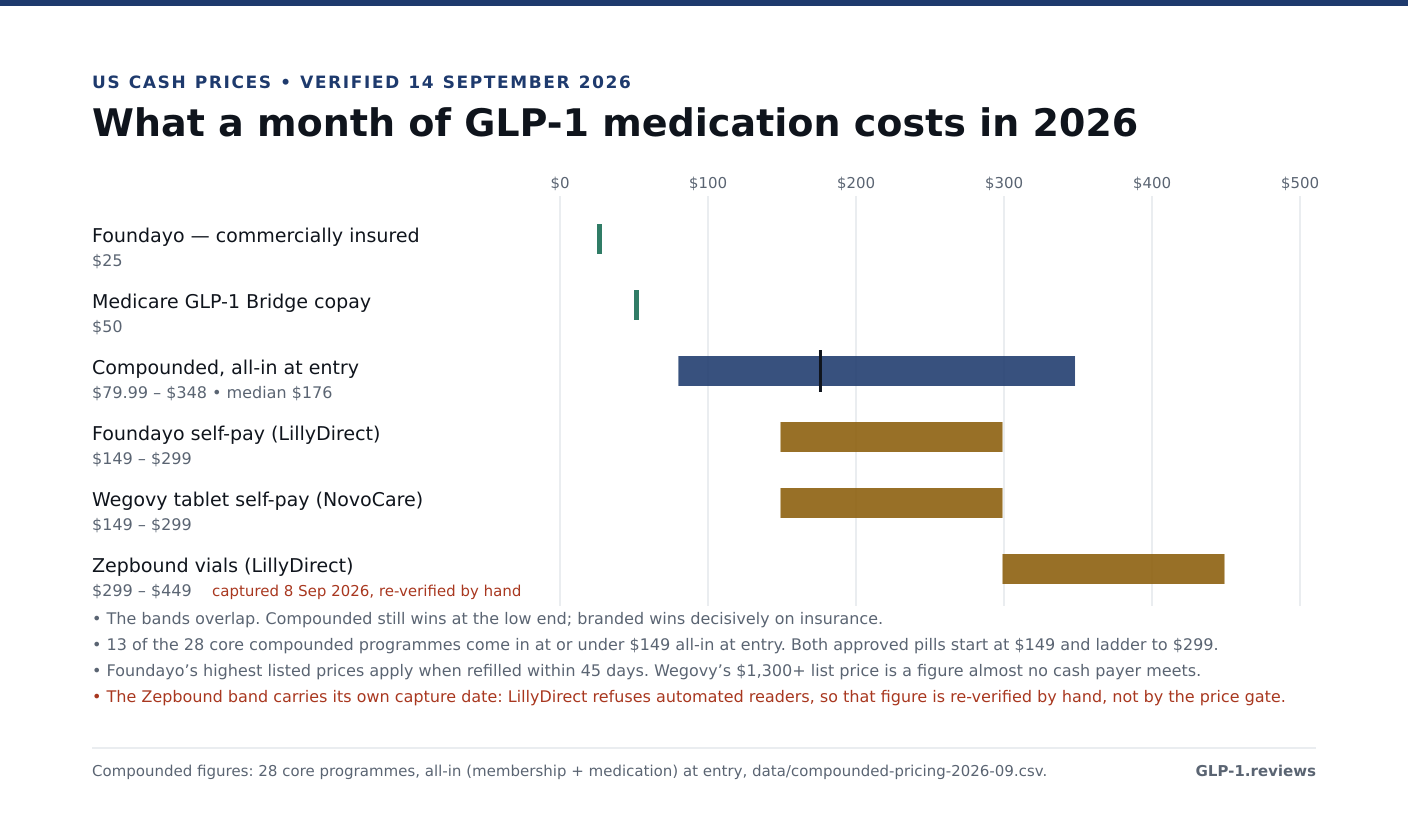
Somewhere between $25 and $299 a month, and which end you land on depends on three things: your insurance, your dose, and whether you buy direct or through a platform from our directory. Which pill you take, Foundayo or the Wegovy pill, barely moves the number.
Foundayo through LillyDirect: from $149 a month self-pay at the starting dose, rising with dose to $199 and then $299 at the higher doses (the top two strengths at $299 only when refilled within 45 days). With the manufacturer’s savings card, $25 a month for patients who are commercially insured with coverage for Foundayo, subject to the programme’s eligibility terms.
The Wegovy pill through NovoCare Pharmacy: $149, $199 and $299 by dose.
Medicare Part D beneficiaries have had a $50 copay route since 1 July 2026 through the Medicare GLP-1 Bridge, running to 31 December 2027.
Not a flat monthly price. Not what most advertising quotes. Not the number you will still be paying in six months.
The mistake that costs people most is treating the entry price as the treatment price. $149 is the starting dose. Both pills ladder upward as the dose increases, so the figure worth budgeting from is what a maintenance dose costs — which is a question you have to ask, because nobody volunteers it.
Neither manufacturer pharmacy charges a membership. A telehealth platform adding $79 a month adds roughly $950 a year to a medication you could buy direct.
The four routes, and what each costs
| Route | Monthly cost | What it includes | Who it suits |
|---|---|---|---|
| Commercial insurance + savings card Foundayo |
$25 | Medication. Eligibility conditions apply. | Anyone with commercial coverage — by a wide margin the cheapest route |
| Medicare GLP-1 Bridge | $50 copay | Medication. Runs to 31 Dec 2027. | Eligible Part D beneficiaries |
| Manufacturer direct, self-pay LillyDirect · NovoCare |
$149 starting dose to $299 higher doses |
Medication only. No membership. Home delivery on LillyDirect. | Cash payers who already have a prescription or want the simplest route |
| Telehealth platform | Medication + membership | Clinical relationship, insurance work, ongoing support | People who want the service, or who need the prior-authorisation help |
The gap between $25 and $149 is paperwork
Worth stating plainly, because it is the largest single difference in the table and it is not about the medication at all.
The savings-card price applies to people with commercial insurance coverage, subject to the programme’s conditions. Getting there frequently involves prior authorisation — a form, a clinical justification, and sometimes an appeal.
Some telehealth platforms do that work for you. Some hand you a form and wish you luck. That difference is worth more than any membership fee: a platform charging $79 a month that reliably gets you to $25 is saving you money, and one charging the same that does not is costing you $124 a month plus its own fee.
So the question to ask a platform is not what it charges. It is whether it handles prior authorisation, and what its success rate is.
The dose ladder, which is the part people miss
Both approved oral GLP-1s are priced by dose. Treatment starts at a low dose and increases over weeks or months toward a maintenance dose.
Why the branded floor sits where it does, and why compounding’s cost case has narrowed, is its own question.
Whether any of these prices is the one you pay comes down to coverage; does insurance cover oral GLP-1s walks the commercial, Medicare and employer routes in order.
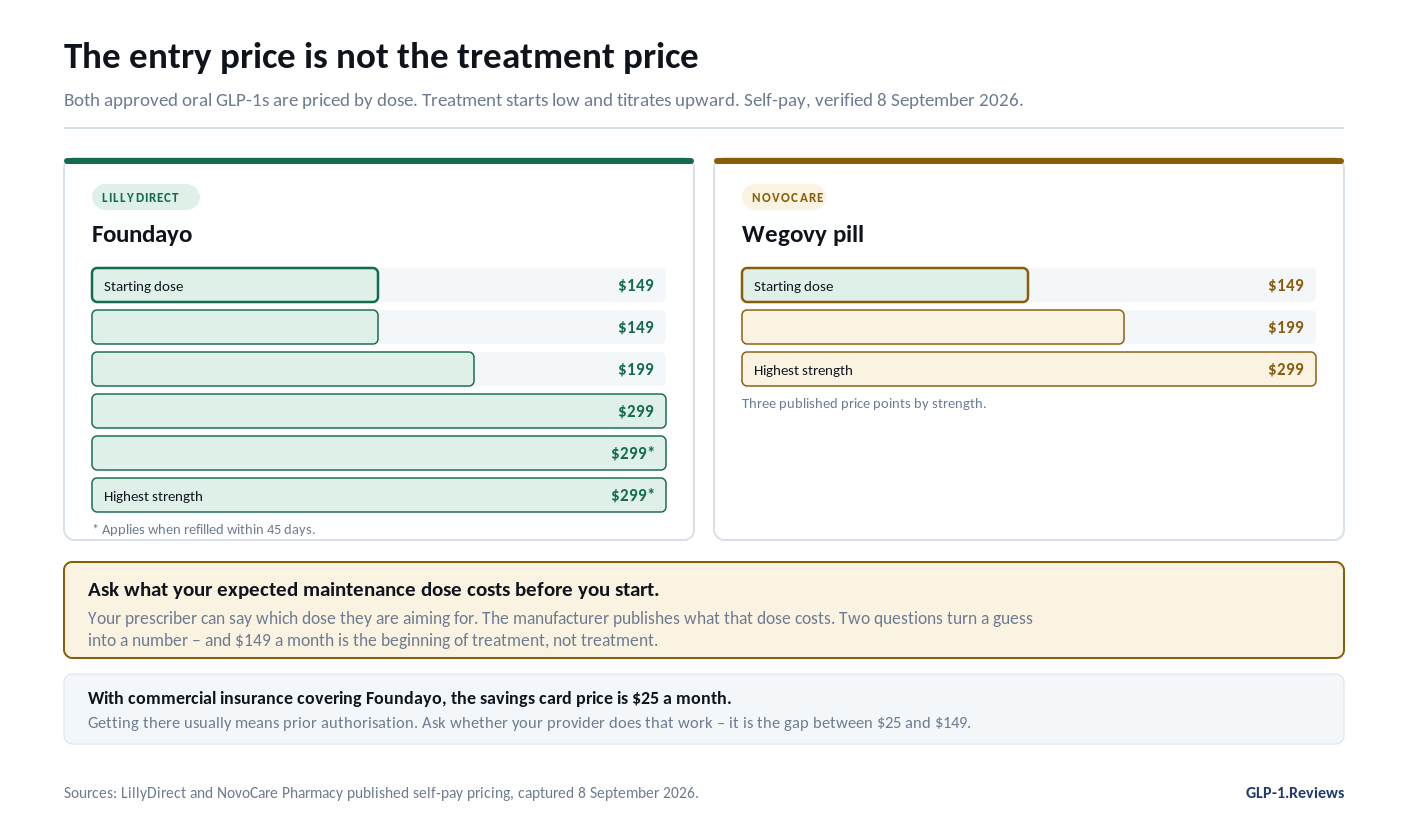
One condition is priced into the top of Foundayo’s ladder and easy to miss: its highest listed prices apply when the prescription is refilled within 45 days. That is a retention condition. A patient who has a gap, from a delayed prescription, a holiday or a supply interruption, may pay more on restarting than the published figure suggests, and the page does not say how much more. Ask before the gap, not after.
Which means the advertised entry price describes the beginning of treatment, not treatment. A patient budgeting $149 a month who titrates upward may find themselves paying substantially more by month four, at exactly the point when stopping feels most wasteful.
This is not concealment — the pricing pages publish the ladder. It is a reading problem, and it is reliably the thing people discover late.
Ask what your expected maintenance dose costs before you start. Your prescriber can tell you what dose they are aiming for; the manufacturer pharmacy publishes what that dose costs. Two questions, and they turn a guess into a number.
One place where compounded pricing still wins
Worth being even-handed about. Branded pricing ladders by dose; many compounded programmes charge a flat monthly rate regardless of dose.
For a patient who ends up at a high maintenance dose, that flat structure can be cheaper over a year than a branded ladder — which runs against the general direction of the market, where branded cash pricing has closed most of the gap. It is one of the few remaining places compounding has a genuine cost argument, and it is worth knowing about even though the legality and continuity questions sit alongside it.
Membership versus medication
Most people do not buy direct. They buy through a telehealth platform, and which platforms carry the pills at all is its own question. Among those that do, Ro, Found, Ivim Health and Noom Med all list both, each with its own membership on top of the medication price. That membership is the subject of this section.
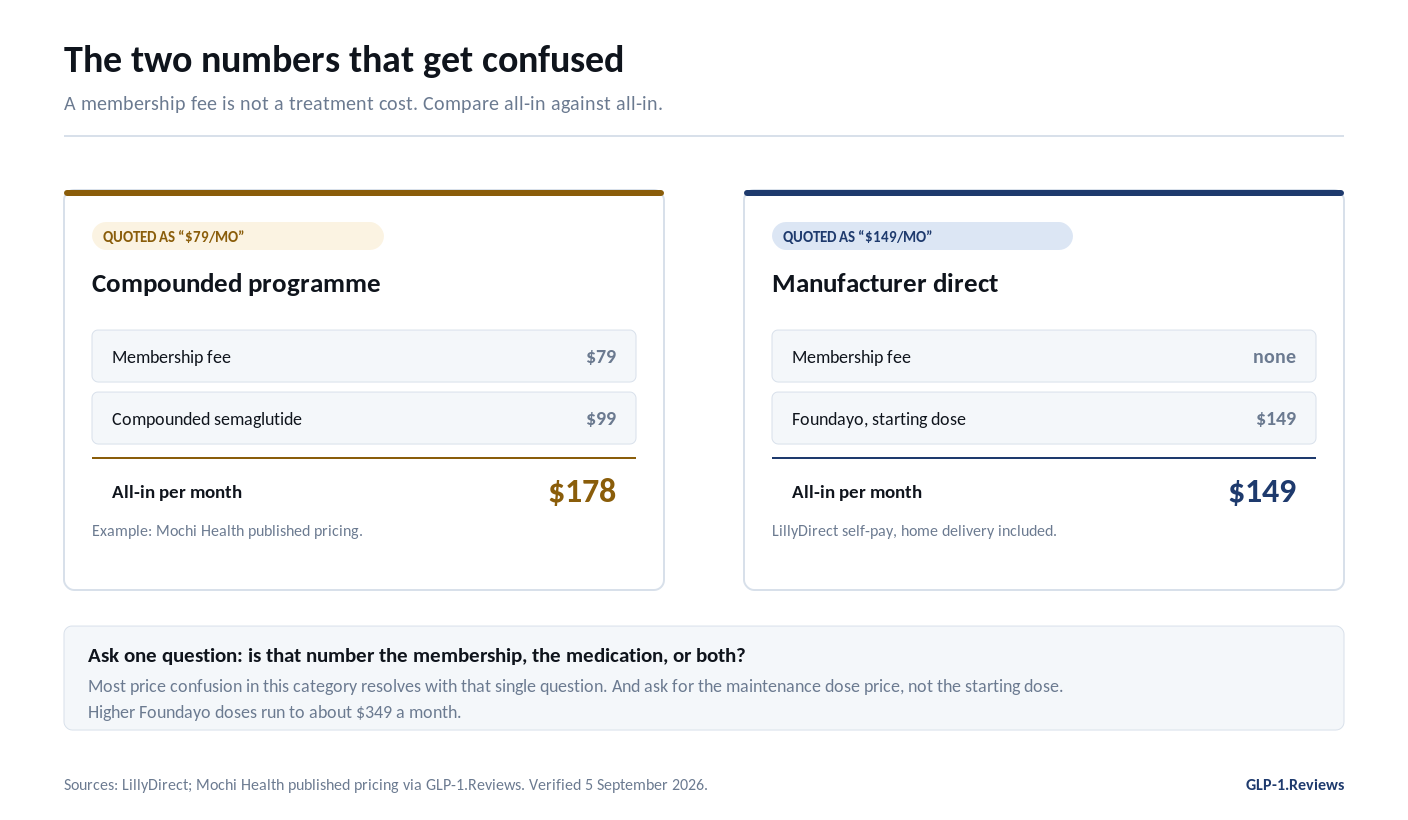
The most common source of confusion in this category, and it takes one question to resolve.
A telehealth platform typically quotes a membership fee — access to a clinician, the platform, sometimes coaching. Medication is billed separately. A manufacturer pharmacy quotes a medication price with no membership, because there is no platform to pay for.
Comparing “$79 a month” against “$149 a month” is comparing two different things, and it is the same trap the compounded-versus-branded comparison falls into. The honest comparison is all-in: membership plus medication, at a maintenance dose.
Ask: is that number the membership, the medication, or both? That single question resolves most price confusion here.
What to check before you commit
If the alternative you are weighing is a compounded programme, the price is only half the comparison: most compounding providers do not say which pharmacy makes the product, and an approved pill comes with a manufacturer on the box.
Your insurance formulary first. Before comparing cash prices, find out whether your plan covers either oral GLP-1 and at what tier. A covered medication at a modest copay beats every cash price in this article, and the answer takes one phone call.
The all-in cost at maintenance dose. Not the entry price, not the membership. One number, monthly, at the dose you expect to reach.
Whether the platform does prior authorisation. This is the $124-a-month question and almost nobody asks it.
What happens if the savings card ends. Manufacturer programmes have terms and can change. Ask what you pay if eligibility lapses, so you know your floor.
If your insurance covers an injectable GLP-1 at a manageable copay, that is likely your cheapest route and none of these cash comparisons is your decision.
These are United States prices for the two approved oral GLP-1s. They do not cover compounded preparations, which are priced differently and carry separate legal and continuity questions.
And these are planning figures captured on a date, not quotes. Manufacturer pricing in this category has changed several times in twelve months. Confirm current pricing before deciding.
Frequently asked questions
Is $149 a month what I’ll keep paying?
Only if you stay at the starting dose. Both approved oral GLP-1s are priced by dose, rising to $299 a month at the higher doses; Foundayo’s top two strengths carry that price only when refilled within 45 days. Ask your prescriber what maintenance dose they are aiming for, then check what that dose costs on the manufacturer’s pricing page.
How do I get the $25 price?
It applies to patients with commercial insurance coverage using the manufacturer’s savings card, subject to that programme’s eligibility conditions. In practice it usually requires prior authorisation. Ask whether your provider handles that process — it is the difference between $25 and $149.
Do I need a telehealth membership to get an oral GLP-1?
No. Both manufacturer pharmacies — LillyDirect for Foundayo, NovoCare for the Wegovy pill — supply direct with no membership fee and publish their cash prices. You still need a prescription. What a membership buys is the clinical relationship, the insurance work and ongoing support, which is worth it for some people and not others.
What does Medicare cover?
The Medicare GLP-1 Bridge has offered eligible Part D beneficiaries a $50 copay since 1 July 2026, running through 31 December 2027. It operates outside the standard Part D benefit, which has consequences most coverage does not explain — the deductible does not apply, the copay does not count toward true out-of-pocket costs, and the low-income subsidy does not apply to it.
Are the pills cheaper than the injections?
At the entry point, yes. Foundayo starts at $149 self-pay against $299 to $449 for Zepbound vials, and drops to $25 with the savings card for the commercially insured with coverage. At higher doses the gap narrows. And if your insurance covers an injectable at a low copay, that beats any cash price on either format.
Ask what the maintenance dose costs
Four routes, from $25 to $299, and the one you land on has more to do with your insurance status and your dose than with which pill you choose.
Two questions get you a real number rather than an advertised one. What does my expected maintenance dose cost, all in? And does this provider handle prior authorisation?
Everything else in this article is a planning figure with a date on it. Those two answers are yours specifically, and they are worth more than any table.
Sources
- LillyDirect — Foundayo self-pay pricing and savings programme terms, captured 8 September 2026 (self-pay $149, $149, $199, $299, $299, $299 by strength; “Regular prices will apply if prescription is not refilled within 45 days”; “as low as $25 a month” if “eligible and commercially insured with coverage for Foundayo”).
- NovoCare Pharmacy — Wegovy pill and pen pricing, captured 8 September 2026 (pill $149, $199, $299 by dose; pen $199 introductory for two fills, then $349, or $399 for the high-dose pen).
- Centers for Medicare & Medicaid Services — Medicare GLP-1 Bridge: $50 copay for eligible Part D beneficiaries, 1 July 2026 to 31 December 2027; covers all Foundayo and Wegovy presentations and the Zepbound KwikPen.
- Eli Lilly and Company — Foundayo launch and pricing announcements, April 2026.
- Novo Nordisk — Wegovy oral availability and pricing announcements.
- GLP-1 Reviews — all-in pricing across 32 compounded programmes, compiled from provider review pages, September 2026.
Medical disclaimer. This article reports published prices. It is not medical advice, does not recommend a medication or provider, and does not address dosing. Which medication is appropriate for you, and at what dose, is a decision for a licensed prescriber.
Pricing note. All figures verified 8 September 2026 against the manufacturer pharmacies named. Prices in this category changed at least three times in the preceding twelve months. Confirm current pricing before making a decision.
Keep exploring our GLP-1 resources:



