Because orforglipron is a different kind of molecule, and that difference runs all the way through to what it costs to make.
Semaglutide and tirzepatide are peptides — chains of amino acids, produced by biological synthesis, unstable enough to need cold-chain handling. Difficult and expensive to manufacture at scale, which is precisely the room a compounder needs. A branded peptide priced high leaves space underneath it.
Orforglipron is a non-peptide small molecule, made by conventional chemical synthesis, with no cold-chain requirement. Small molecules are the cheap end of pharmaceutical manufacturing.
Not a promotion. Not a launch discount that expires. Not a price a competitor undercuts by being scrappier.
Which is why Foundayo’s $149 self-pay entry price is structural rather than a land grab. It reflects what the product costs to produce, and a compounded copy carrying regulatory risk cannot get meaningfully below a branded price set on that basis.
The market has already moved on this. Across the 28 core compounded programmes in our directory we price, the median all-in cost at entry is $176 a month against a $149 branded floor — and at the top of each programme’s own published range the median is $314.50, against a branded ladder that stops at $299.
The arbitrage that built the compounded GLP-1 industry has not disappeared entirely. It has narrowed to the point where it is no longer, by itself, the reason to choose one.
What the compounded market was actually selling
It is worth being precise about the business that existed between 2023 and 2025, because the reason it worked explains why it is unwinding.
Compounded semaglutide was not cheaper because compounders were more efficient than Novo Nordisk. It was cheaper because a branded peptide carried a list price above $1,300 a package, set against insurance rather than against cash payers, and because a drug shortage made copying it lawful.
Two things were being sold at once: a molecule, and access to a price that the branded channel did not offer to people paying cash.
Both halves have now changed. The shortage exception closed when the FDA declared the shortages resolved, and the manufacturers built direct-to-consumer channels that price against cash payers. The second change gets far less coverage than the first and matters more to what you pay.
Why peptides left room and small molecules do not
The manufacturing difference is not a detail. It is the whole mechanism.
| Peptides semaglutide, tirzepatide |
Small molecules orforglipron |
|
|---|---|---|
| How they are made | Biological or complex synthesis | Conventional chemical synthesis |
| Relative production cost at scale | Higher | Substantially lower |
| Stability | Fragile; degradation not visible | Robust, like an ordinary tablet |
| Cold chain | Required through the supply chain | Not required |
| Room beneath the branded price | Enough for a compounded market to exist | Very little |
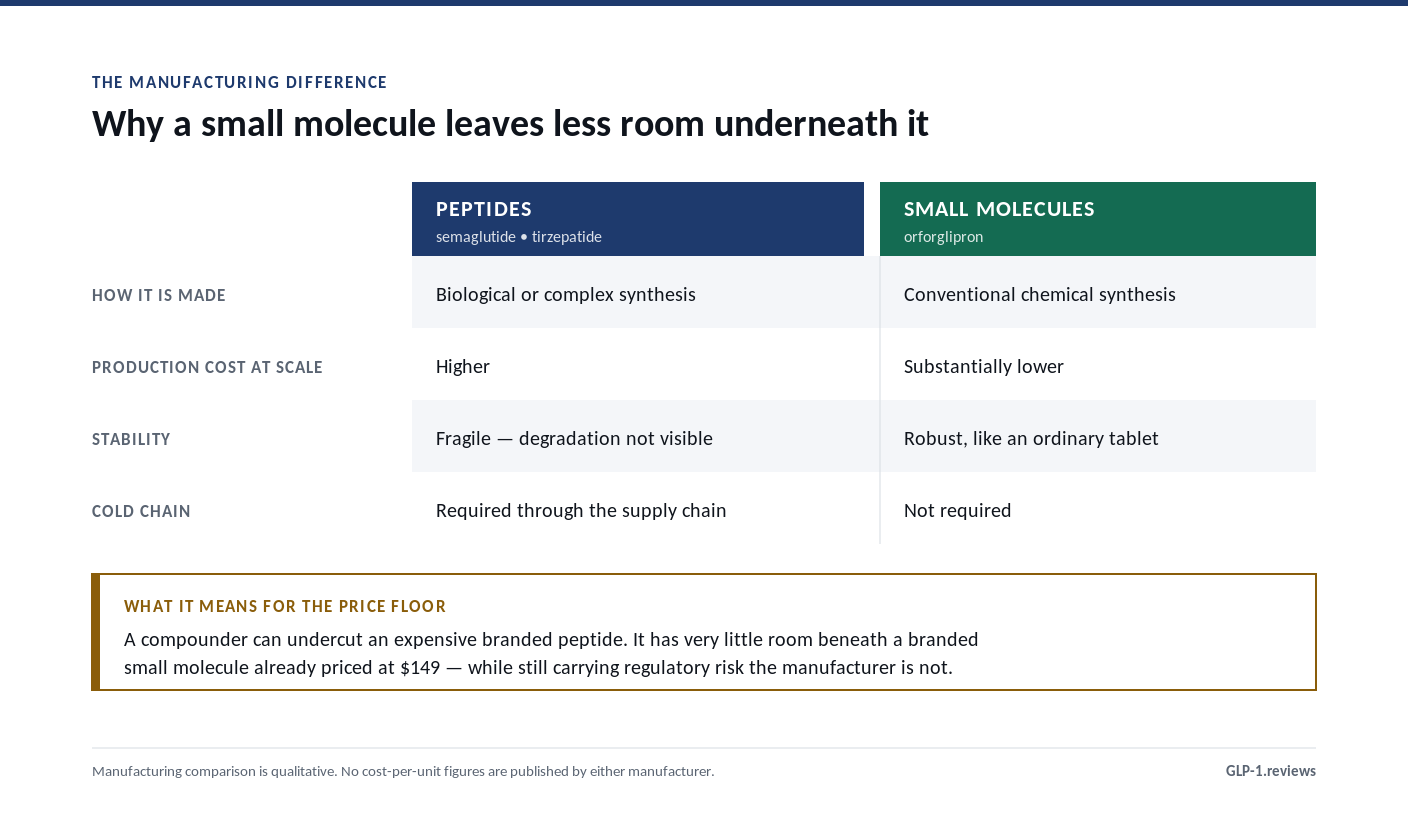
A compounder replicating a peptide faces a hard job, but so does the originator — and the originator’s price historically reflected a market where insurers, not patients, paid. That gap was the business.
With a small molecule, the manufacturer’s own cost floor is low. A compounder cannot undercut it by much, and it is carrying regulatory exposure the manufacturer is not. There is simply less space to operate in.
What the numbers show today
Across the 28 core compounded programmes we price, the median advertised entry price is $149 — exactly the branded floor. Add the membership fee and the median becomes $176. Take the top of each programme’s own published range and it becomes $314.50, with 27 of the 28 sitting above $149.
Both approved oral GLP-1s start at $149 self-pay and ladder upward by dose. Foundayo reaches $25 a month for patients whose commercial insurance covers it.
So compounding still wins at the cheap end of its own range, and branded wins decisively on insurance. Between those poles the two sit within roughly $27 a month at entry and roughly $15 at the top of each side’s published range — a difference small enough that legality, supply continuity and dose-measurement burden start doing the deciding instead.
The cheap number is the entry number
This is the compounded side of the arithmetic. What an oral GLP-1 actually costs sets out the branded ladder in full, the compounded-versus-branded comparison works the same numbers from the other direction, and the pills against the injections is a different comparison again.
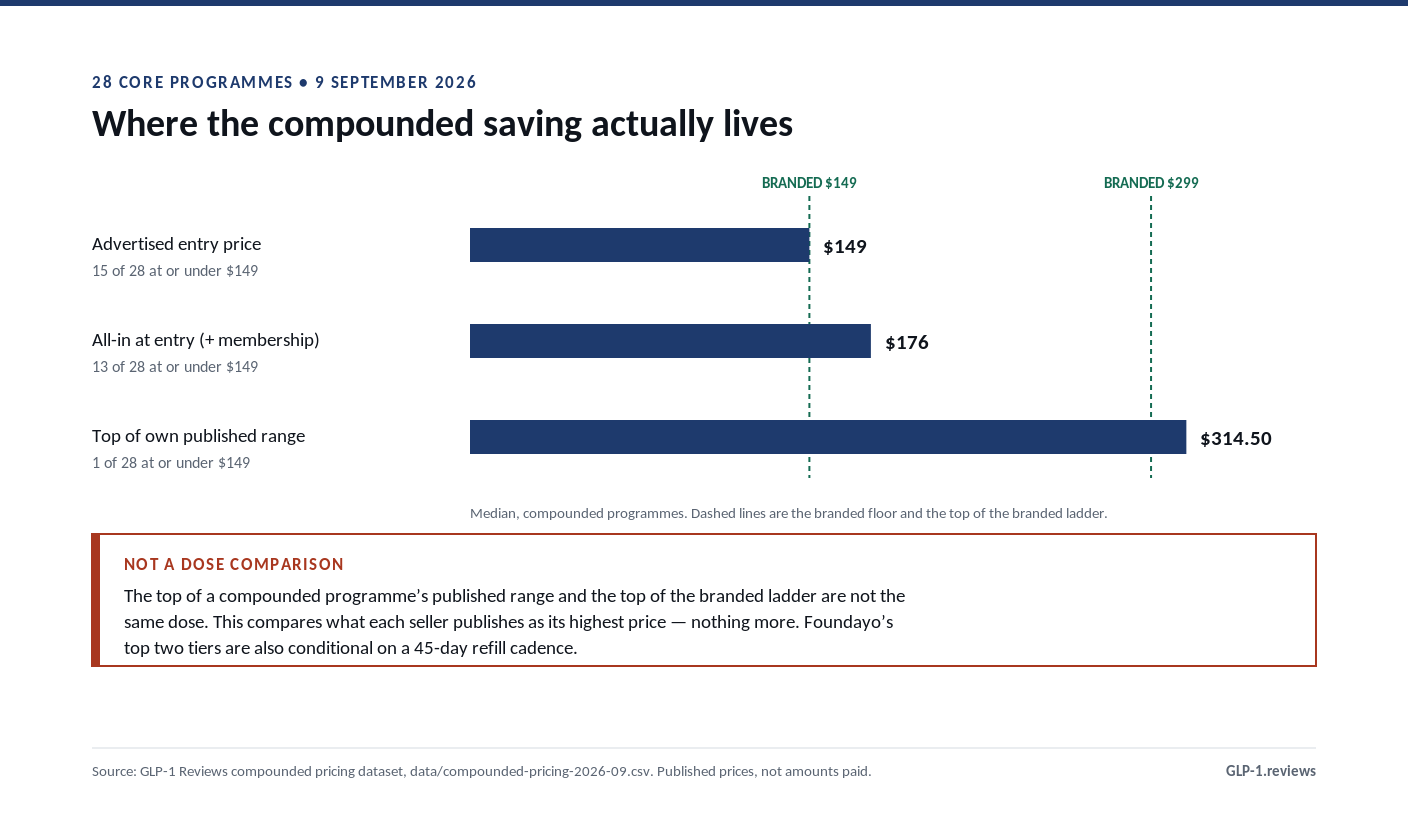
Splitting the same 28 programmes three ways shows where the saving actually lives.
| What is being measured | Median | Range | At or under $149 |
|---|---|---|---|
| Advertised entry price | $149 | $49 – $299 | 15 of 28 |
| All-in at entry (+ membership) | $176 | $79.99 – $348 | 13 of 28 |
| Top of the programme’s own published range | $314.50 | $133 – $1,399 | 1 of 28 |
Source: GLP-1 Reviews compounded pricing dataset, 28 core programmes, derived 9 September 2026. The wider set of 53 priced programmes gives medians of $149, $160 and $322 on the same three measures.
At the shop window, compounded and branded are the same price. The median advertised entry price across compounded programmes is $149, and both approved pills start at $149.
The divergence appears twice after that. Once when the membership fee is added, which moves the compounded median to $176 while the branded price does not move. And again at the top of each seller’s own published range, where the compounded median reaches $314.50 and the branded ladder stops at $299.
The share tells it more plainly than the median. Thirteen of 28 compounded programmes are at or under $149 all-in when you start. One is still there at the top of its own range.
What this comparison is not
Three limits, and they matter enough that the paragraph above should not be read without them.
It is not a dose-for-dose comparison. The top of a compounded programme’s published range and the top of the branded ladder are not the same dose, and in most cases we cannot tell what dose either represents. This compares what each seller publishes as its highest price, not what two comparable prescriptions cost. Anyone presenting these figures as a dose equivalence is overreading them, including us if we ever do it.
The branded ceiling has conditions. Foundayo’s top two price tiers are conditional on a 45-day refill cadence. A patient who does not meet that condition is not paying the ceiling this table compares against.
Published is not paid. Every figure here is what a company publishes. Promotional first months, quantity commitments and lapsed memberships all move what actually leaves an account, and none of them appear in a price page.
The industry moved before the regulator finished
The clearest evidence that this is structural rather than cyclical is what the companies did without waiting for a ruling.
In March 2026, Hims & Hers announced it would stop advertising compounded GLP-1s, entered a collaboration with Novo Nordisk, and began transitioning patients to FDA-approved medicines. That decision came seven weeks before the FDA published its proposal to exclude these substances from the 503B bulks list — and it was made while compounded was still, for many patients, the cheaper option.
A company does not restructure its largest product line for a price advantage it still holds. It does so because it has concluded the advantage is temporary.
Manufacturers have moved in the same direction from the other side, cutting cash prices repeatedly through 2025 and 2026. Every approval in this category since December 2025 has arrived with a cash-price announcement attached.
What this does not mean
The cheap end of the compounded range is real and it is where the remaining saving sits. Maximus opens at $79.99 all-in, OrderlyMeds at $83, and FuturHealth at $99 — all below the branded floor, and all with their own range above them.
Three things worth stating plainly, because the argument above is easy to over-extend.
It does not mean compounding is finished. Patient-specific compounding under a documented prescriber determination remains lawful and remains the right answer for people who genuinely need it — an excipient allergy, a dose the commercial product does not supply. That category is narrow and it is real.
It does not mean branded is always cheaper. Thirteen of the 28 core programmes come in at or under $149 all-in at entry, and one holds a price at or under $149 all the way up its own range. And flat-rate compounded pricing can beat a branded dose ladder over a year for someone who titrates to a high maintenance dose.
It does not predict prices. The mechanism described here explains why a low branded floor is sustainable. It does not guarantee that any particular price holds, and manufacturer programmes change terms without notice.
What to do with it
If you chose a compounded programme primarily on price, the comparison you made is probably out of date. Re-run it: all-in monthly cost at your maintenance dose, against the manufacturer pharmacy’s published price for the same dose, plus whatever your insurance would contribute.
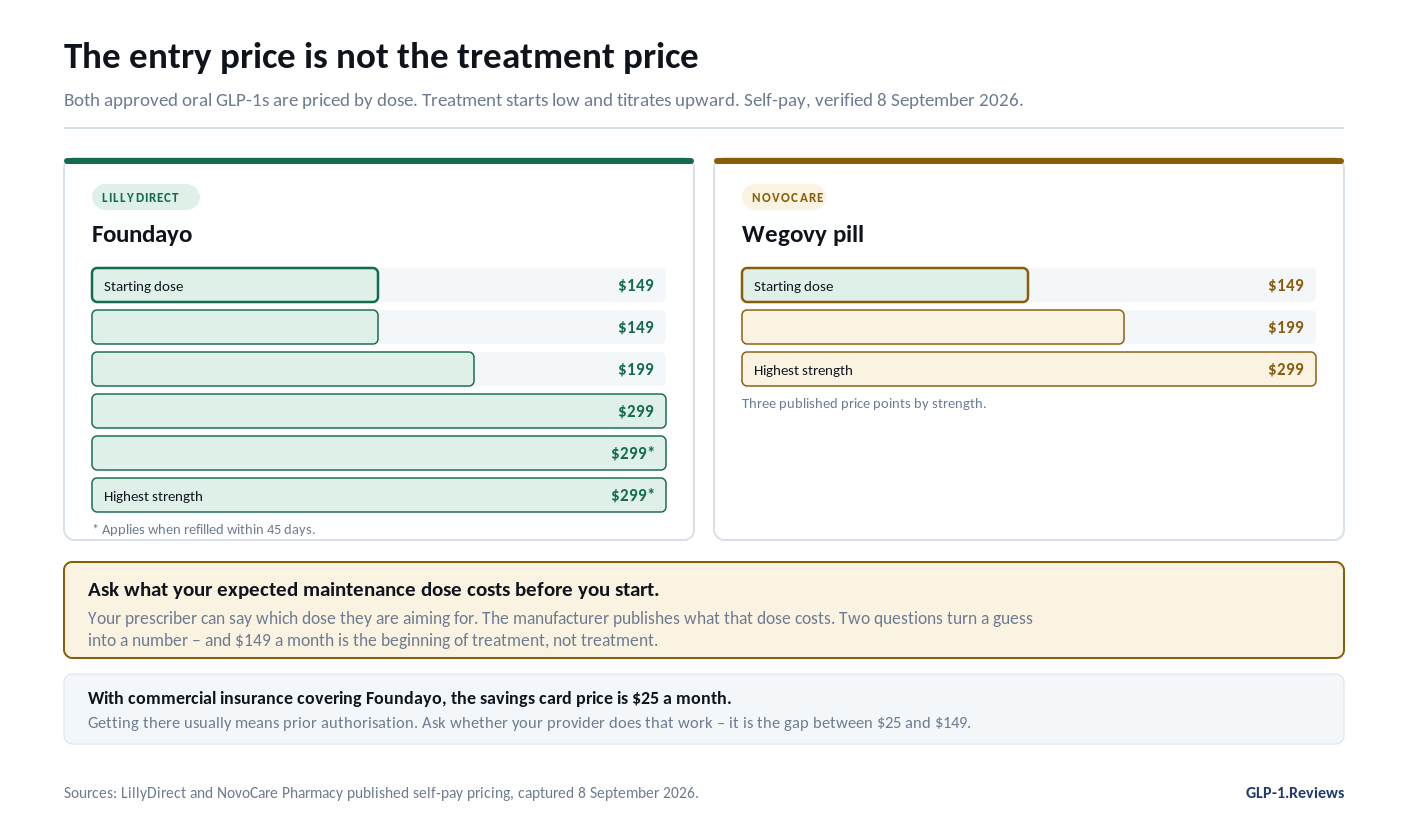
If the gap has closed to a small monthly figure for you, the question stops being about money. It becomes whether your supply has a lawful basis, whether the pharmacy is named, and whether your provider has a plan if the rules tighten — questions worth a modest premium.
And if the gap is still large for you, that is a legitimate finding. Just make sure you are comparing all-in against all-in, at the dose you will actually be taking.
If your insurance covers a GLP-1 at a manageable copay, none of this comparison is your decision — the covered route beats every cash price discussed here.
This is an argument about United States cash pricing and manufacturing economics. It does not address whether any particular medicine is clinically right for you.
And it is analysis, not prediction. The mechanism is real; what any specific price does next is not something this article can tell you.
Frequently asked questions
Is $149 a temporary launch price?
The manufacturing economics suggest not. Orforglipron is a small molecule made by conventional synthesis with no cold-chain requirement, so a low cash price reflects a genuinely low production cost rather than a subsidy. That said, no manufacturer guarantees a price indefinitely, and programme terms change.
Why was compounded semaglutide so much cheaper before?
Two reasons stacked. Branded peptides carried list prices set against insurers rather than cash payers, and a drug shortage made compounding them lawful. When the shortages resolved and manufacturers built direct-to-consumer channels priced for cash payers, both halves of the advantage narrowed.
Can compounders still undercut the pills?
Sometimes. Thirteen of the 28 core programmes we price come in at or under $149 all-in at entry, though only one of the 28 still does at the top of its own range. And flat-rate compounded pricing can beat a branded dose ladder over a year at high maintenance doses. What has gone is the automatic, decisive advantage that made the choice obvious.
Does this mean compounded GLP-1s will disappear?
Not the lawful category. Patient-specific compounding for a documented clinical need is a long-standing part of pharmacy practice and is unaffected by pricing. What is under pressure is the mass-market model, and that is under pressure from regulation as well as economics.
Should I switch from compounded to branded on price?
Re-run your own numbers first — all-in, at your maintenance dose, including any insurance contribution. If the difference is small, the non-price factors matter more. Whether to change medication at all is a clinical decision for your prescriber, not a pricing one.
The molecule changed the market
For two years the case for compounded GLP-1s was overwhelming on price, and everything else was a trade you made against a large saving.
A non-peptide small molecule priced at $149 by its own manufacturer changes that arithmetic — not by regulation, and not by anyone’s decision, but because there is less room underneath a cheap thing than underneath an expensive one.
The saving is now small enough to weigh against the questions it used to outrank.
Sources
- LillyDirect and NovoCare Pharmacy — published self-pay pricing, captured 11 September 2026.
- Eli Lilly and Company — Foundayo launch and pricing announcements, April 2026.
- Hims & Hers Health, Inc. — Hims & Hers Announces Strategic Shift for US Weight Loss Business, investor release, 9 March 2026.
- U.S. Food and Drug Administration — shortage resolution announcements and compounder policy guidance.
- U.S. Food and Drug Administration — proposal to exclude semaglutide, tirzepatide and liraglutide from the 503B bulks list, announced 30 April 2026 and published in the Federal Register on 1 May 2026 (document 2026-08552); comment period closed 30 July 2026.
- GLP-1 Reviews — compounded pricing dataset, data/compounded-pricing-2026-09.csv, derived 9 September 2026. Metric definition, inclusion rule and per-provider rows are published in that file.
- Peer-reviewed and industry literature on peptide versus small-molecule manufacturing.
Medical disclaimer. This article analyses pricing and manufacturing economics. It is not medical advice, does not recommend any medication or provider, and does not address dosing. Do not change treatment on the basis of a pricing argument; that decision belongs with your prescriber.
Analysis note. The manufacturing-cost comparison is qualitative. Prices verified 11 September 2026 and change frequently; the mechanism described does not guarantee any specific future price.
Keep exploring our GLP-1 resources: