
Eleven questions. They fall into four groups.
Whether to switch at all — what would improve, what you would give up, and whether the reason is clinical or logistical.
How the change would be handled — starting dose, timing between the last injection and the first tablet, and how the transition is monitored.
What the daily routine becomes — the dosing conditions on the oral products are strict, and they are a real change in how the medicine fits your day.
What happens if it does not work — the route back, and who pays for what along the way.
One thing this article deliberately does not contain: a dose conversion table. There is no published equivalence between an injectable dose and an oral one, and a table implying otherwise would be a prescribing instruction dressed as information. The starting dose on a switch is a decision for the person writing the prescription, and it is question three.
Before the questions: what kind of decision this is
Switching between medicines in the same class is a clinical decision, not a consumer one. That sounds like a disclaimer. It is actually the most useful thing on this page, because it tells you what the questions below are for.
They are not there to help you decide and then inform your prescriber. They are there so that the conversation covers everything that matters, so you leave it understanding the plan, and so you can tell the difference between a considered switch and one that happened because it was easy to sell you.
That last point is worth dwelling on. Oral GLP-1s launched into a market with a great deal of promotional energy behind them. A prescriber who can answer questions three, four and five in specifics is treating the switch as a clinical change. One who cannot is treating it as a product swap.
Group one: whether to switch at all
| Ask | What it is testing |
|---|---|
| 1. What specifically would improve for me if I switched? | Whether there is a clinical reason or only a convenience one. Both are legitimate. They lead to different conversations, and you should know which one you are having. |
| 2. What would I be giving up? | The injectables have longer clinical track records and larger accumulated outcome data. A prescriber who says you would give up nothing is not describing a trade-off that exists. |
If your current injectable is working, tolerated, and affordable, question one may not have a good answer — and that is a complete finding. “Nothing would improve, but you dislike needles” is a real reason. It is just a different reason from a clinical one, and it should be named as what it is.
Group two: how the change is handled
| Ask | What it is testing |
|---|---|
| 3. What dose would I start on, and how did you arrive at it? | The single most important question here. Both oral products carry their own labelled titration schedules starting at the lowest dose. Whether a switch follows that schedule or something else is a decision that needs a reason attached. |
| 4. How long between my last injection and the first tablet? | The injectables are long-acting. Timing matters and is not something to work out yourself. |
| 5. How will we know if it is working, and when do we check? | Whether there is a monitoring plan or just a repeat prescription. Ask for the interval and what is being measured. |
| 6. What side effects should I expect in the first weeks, and which ones mean I should contact you? | Both classes share a gastrointestinal side-effect profile that is most pronounced during dose increases. The second half of the question is the important half: you want a named threshold and a way to reach someone. |
On question three: resist the urge to research your own answer beforehand and arrive with a number. There is no published conversion between injectable and oral doses, and arriving with one you found online puts pressure on a decision that should be made from your history, your current dose, how you tolerated titration the first time, and what else you take.
Group three: what your day actually looks like
This group gets skipped most often and causes the most trouble later.
The oral GLP-1s carry dosing conditions that the injectables do not, and the two approved products differ sharply from each other. One is taken on waking with a limited amount of plain water and a required wait before food, other drinks or other oral medicines; the other is taken once daily with or without food, at any time of day. Which of those you are being prescribed changes your morning completely, and your prescriber or the label supplied with the medicine is the authority on the conditions that apply to you. This article does not reproduce either set, because the one that matters is the one on your label.
What that means in practice is that a weekly injection can become a daily routine with a fixed window at the start of every day — what that protocol protects is worth understanding before you agree to it.
| Ask | What it is testing |
|---|---|
| 7. Walk me through the dosing conditions for the product you are prescribing. | Whether they know them specifically, and whether you have heard them from a clinician rather than a marketing page. |
| 8. I take [list everything, including supplements] — how does the waiting period affect those? | The wait applies to other oral medications too. If you take a morning thyroid medicine, a proton pump inhibitor, or anything else timed to waking, this needs working out in advance rather than discovered in week two. |
| 9. What do I do if I miss a dose, or if my mornings are unpredictable? | Shift work, small children, travel across time zones. If your mornings are not reliably your own, that is a genuine input into whether a daily-on-waking medicine suits you. |
Group four: the way back, and the money
Cost is where a switch most often unravels, and it is worth reading how coverage actually works for the pills before the appointment. If you are moving from a compounded injectable, the questions are different again, and the compounded-prescription checklist covers those.
| Ask | What it is testing |
|---|---|
| 10. If the oral does not suit me, what happens? Can I go back, and how quickly? | Whether a reversal has been thought about. Also worth asking your provider, separately from your prescriber: does the programme let you switch back without restarting anything administrative? |
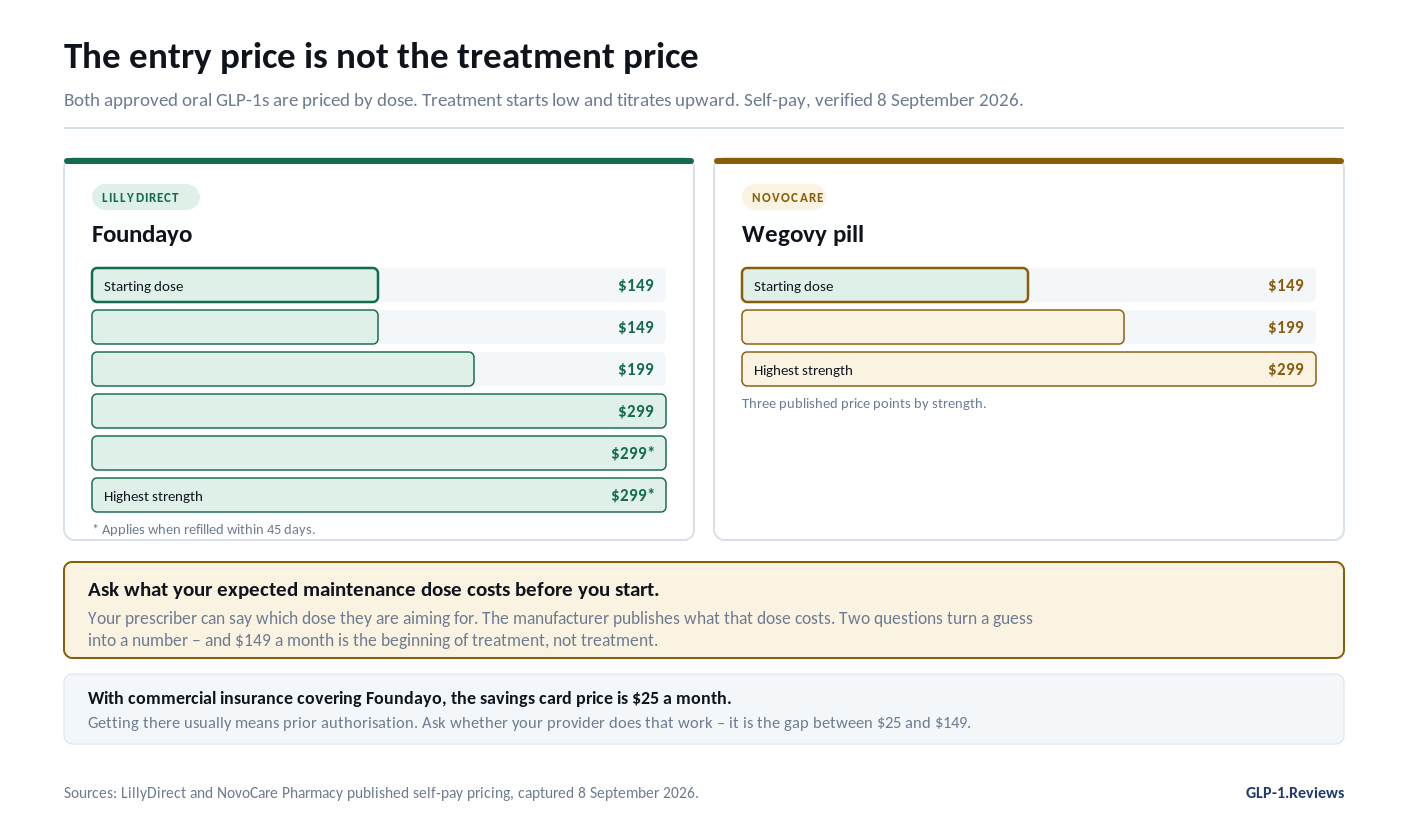
| 11. What will this cost me at each dose level, and what changes if my insurance decides differently? | Both oral products use a dose ladder, so the price at your maintenance dose may differ from the entry price. Ask for the whole ladder, not the headline. |
Question ten is the one people forget. A switch feels like a one-way door when you are in the middle of one, and knowing in advance that it is not makes the trial easier to attempt and easier to abandon.
Two things worth checking on your own
First, whether your provider carries it at all. Among those in our directory that list both pills, Ro, Found, LifeMD and Hims & Hers are the largest; a provider that carries only one has effectively made the choice for you.
Separate from the clinical conversation, two practical items are yours to verify.
Whether your provider actually carries it. Not every telehealth programme dispenses both approved oral products, and some carry neither. A switch you have agreed with a prescriber can still be blocked by a formulary you never see.
What your insurance does. Coverage for the oral products is still settling, and it differs between the two. The self-pay price is the fallback, not the plan.
If you are not currently on an injectable GLP-1, this is not your article — starting fresh is a different conversation with a different set of questions.
This is a list of questions to ask a prescriber. It is not a protocol, not a recommendation to switch, and not a recommendation against it. It contains no dosing guidance and no dose conversion, deliberately.
If you are pregnant, trying to conceive, or breastfeeding, the labelled guidance on these medicines differs and that conversation should start there rather than here.
Frequently asked questions
Can I switch from an injectable to an oral GLP-1?
That is a clinical decision for your prescriber. Both approved oral products carry their own labelled titration schedules, and there is no published dose equivalence between injectable and oral. How the two routes compare is a separate question from how you move between them. What you can do is ask the eleven questions above so the decision is made with everything on the table.
What dose would I start on?
Not something this article can tell you, and not something to work out yourself. Both oral labels start at the lowest dose and titrate. Whether a switch follows that schedule is a prescribing decision that should come with a stated reason.
Are the side effects different?
Both classes share a gastrointestinal side-effect profile that is most pronounced during dose increases. The labelled adverse reactions for each product are the authority on specifics, and they differ between products. Ask question six and get a named threshold for contacting your prescriber.
Is the oral less effective?
The trial results are not directly comparable — different populations, different endpoints, different durations. Reported average weight reduction in the oral trials is lower than the headline figures from the highest-dose injectable trials, but that comparison does more harm than good without the trial designs beside it.
Can I go back to the injection if I do not like it?
Usually yes clinically, but ask question ten and get it confirmed — both by your prescriber and by your provider, since the administrative side can be a separate obstacle from the medical one.
Take the list, not the conclusion
The value of a question list is that it changes the shape of the appointment. Eleven specific questions produce a plan; “should I switch to the pill?” produces an opinion.
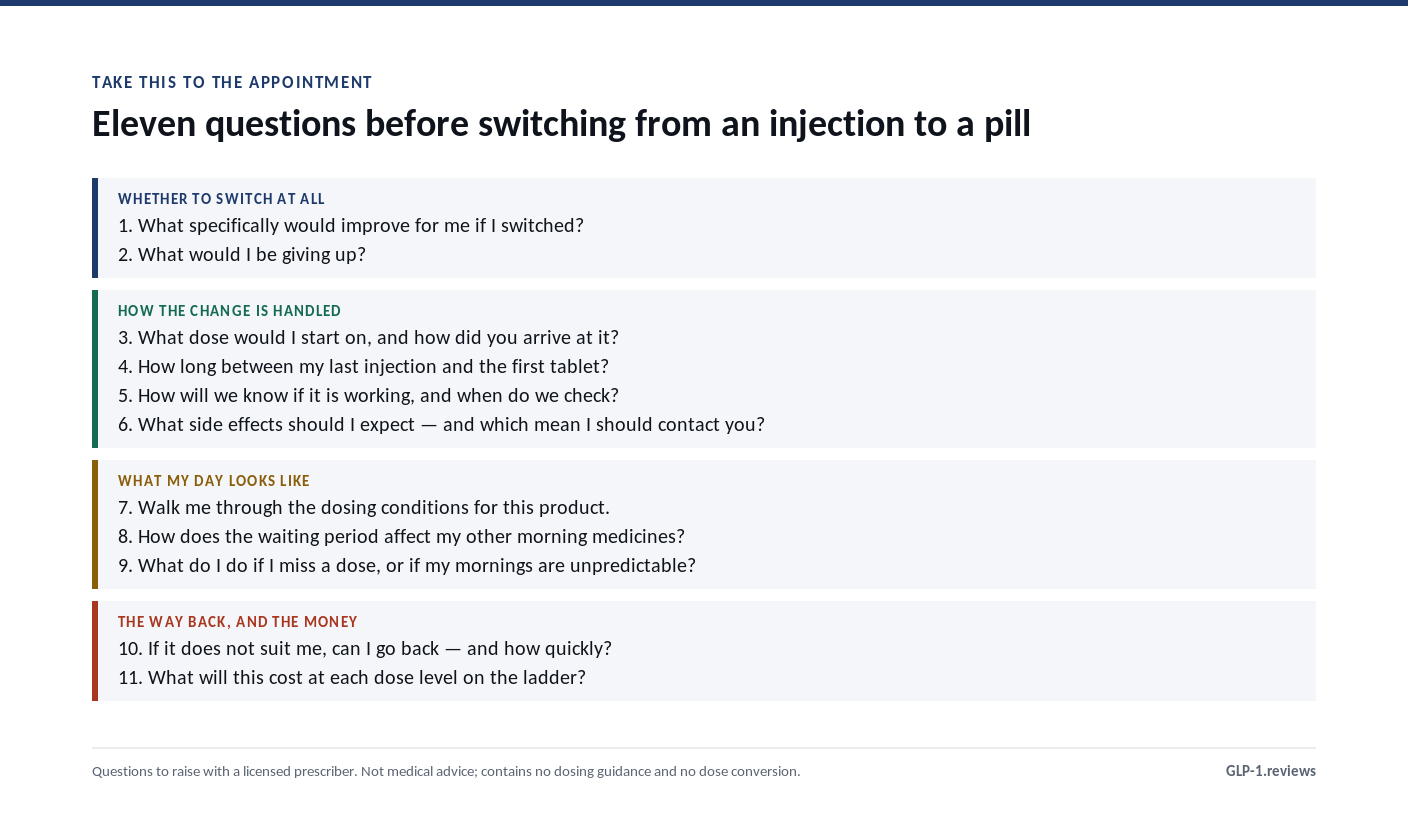
And if you leave with clear answers to three, four, seven and ten, you will understand your own treatment change better than most people do — which is the actual point.
Sources
- U.S. Food and Drug Administration — prescribing information for the approved oral GLP-1 products, dosage and administration sections, current versions captured 9 September 2026.
- U.S. Food and Drug Administration — prescribing information for the approved injectable GLP-1 products.
- Published clinical trial results for the oral GLP-1 programmes, peer-reviewed.
- GLP-1 Reviews — provider formulary audit, which programmes dispense which oral products, September 2026.
Medical disclaimer. This article is a list of questions to raise with a licensed prescriber. It is not medical advice, contains no dosing guidance, and does not recommend switching or staying. Do not change or stop a prescribed medication without speaking to your prescriber.
Keep exploring our GLP-1 resources:



