
Sometimes, and the step that usually decides it is prior authorisation rather than whether the drug appears on your plan’s list at all.
Three routes exist and they work differently.
Commercial insurance. If your plan covers Foundayo, the manufacturer’s savings card brings it to $25 a month. Without coverage, self-pay through LillyDirect starts at $149 and ladders to $299 by dose. That $124 gap is not a discount — it is paperwork.
Medicare. The Medicare GLP-1 Bridge has offered eligible Part D beneficiaries a $50 copay since 1 July 2026, running to 31 December 2027. It sits outside the standard Part D benefit, which has three consequences almost nobody explains.
Employer plans. Roughly a third of large employers cover GLP-1s for weight loss, and that share has stopped growing. Coverage climbs with employer size and, KFF’s 2025 survey suggests, is deepening among the largest employers rather than spreading to the rest. A meaningful minority have dropped coverage, and a growing group now point employees at direct-to-consumer platforms instead.
Not a yes-or-no question. Not decided by the formulary alone. Not the same answer this year as last.
The practical version: find out whether your plan covers it, then find out who does the prior-authorisation work. Those two answers determine your cost more than any price page.
Commercial insurance: the savings card and the form
For the commercially insured, the headline number is $25 a month for Foundayo through the manufacturer’s savings programme. The condition attached to it is the part that matters: it applies to patients whose plan covers Foundayo, subject to the programme’s own eligibility terms.
Coverage is one of the four groups in the switching checklist, and the appeal question is easier to raise before you change medicines than after.
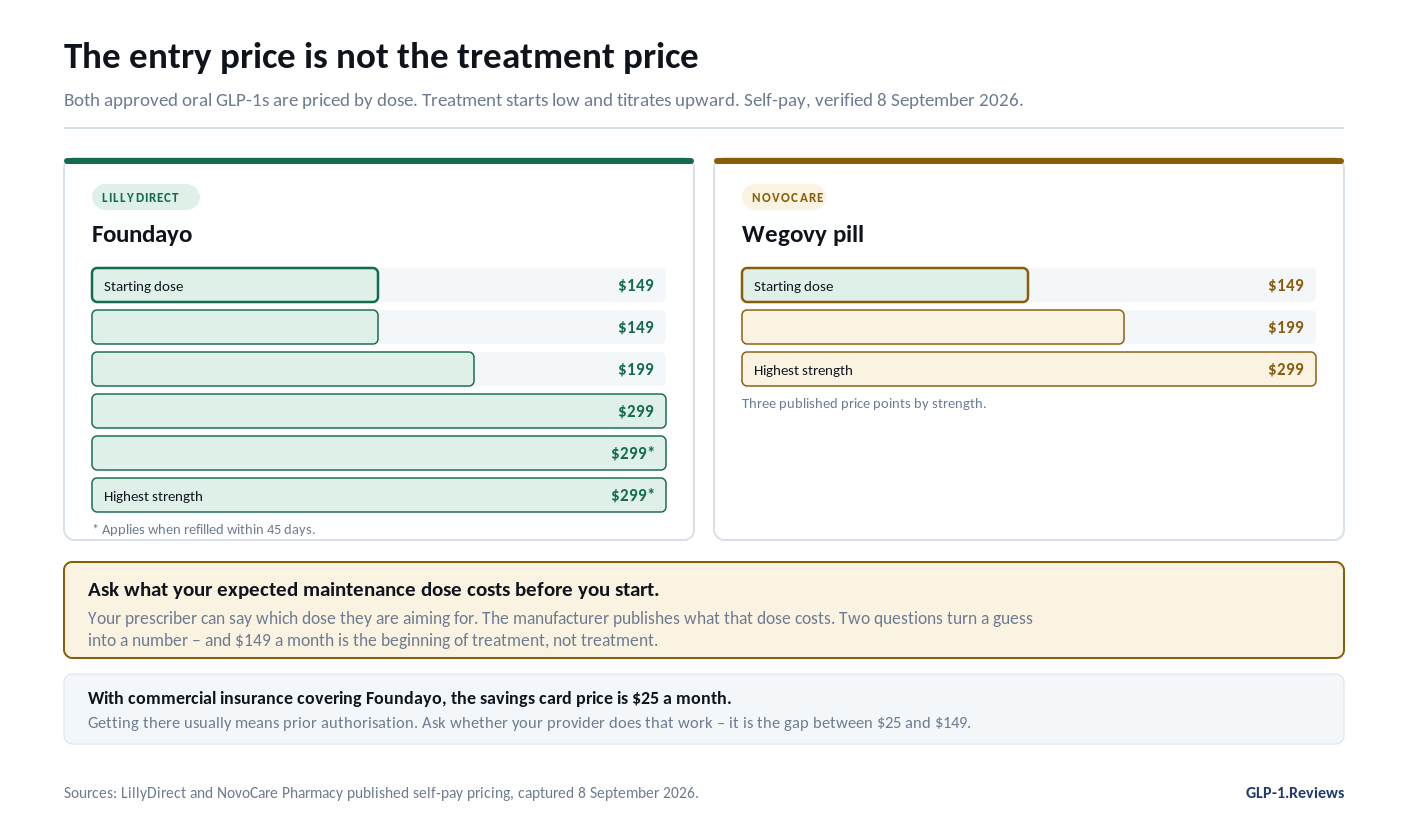
So the sequence is coverage first, savings card second. And coverage, for weight-management medications, almost always runs through prior authorisation.
What prior authorisation actually involves
Your prescriber submits a request to your insurer arguing that the medication is appropriate for you. Plans typically want documented BMI, sometimes evidence of prior attempts at weight management, and sometimes step therapy — a requirement that you try a preferred medication first.
Approvals and denials both happen, denials can be appealed, and appeals succeed often enough to be worth pursuing. The whole process can take days or weeks.
Which is why the question to ask a telehealth provider is not what it charges. It is whether it handles prior authorisation and how often it succeeds. A platform charging a monthly membership that reliably gets you from $149 to $25 has paid for itself several times over. One charging the same fee that hands you a form has not.
Medicare: the Bridge, and what sits outside it
Medicare’s position on weight-loss medication has historically been restrictive. The Medicare GLP-1 Bridge changed that for a defined period, offering eligible Part D beneficiaries a $50 monthly copay from 1 July 2026 through 31 December 2027.
It is a genuinely large improvement on the alternative. It is also structured in a way that produces three consequences worth understanding before you rely on it.
| Because the Bridge sits outside standard Part D | What that means for you |
|---|---|
| Your Part D deductible does not apply to it | Helpful. You pay the copay from the start rather than working through a deductible first. |
| Payments do not count toward true out-of-pocket costs (TrOOP) | Less helpful. Spending on this does not move you toward the catastrophic phase of your Part D benefit, so it does not reduce what you pay for your other medications. |
| The low-income subsidy does not apply | Consequential for those it affects. Beneficiaries who receive Extra Help on their other drugs do not get it here, so the $50 is $50. |
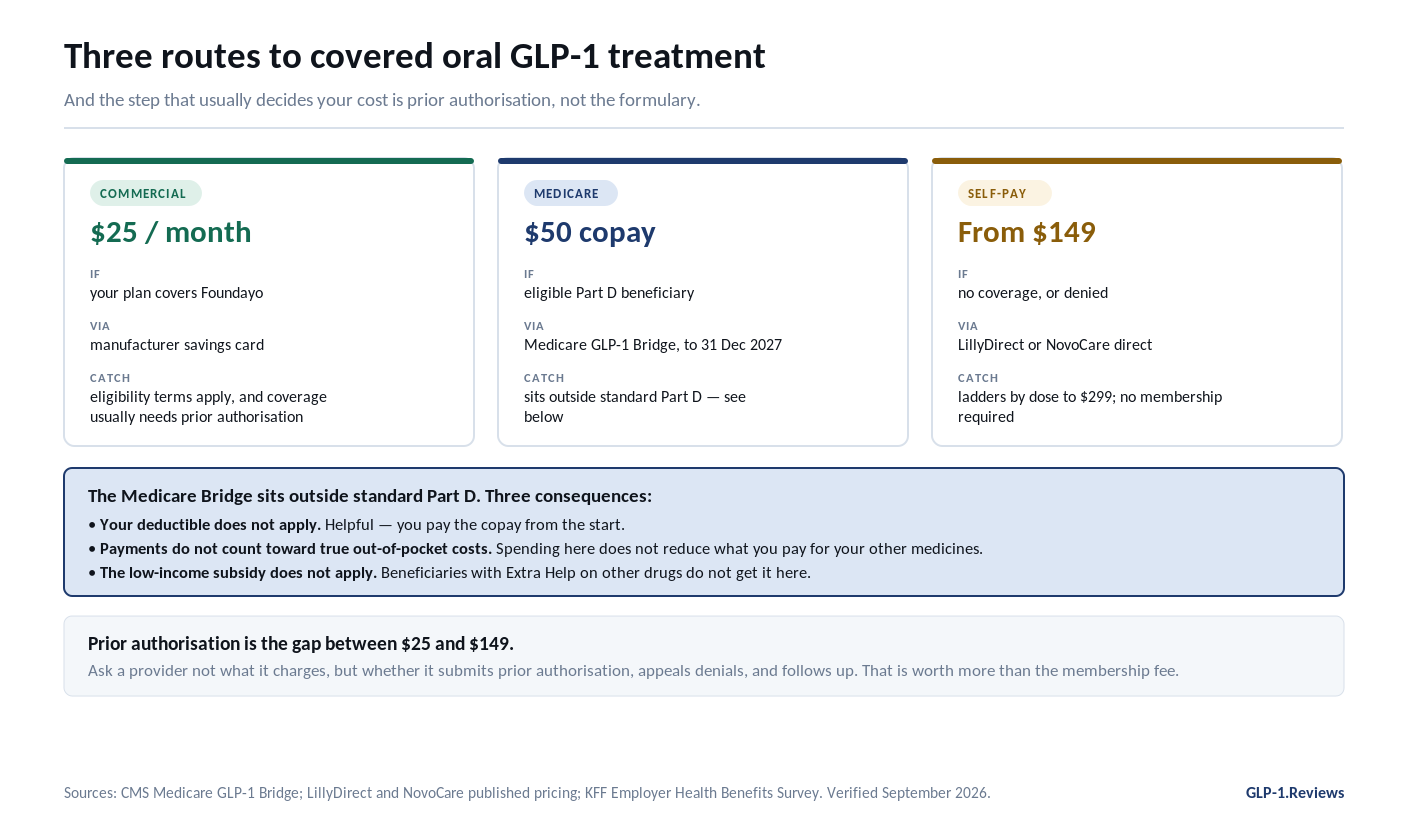
The TrOOP point is the one that surprises people. If you take several medications, a year of GLP-1 copays that does not count toward your out-of-pocket total is a year in which your other drug costs behave as though you were not spending anything at all.
And the programme has an end date. December 2027 is not far away for a treatment most people expect to continue, and what follows it has not been announced.
Employer plans: the direction of travel
Employer coverage is where most commercially insured people actually get their answer, and the picture has stopped improving.
Coverage rises steeply with employer size. In KFF’s 2025 Employer Health Benefits Survey (fielded January to July 2025, published October 2025), 16% of firms with 200 to 999 workers, 30% of firms with 1,000 to 4,999 workers and 43% of firms with 5,000 or more covered GLP-1s used primarily for weight loss. The largest group was up from 28% a year earlier. Among the large firms that did not cover them, 1% said they were very likely to start within twelve months. So the direction of travel is not “spreading”; it is “the biggest employers going deeper while everyone else holds.” A small but real share have dropped coverage they previously offered, generally citing cost. And a growing group have taken a third path: keeping employees on the plan for other purposes while directing them to direct-to-consumer platforms for GLP-1s specifically.
That last group matters if you are one of them, because being steered to a DTC platform means the cash prices in our pricing coverage are your prices. The employer has not denied you the medication; it has moved you into the self-pay market.
If your employer changed its policy this year, it is worth asking benefits directly which of those three things happened, because the answer determines whether you are appealing a denial, shopping cash prices, or eligible for a savings card you did not know about.
What to do, in order
Some providers do the paperwork as part of the service. Knownwell advertises prior-authorisation support for Foundayo, Calibrate sells full-service insurance navigation as part of its membership, and LifeMD lists both pills as insurance-accepted. Which providers carry the pills at all is in the directory; whether they will file the form for you is the next question to ask, and the directory is where to start.
1. Check your formulary before comparing cash prices
Call the number on your insurance card, or search your plan’s drug list, for the specific brand name — Foundayo or the Wegovy pill. Ask whether it is covered, at what tier, and whether prior authorisation or step therapy applies. This takes one call and it changes everything downstream.
2. If it is covered, ask who submits the paperwork
Your prescriber submits prior authorisation. Whether a telehealth platform will chase it, appeal a denial and follow up is a service question that varies enormously between providers, and it is worth more to you than the membership fee.
3. If it is denied, ask why and consider appealing
Denials frequently rest on missing documentation rather than a judgment that the medication is inappropriate. Your prescriber can see the reason and decide whether to appeal.
4. If it is not covered, price the self-pay routes properly
Compare the all-in monthly cost at your expected maintenance dose, not the entry price. Both manufacturer pharmacies supply direct without a membership.
This covers United States coverage for the two approved oral GLP-1s. It does not cover compounded preparations, which insurers generally do not reimburse.
Coverage for type 2 diabetes follows different rules from coverage for weight management, and the same medication can be covered for one and not the other.
And plan terms are specific to your plan. Everything here describes patterns; your formulary is the authority.
Frequently asked questions
Why is it $25 for some people and $149 for others?
Because the savings card applies to patients whose plan covers the medication. Getting coverage confirmed usually means prior authorisation. So the difference is not a discount you qualify for by asking — it is the outcome of a paperwork process, and whether anyone chases it on your behalf.
Does Medicare cover the oral GLP-1s?
Through the Medicare GLP-1 Bridge, eligible Part D beneficiaries have had a $50 copay since 1 July 2026, running to 31 December 2027. It operates outside standard Part D: the deductible does not apply, the payments do not count toward true out-of-pocket costs, and the low-income subsidy does not apply to it.
My employer dropped GLP-1 coverage. What are my options?
Ask benefits precisely what changed — some employers dropped coverage, and others kept it while steering GLP-1s to a direct-to-consumer platform. Those are different situations. If you are genuinely uncovered, the manufacturer pharmacies publish self-pay prices and charge no membership.
What is step therapy?
A requirement to try a preferred medication before the plan will cover the one you were prescribed. It is common for weight-management drugs. Your prescriber can sometimes request an exception where a step-therapy medication is unsuitable for you, which is a conversation worth having rather than accepting the requirement as final.
Should I appeal a denial?
Often worth it. Denials frequently rest on missing documentation rather than a clinical judgment, and appeals succeed often enough to be worth the effort. Ask your prescriber for the stated reason — that determines whether an appeal is likely to change anything.
Two questions, not one
If the answer to both is no, the comparison shifts to cash prices, and there the pills against the injections and branded against compounded are different arithmetic from the insured case.
Most people ask whether their insurance covers an oral GLP-1 and stop at the answer. The formulary is only half of it.
The other half is who does the work — who submits the prior authorisation, who appeals the denial, who follows up when nothing happens for three weeks. That is what separates $25 a month from $149, and it is a service question rather than a coverage one.
Ask both. The second one is the one nobody volunteers.
Sources
- Centers for Medicare & Medicaid Services — Medicare GLP-1 Bridge programme terms. cms.gov, checked 8 September 2026.
- LillyDirect — Foundayo savings programme terms and self-pay pricing, captured 8 September 2026.
- NovoCare Pharmacy — Wegovy pricing, captured 8 September 2026.
- KFF — 2025 Employer Health Benefits Survey, GLP-1 coverage findings (16% / 30% / 43% by firm size; 43% vs 28% for the largest firms; 1% of non-covering large firms very likely to add coverage).
- Published 2026 employer benefits surveys on GLP-1 coverage and direct-to-consumer steering.
- U.S. Food and Drug Administration — approvals of oral semaglutide (Dec 2025) and orforglipron (Apr 2026).
Medical disclaimer. This article explains coverage mechanisms. It is not medical advice, does not recommend any medication, and does not address dosing. Your plan documents govern your coverage; nothing here overrides them.
Note. Coverage terms verified against CMS and manufacturer sources on 8 September 2026. The Medicare GLP-1 Bridge runs to 31 December 2027 and what follows it has not been announced.
Keep exploring our GLP-1 resources:



