
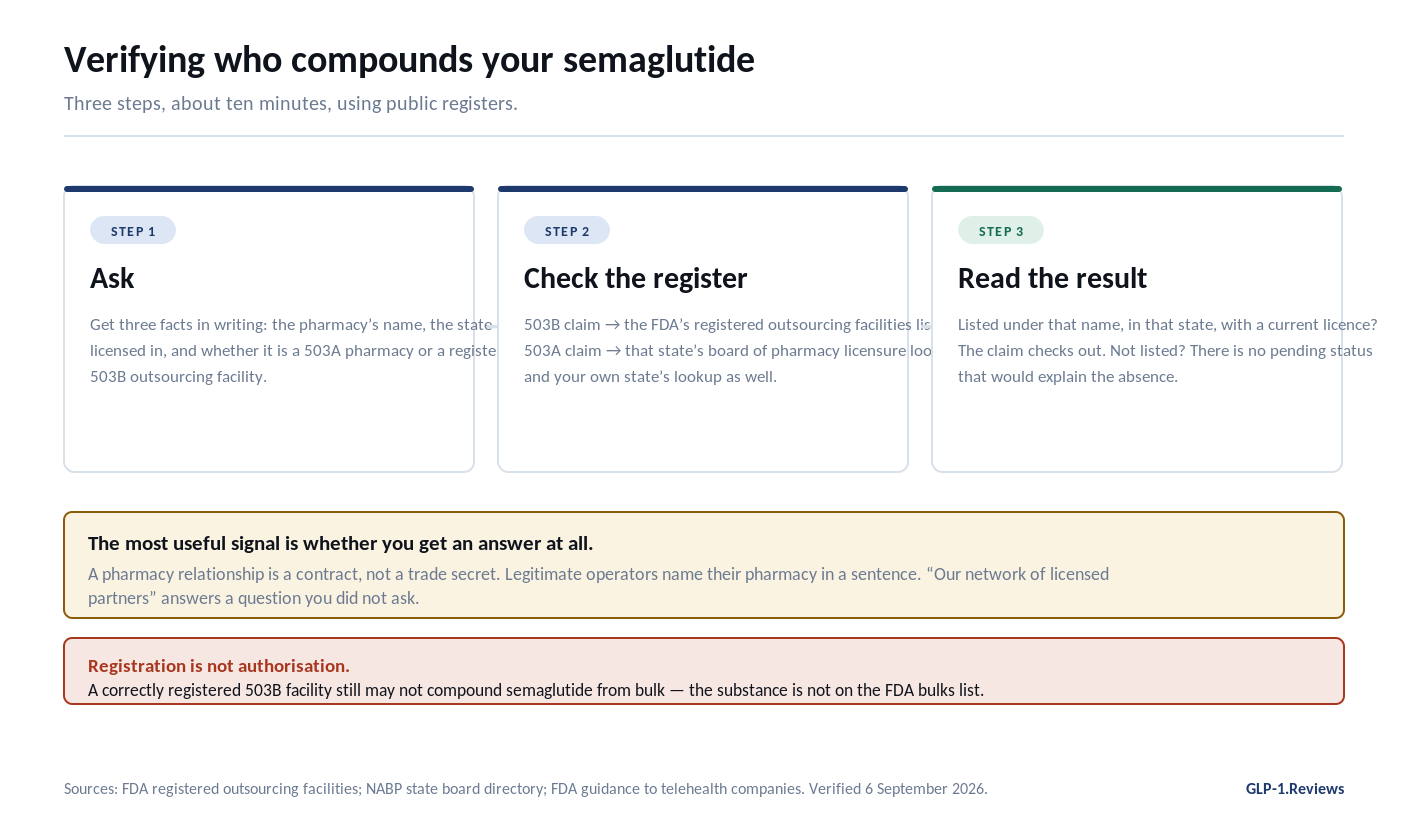
Ask three questions: what is the compounding pharmacy called, which state is it licensed in, and is it a 503A pharmacy or a registered 503B outsourcing facility. Then check the answers against public registers, which takes about ten minutes.
You have to ask because most telehealth platforms do not volunteer it. The medication typically arrives in packaging carrying the telehealth company’s own brand, with no indication of who actually made it.
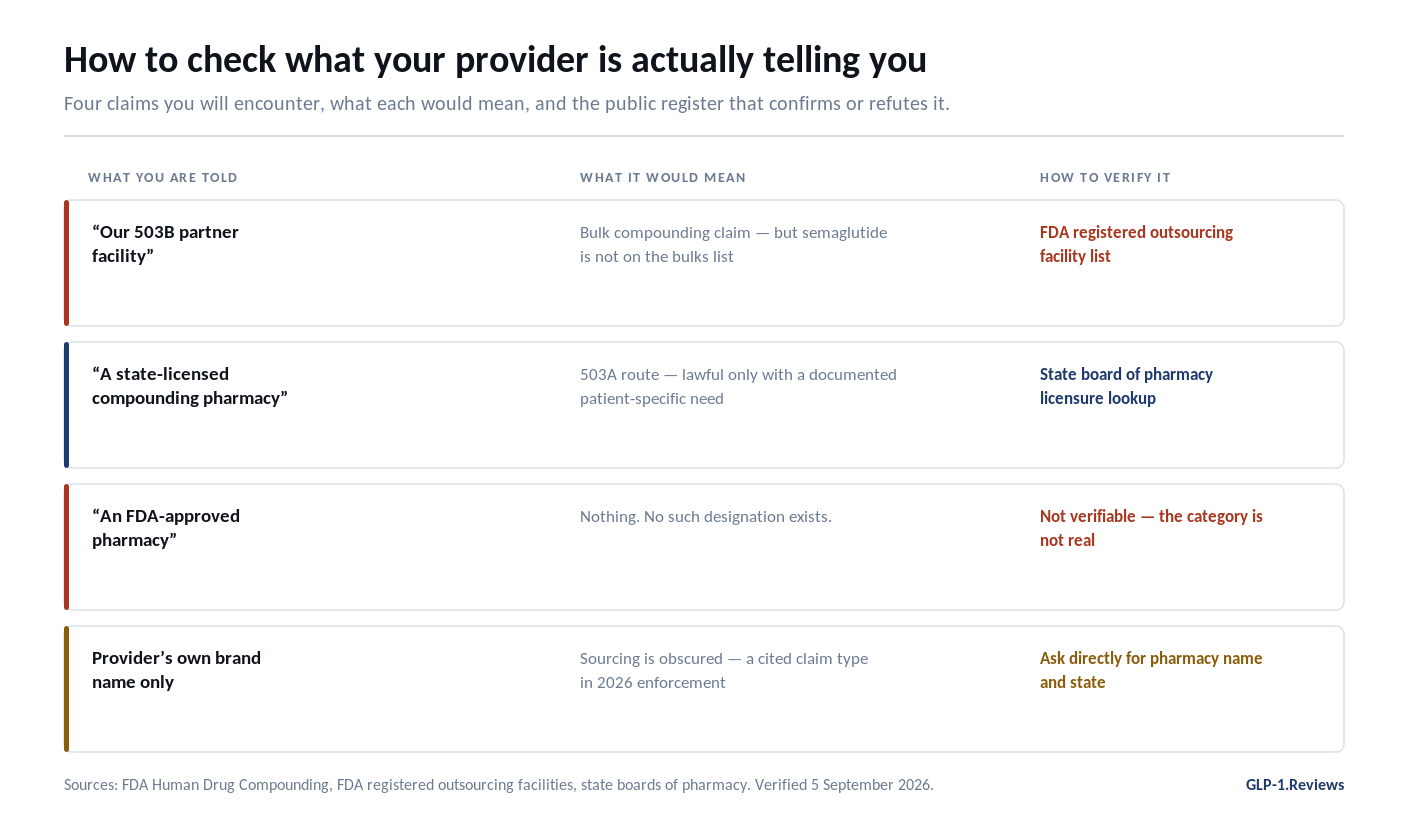
That is not an accident of design, and it is not a neutral choice. Advertising a compounded drug branded with the seller’s own name, without qualification, is one of six claim types the FDA cited when it wrote to telehealth companies in 2026 — because it obscures sourcing and implies the seller manufactured a drug it did not make.
Not a paperwork exercise. Not something only pharmacists need to care about. Not a question a legitimate provider finds difficult.
The single most useful signal is not the answer itself. It is whether you get one. A company confident in its supply chain names its pharmacy in a sentence. A company that deflects, answers a different question, or points you back to its own marketing has told you something the register never will.
The FDA issued 55 warning letters to telehealth companies in 2026, 30 in March and 25 in June, following more than 100 in 2025. Checking whether a company you are about to hand a prescription to appears in that database is not paranoia. It is a realistic check with public data.
Why the pharmacy is hidden in the first place
When you buy an FDA-approved medication, the manufacturer is on the box. Novo Nordisk makes Wegovy. Eli Lilly makes Zepbound. There is no ambiguity because approved drugs carry approved labelling.
Before any of these steps, you need the pharmacy’s name, and most providers do not volunteer it: 13 of the 58 compounding providers in our directory name their pharmacy on a page you can reach before you pay, most of them in a collapsed FAQ or fine print; ten name it only in legal pages, and in 33 we found no name at all.
Compounded medications work differently. The telehealth platform you signed up with is almost never the entity that made the drug. It operates the website, employs or contracts the prescriber, and arranges fulfilment. A separate licensed pharmacy compounds the preparation and ships it.
Many platforms present the result as a single branded product anyway. The vial carries their logo, the marketing describes it as their programme, and the pharmacy is named nowhere in the purchase flow.
The FDA’s objection to this is specific. Its guidance to telehealth companies identifies advertising a drug product branded with the firm’s own name or trademark, without qualification, as a practice that obscures sourcing and can render a drug misbranded. It is not that the arrangement is illegitimate — outsourcing fulfilment to a licensed pharmacy is normal. It is that presenting the result as your own product, without saying whose it is, misleads the buyer about a fact that matters.
Why it matters to you specifically
Three reasons, in ascending order of importance.
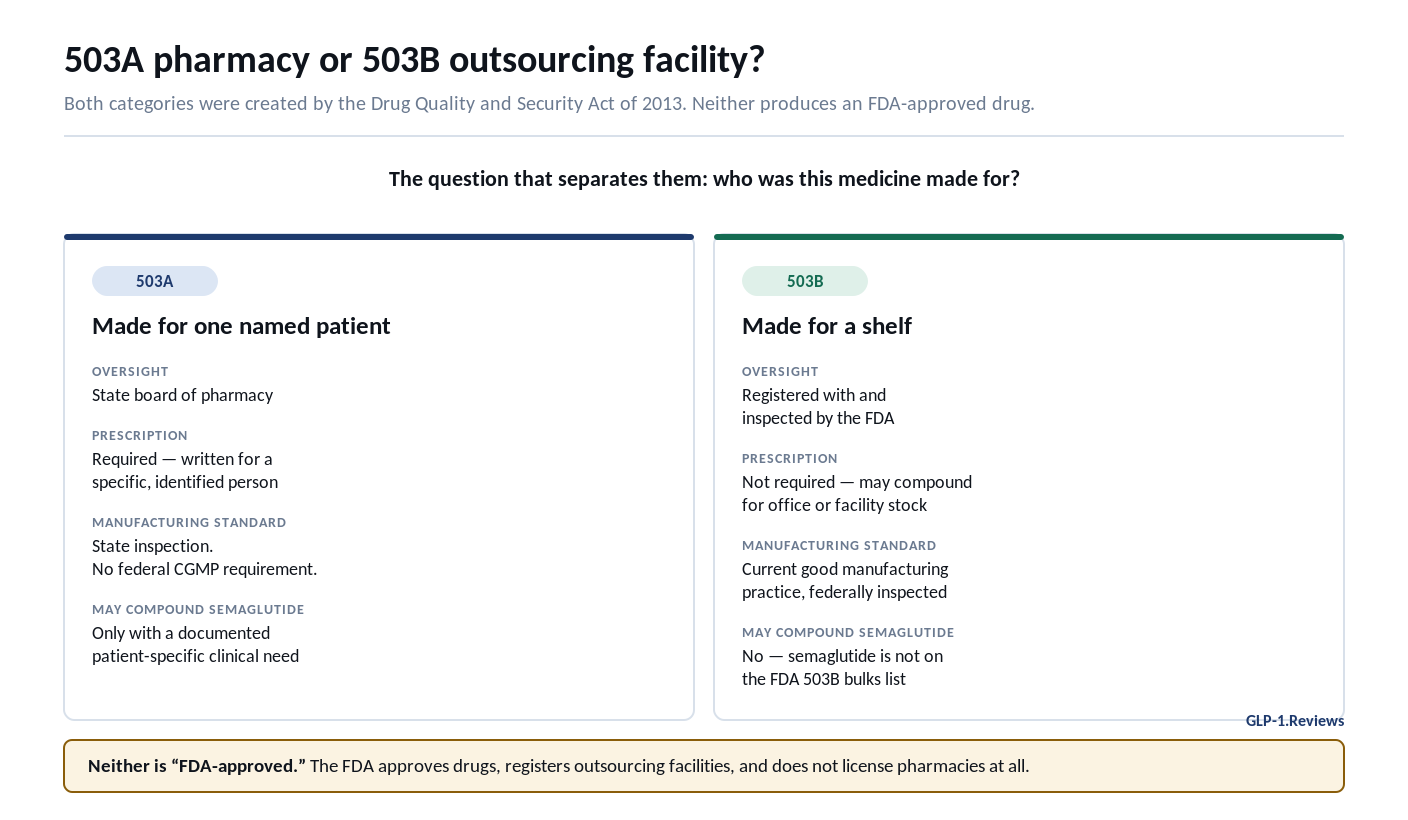
The first is quality oversight. A 503B outsourcing facility is inspected by the FDA under current good manufacturing practice. A 503A pharmacy is inspected by its state board, and state standards vary considerably. Knowing which one made your medication tells you which regime applies.
The second is legality. Semaglutide is not on the FDA’s 503B bulks list, so a 503B facility cannot lawfully compound it from bulk. A 503A pharmacy can compound it only where the prescriber has documented that a change produces a significant difference for you individually. Knowing the route tells you which rule your prescription has to satisfy.
The third is continuity. If the pharmacy behind your programme stops compounding — because it is inspected, warned, or simply exits the category — your treatment stops with it. Patients generally find this out when a refill fails to arrive.
The three questions, and what good answers look like
Ask by email rather than on a chat widget, so you have the answer in writing.
Our provider reviews record what each platform disclosed about its compounding pharmacy when we walked through its intake; the Mochi Health, Ivim Health and Hims & Hers reviews show the range, from a named partner pharmacy to partners not publicly identified.
| Ask | A good answer sounds like | A poor answer sounds like | What the poor answer means |
|---|---|---|---|
| What is the name of the pharmacy that compounds this medication? | A specific business name you can search | “Our licensed pharmacy partners” / the platform’s own brand name | Sourcing is obscured — the exact practice FDA has cited |
| Which state is it licensed in? | A named state, and often a licence number | “We work with pharmacies nationwide” | Nothing verifiable; you cannot check a licence you cannot locate |
| Is it a 503A pharmacy or a registered 503B outsourcing facility? | One or the other, stated plainly | “FDA-approved” / “FDA-registered pharmacy” / a non-answer | Either the company does not know its own regulatory status or is obscuring it |
Note the third row. There is no such thing as an FDA-approved pharmacy, and “FDA-registered pharmacy” conflates facility registration with drug approval. Both phrases appear in the FDA’s 2026 warning letters. A company using either has told you it either does not understand its obligations or is relying on you not to.
How to check a 503B claim
This one is straightforward, because the FDA publishes the list.
Registered outsourcing facilities appear in the FDA’s public register, searchable by name and state. If a provider claims 503B sourcing and the facility does not appear there, the claim is wrong — there is no partial or pending status that would explain the absence.
If the facility does appear, two further things are worth reading. The register shows the registration date, and the FDA publishes inspection outcomes separately. A facility that registered recently has less inspection history behind it, which is neither good nor bad but is worth knowing.
The critical point: a 503B facility appearing on the register does not mean it may lawfully compound semaglutide. Registration authorises the facility. The bulks list authorises the substance. Semaglutide, tirzepatide and liraglutide are on no version of that list, and in April 2026 the FDA proposed excluding all three permanently. A correctly registered facility compounding semaglutide from bulk is still operating outside the statute.
How to check a 503A claim
Harder, because there is no single national register, but still doable.
Each state board of pharmacy licenses pharmacies operating in or shipping into that state, and most publish a searchable lookup. Search the pharmacy name in the state the provider named, and separately in your own state — a pharmacy shipping to you generally needs authority to do so where you live, not only where it sits.
The National Association of Boards of Pharmacy maintains directories of state boards, which is the fastest way to find the right lookup tool for a given state.
What you are checking for is simple: does this pharmacy exist under this name, in this state, with a current licence. A pharmacy that cannot be found under the name you were given is the answer to your question.
| Claim made | Register to check | What confirms it | What refutes it |
|---|---|---|---|
| 503B outsourcing facility | FDA registered outsourcing facilities list | Facility appears by name and state | Not listed — there is no pending status |
| 503A compounding pharmacy | State board of pharmacy licensure lookup | Current licence under that name | No record, or a lapsed licence |
| Ships to my state | My own state’s board lookup | Non-resident or out-of-state pharmacy licence | Licensed only in its home state |
| “FDA-approved pharmacy” | None — the category does not exist | Nothing can confirm it | The claim itself is the finding |
What a non-answer tells you
Most people never reach the register step, because the question does not get answered. That outcome is more informative than any lookup.
Consider what the question actually asks. It asks a company to name the licensed business that manufactured the drug it sold you. That is not commercially sensitive, it is not complicated, and every legitimate operator knows it without checking. A pharmacy relationship is a contract, not a trade secret.
So the deflections are worth reading closely. “We work with a network of licensed pharmacies” answers a question you did not ask — you asked which one made yours. “All our medications are made in FDA-registered facilities” substitutes a category claim for a specific one. “Our compounding partners are fully licensed and compliant” asserts the conclusion while withholding the fact that would let you check it.
None of these is proof of wrongdoing. All of them are a company choosing not to tell you something it plainly knows, about a prescription drug you are about to inject.
Then check the warning letter database
Whether or not you get an answer, search the company’s name in the FDA’s warning letter database. It is public and searchable. With 55 letters to telehealth firms in 2026 and more than 100 in 2025, the base rate is high enough that this is a routine check rather than a suspicious one.
A letter is not proof a company is unsafe. Most of the 2026 letters concern how products were described rather than findings of contamination. What the letter gives you is a dated record of what the FDA found, and the company’s current marketing tells you whether anything changed afterwards.
If you are prescribed an FDA-approved medication — Ozempic, Wegovy, Mounjaro, Zepbound or the approved oral formulations — none of this applies. Those are manufactured under full FDA approval by a named manufacturer and there is no compounding pharmacy to identify.
It also does not apply to a compounded medication from a pharmacy you already know: a local independent compounder your prescriber referred you to, for instance, is not obscuring anything.
And a provider naming its pharmacy is not thereby endorsed. Disclosure is the minimum, not the finish line. The register check is what turns a name into a fact.
Frequently asked questions
Is a telehealth company legally required to tell me which pharmacy compounds my medication?
Disclosure practices sit under a mix of federal drug-marketing rules and state pharmacy law rather than one single labelling requirement, so the honest answer is that it depends on the state and the arrangement. What is clear is the FDA’s position on the marketing side: advertising a compounded drug branded with the firm’s own name, without qualification, is a practice it has issued warning letters over because it obscures sourcing.
Whatever the legal floor, you can simply ask, and what you learn from the answer does not depend on whether the company was obliged to give it.
What if the pharmacy is registered with the FDA but still compounds semaglutide?
Registration and authorisation are different things. A 503B facility being on the FDA register means the facility has identified itself and accepted inspection. It does not mean any particular substance may be compounded there. Semaglutide is not on the 503B bulks list, so bulk compounding of it is outside the statute regardless of how properly the facility is registered.
My medication arrived in packaging with only the telehealth company’s name. Is that a red flag?
It is the practice FDA has cited, but on its own it is a prompt to ask rather than a conclusion. Some companies brand packaging while disclosing the pharmacy clearly elsewhere. The question is whether you can find out who made it if you want to. If you ask directly and still cannot, that is the red flag.
How long does verifying actually take?
The register checks take about ten minutes once you have a name and a state. Getting the name and state is the slow part, and how slow it is tells you most of what you wanted to know.
Does any of this change if the FDA finalises its 503B proposal?
It makes the 503B answer simpler and more consequential. If the FDA finalises the exclusion of semaglutide, tirzepatide and liraglutide from the bulks list, bulk compounding of those three ends outright, and a provider still claiming a 503B route for them would be describing something that cannot lawfully happen. The 503A questions are unchanged either way.
Ask the question and watch what happens
The register checks in this article are worth doing, and they are not the point.
The point is that you can send one email asking a company to name the pharmacy that made your prescription drug, and the response — its speed, its specificity, whether it answers the question you asked — will tell you more about how that company operates than any score, including ours.
Legitimate operators answer in a sentence. That is the whole test.
Sources
- U.S. Food and Drug Administration. FDA to Telehealth Companies: What to Know When Promoting Compounded Drugs. fda.gov, accessed 6 Sep 2026.
- U.S. Food and Drug Administration. Registered Outsourcing Facilities — searchable register. fda.gov.
- U.S. Food and Drug Administration. Human Drug Compounding — regulatory hub. fda.gov.
- U.S. Food and Drug Administration. 503B Bulk Drug Substances List. fda.gov.
- U.S. Food and Drug Administration. Warning Letters — public database. fda.gov.
- U.S. Food and Drug Administration. FDA warns 30 telehealth companies against illegal marketing of compounded GLP-1s. 3 Mar 2026.
- U.S. Food and Drug Administration. FDA Proposes to Exclude Semaglutide, Tirzepatide, and Liraglutide on 503B Bulks List. 30 Apr 2026.
- National Association of Boards of Pharmacy. State Boards of Pharmacy directory. nabp.pharmacy.
- U.S. Food and Drug Administration. Compounding Laws and Policies — FD&C Act sections 503A and 503B. fda.gov.
- U.S. Food and Drug Administration. FDA’s Concerns with Unapproved GLP-1 Drugs Used for Weight Loss. fda.gov.
Corrected 8 October 2026. This page said that two of the 58 compounding providers name their pharmacy before you pay, ten name it somewhere and 44 do not name it at all. Those figures came from a September read that missed some providers’ pages and could not see text inside collapsed sections, and they understated disclosure. That was our error. The figures here are from a re-read on 8 October 2026 that includes collapsed content; the full count and its correction.
Medical disclaimer. This article explains how to verify publicly recorded facts about pharmacies and providers. It is not medical advice, does not recommend or discourage any medication or provider, and does not address dosing. Treatment decisions belong with a licensed healthcare provider who knows your medical history.
Regulatory status note. Verified against FDA and NABP sources on 6 September 2026. The FDA’s 503B bulks list determination was pending as of that date.
Keep exploring our GLP-1 resources:



