
No, not at the top end — and the honest version of that answer comes with a caveat large enough to change what you do with it.
In ATTAIN-1, published in the New England Journal of Medicine, orforglipron at its highest dose produced a mean body-weight reduction of 12.4% at 72 weeks, about 27 pounds. Roughly 59.6% of participants lost at least 10% of their body weight; roughly 39.6% lost at least 15%.
The injectable trials report higher figures, with tirzepatide leading the class.
Not a small gap. Not a meaningless one. Not a measured one either.
No trial has compared an oral GLP-1 against an injectable head to head. Every comparison you will read, this one included, sets separate studies side by side — different participants, different baseline weights, different durations, different amounts of lifestyle support built into the protocol. That is a reasonable way to sense magnitude and an unreasonable way to declare a difference.
And there is a second thing no trial measures. Real-world adherence to GLP-1 treatment is poor, and the reasons are practical rather than clinical. A medication you are still taking in month twelve outperforms a stronger one you stopped in month four, by a margin that dwarfs the trial gap.
What the trials actually found
Start with what is solid, because there is a reasonable amount of it.
ATTAIN-1 followed participants on orforglipron for 72 weeks. At the highest dose studied, mean body-weight reduction was 12.4% — approximately 27 pounds. Around three in five participants lost at least a tenth of their body weight, and around two in five lost at least fifteen percent.
By any pre-2021 standard those are remarkable numbers for a weight-loss medication. They are also, on the face of it, below what the injectable tirzepatide trials report.
Within the injectable class there is one genuinely direct comparison. SURMOUNT-5 tested tirzepatide against semaglutide head to head, and established tirzepatide’s advantage. That is the injectable side of the comparison; neither of the two pills has been tested against either injectable. That is the only such comparison in the category, and it is worth flagging precisely because it is so rare — almost every other ranking you will encounter is inferred.
Why the ranking is weaker evidence than it looks
Three problems with reading across trials, in ascending order of importance.
Different populations
Trials recruit different people. Baseline weight, age distribution, proportion with type 2 diabetes, and comorbidity all vary between programmes, and all of them affect how much weight participants lose. A percentage from one trial and a percentage from another are not two measurements of the same thing.
Different protocols
Every GLP-1 trial layers the drug on top of a lifestyle intervention, and the intensity of that intervention differs. Some programmes provide structured dietary counselling and regular contact; others less. Part of any trial result is the support, not the molecule.
Trials are ceilings
Participants in a 72-week trial are screened for suitability, monitored regularly, supplied without interruption, and followed up when they miss appointments. Almost none of that describes ordinary care. Real-world results across this class are consistently lower than trial results — for the orals and the injectables alike.
So the ordering — injectable tirzepatide, then injectable semaglutide, then the orals — is probably right in direction. The size of the gaps between them is much less certain than the numbers make it appear.
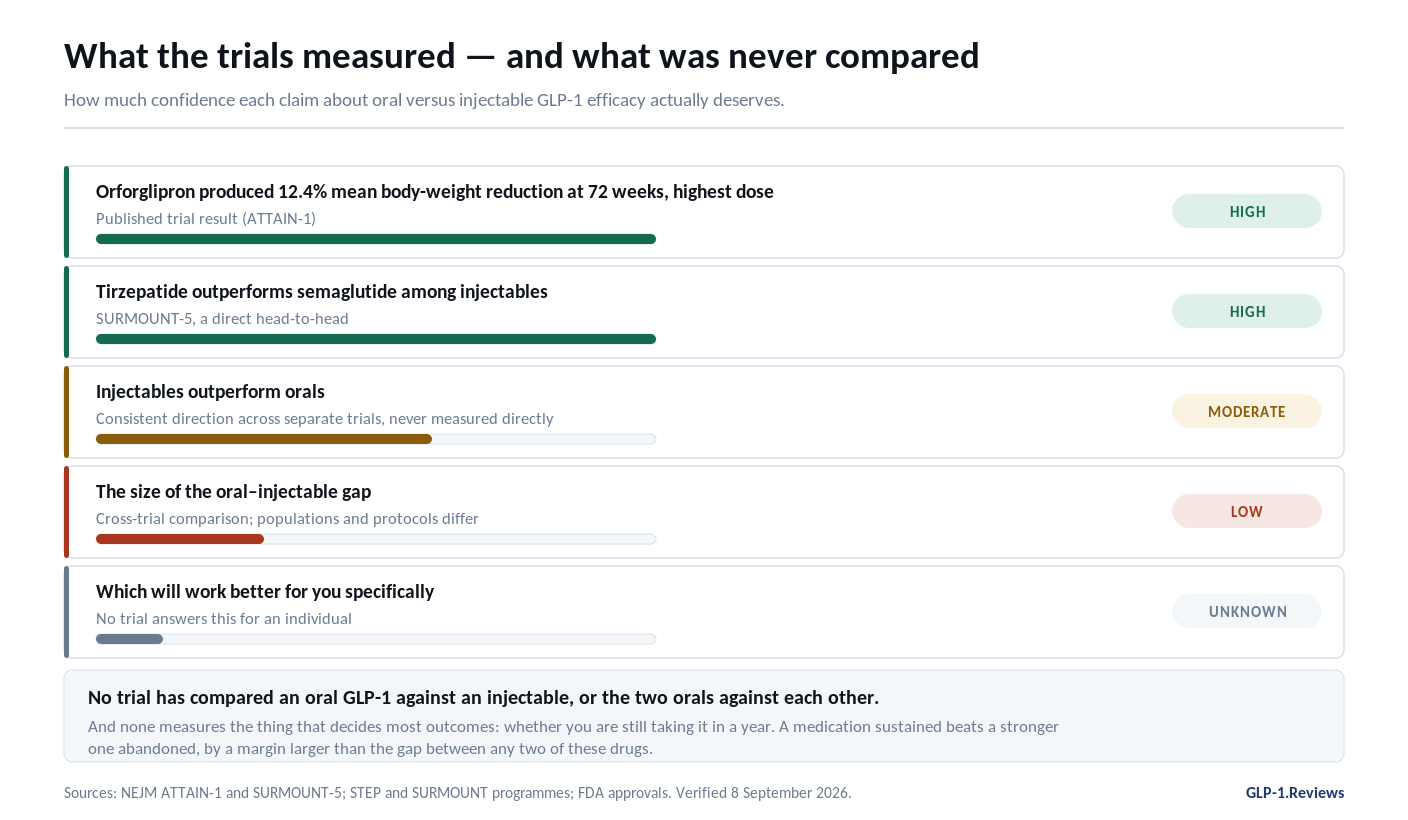
| What we know | Confidence | Why |
|---|---|---|
| Orforglipron produced 12.4% mean reduction at 72 weeks, highest dose | High | Published trial result |
| Tirzepatide outperforms semaglutide, injectable | High | SURMOUNT-5, a direct head-to-head |
| Injectables outperform orals | Moderate | Consistent direction across separate trials, never measured directly |
| The size of the oral-injectable gap | Low | Cross-trial comparison; populations and protocols differ |
| Which will work better for you specifically | Unknown | No trial answers this for an individual |
The thing the trials cannot measure
Every figure above assumes participants took the medication as prescribed for the full duration. In trials, most did. Outside trials, the picture is different, and the difference is large enough to swamp the comparison.
People stop GLP-1 treatment for reasons that are mostly not clinical. Cost, when insurance changes or a promotional price ends. Side effects during dose escalation. Supply interruption, which in this category has been common. Injection burden. Travel and refrigeration. A protocol that stopped fitting a changed routine.
Consider what that does to the arithmetic. A medication producing a larger trial result, stopped at month four, delivers a fraction of its potential. A medication producing a smaller trial result, taken continuously for two years, delivers most of its potential. The second one wins, comfortably, and no published percentage captures that.
This is not an argument that orals are secretly better. It is an argument that the trial gap is one input among several, and for many people it is not the decisive one.
Which format survives contact with your life
Worth asking concretely rather than in the abstract.
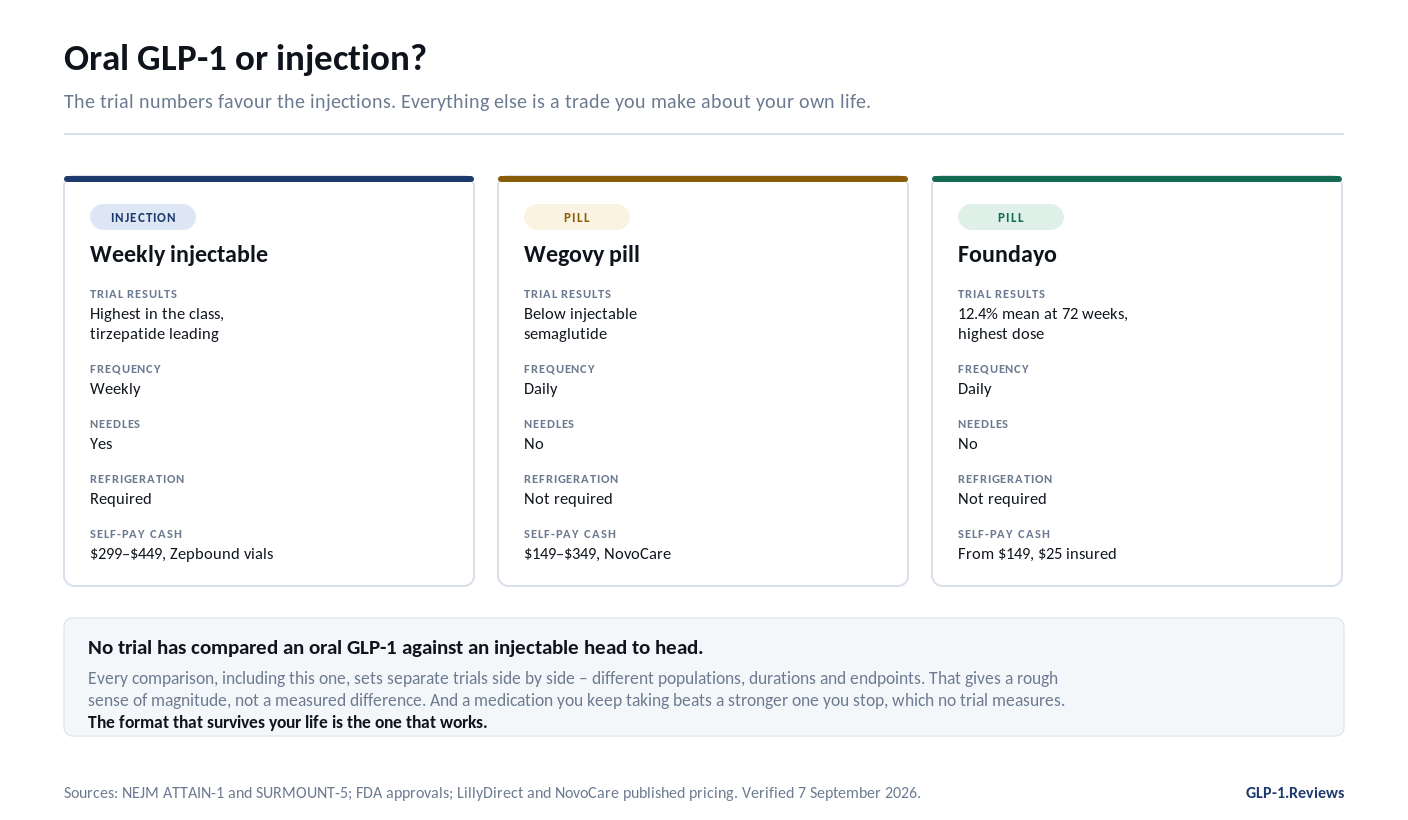
If needles are a genuine barrier for you, an injectable’s trial advantage is theoretical — you will not access it. If your mornings are unpredictable, the Wegovy pill’s absorption protocol is a daily obstacle, and Foundayo’s absence of one matters more than a percentage point. If your budget is the constraint, the option you can afford at your maintenance dose beats the one you cannot.
None of those are reasons to prefer a weaker medication. They are reasons why “weaker” and “better for you” are not opposites.
What this means in practice
Start with what you can get. Eighteen providers in our directory list the Wegovy pill and eighteen list Foundayo; Ro, Ask-Rx and Maximus are among those listing both, and the directory carries the rest. A trial percentage only matters for a pill you can actually be prescribed.
Three things worth taking from the evidence as it stands.
If maximum weight loss is the priority and the format is not a barrier, the injectables lead and tirzepatide leads them. That is the clearest signal in the data.
If the format is a barrier, an oral is not a compromise so much as a different route to the same mechanism, with a result that is meaningfully large in its own right. Twelve percent of body weight is not a consolation prize.
If you are choosing between the two orals, efficacy is the wrong axis. No trial has compared them, so any ranking between them is inference on inference. The differences that are certain are the dosing protocol and the price.
If you are already established on a GLP-1 and responding well, none of this is a reason to change. Switching has its own considerations and it is a clinical decision, not a shopping one.
If you take a GLP-1 for type 2 diabetes rather than weight management, the relevant trials, endpoints and approvals differ and this comparison is not built for that.
And no trial result predicts an individual response. Trial averages describe populations; what you will lose is not knowable in advance from any published figure.
Frequently asked questions
How much weight do people lose on an oral GLP-1?
In ATTAIN-1, orforglipron at its highest dose produced a mean body-weight reduction of 12.4% at 72 weeks, roughly 27 pounds, with about 59.6% losing at least 10% and 39.6% at least 15%. Individual results vary widely around any mean, and real-world outcomes are typically lower than trial outcomes across this whole class.
Has anyone compared an oral directly against an injectable?
No. Every oral-versus-injectable comparison, including this one, reads across separate trials with different participants and protocols. The only direct head-to-head in the category is SURMOUNT-5, which compared two injectables. Whether a compounded product would behave like either is a separate question with its own evidence problems.
Are the two oral GLP-1s equally effective?
Unknown. They have not been compared against each other either, so any ranking between them is inference from separate studies. If you are choosing between them, the certain differences are the dosing protocol and the cost, not the efficacy.
Why are real-world results lower than trial results?
Trial participants are screened, monitored, followed up, and supplied without interruption. Ordinary care provides less of all four, and people stop treatment for practical reasons that trials mostly design out. This is true across the class, not specific to the orals.
Does a smaller trial result mean I’ll lose less weight?
Not necessarily, and this is the most important caveat. Trial averages describe groups under trial conditions. What determines your outcome is closer to whether you keep taking the medication — and the format you can sustain matters more to that than a few percentage points in a study you were not in.
The gap is real. It is also not the only number.
The injections produce larger trial results. Anyone telling you the pills have caught up is overselling, and the direction of the evidence is consistent enough to trust.
But the comparison rests on reading across studies that were never designed to be read against each other, and it assumes something no trial tests: that you will still be taking this in a year.
Twelve percent sustained beats twenty percent abandoned. Choose for the version of yourself who has to do this on an ordinary Tuesday.
Sources
- New England Journal of Medicine — ATTAIN-1 trial results for orforglipron, efficacy estimand.
- New England Journal of Medicine — SURMOUNT-5, tirzepatide versus semaglutide.
- Novo Nordisk — WEGOVY prescribing information and the STEP trial programme.
- Eli Lilly and Company — Zepbound prescribing information and the SURMOUNT programme.
- U.S. Food and Drug Administration — approvals of oral semaglutide (Dec 2025) and orforglipron (Apr 2026).
- Peer-reviewed literature on real-world GLP-1 persistence and discontinuation.
- American Diabetes Association — Standards of Care in Diabetes 2026, obesity management.
Medical disclaimer. This article compares published trial results. It is not medical advice, does not recommend any medication, and does not address dosing. Trial averages do not predict individual outcomes. Which medication is appropriate for you is a decision for a licensed prescriber who knows your medical history.
Evidence note. No head-to-head trial has compared an oral GLP-1 against an injectable, or the two orals against each other. Comparisons here are drawn across separate trials and should be read as indicative of magnitude only. Verified 8 September 2026.
Keep exploring our GLP-1 resources:



