A Certificate of Analysis is a laboratory test report for one specific batch of a compounded medication. It states what the batch was tested for, what the results were, and who ran the tests.
It is a genuinely useful document. It is also the most over-claimed piece of paper in this category.
A CoA does not mean the product is FDA-approved, that it works, that it is equivalent to a branded medication, or that it is right for you. It means one batch was tested and these were the results.
Not a substitute for approval. Not a guarantee of safety. Not proof of anything beyond the batch it names.
The distinction that decides whether a CoA is worth anything to you is whether it is for your batch or a sample. A batch-specific CoA carries a lot number matching the vial in your hand. A generic one posted on a website shows what some batch looked like once, which tells you the pharmacy runs tests and nothing about your medication.
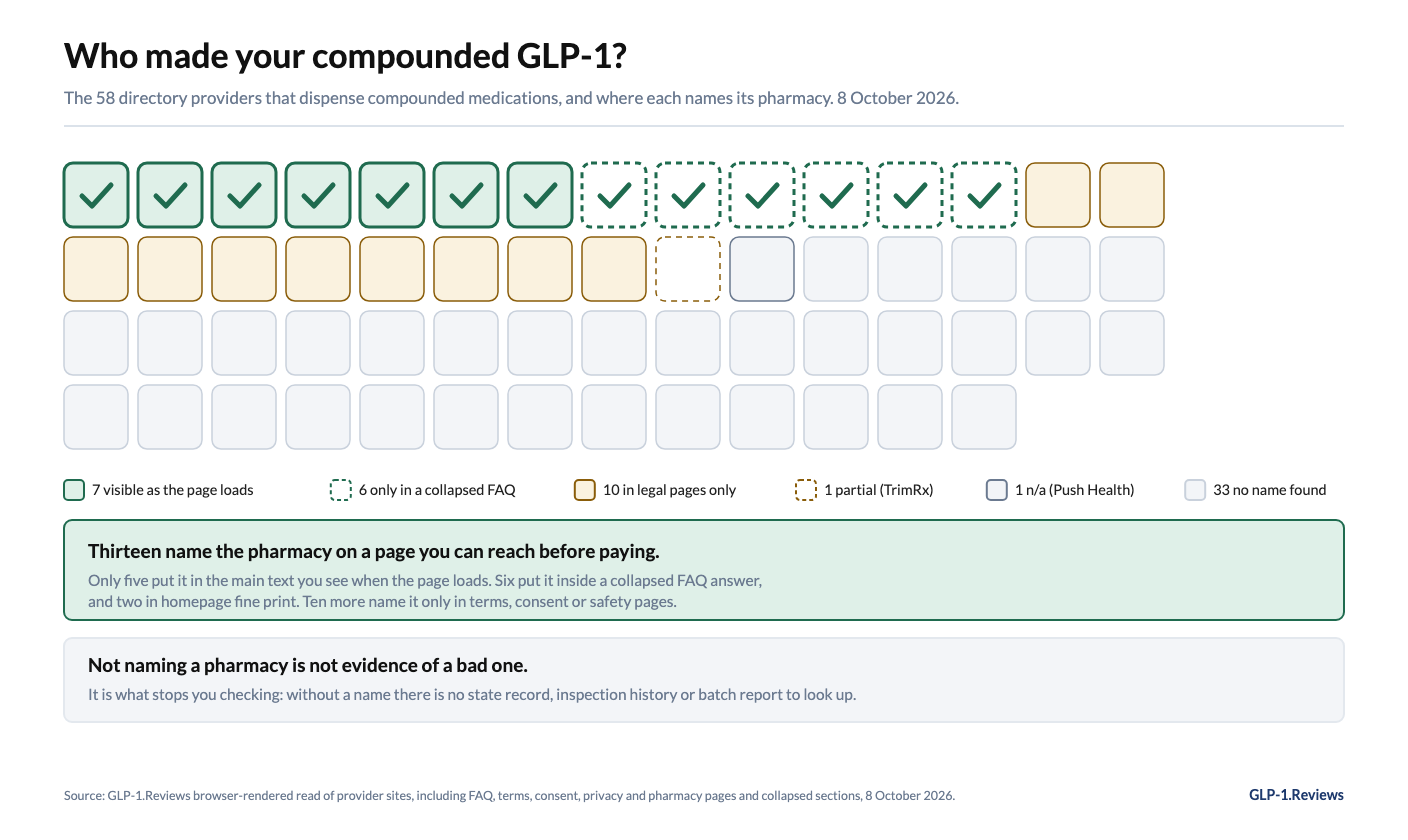
And there is a problem before any of this. Across the 58 providers in our directory that dispense compounded GLP-1s, 33 name no pharmacy we could find on their own pages. You cannot request a batch document from a company you cannot identify — which means for most buyers, the CoA question begins one step earlier than every guide to reading one admits.
Start earlier than the document
Most explanations of Certificates of Analysis assume you have one. In this market, most people cannot get one, and the reason is structural rather than obstructive.
A CoA is produced by the compounding pharmacy, not by the telehealth company that took your payment. To request the CoA for your batch, you need to know which pharmacy made it. We re-read all 76 provider sites in a browser on 8 October 2026, including text inside collapsed sections, and found no pharmacy name for 33 of the 58 that compound: not in the FAQ, not in the terms, not in the privacy policy.
Thirteen name a pharmacy on a page you can reach before paying, but only five put it in the main text you see when the page loads, among them Polly and Eden; the rest put it in a collapsed FAQ or homepage fine print.
The certificates themselves are rarer still. In the same browser read of all 58 compounding providers we found no provider publishing a batch certificate on its own pages. Two providers keep a page titled “certificate of analysis” that currently returns nothing. One, Yucca Health, states that a certificate is available on request, which is the honest version of the offer: the document exists, it is not on the website, and you have to ask.
So before the document, the question is the identity. Once you have a name, check the pharmacy itself before you ask it for anything. If you cannot get a pharmacy name, you have no addressee for the request, and a provider that offers to send “a CoA” without saying whose it is has answered a different question.
What a CoA actually reports
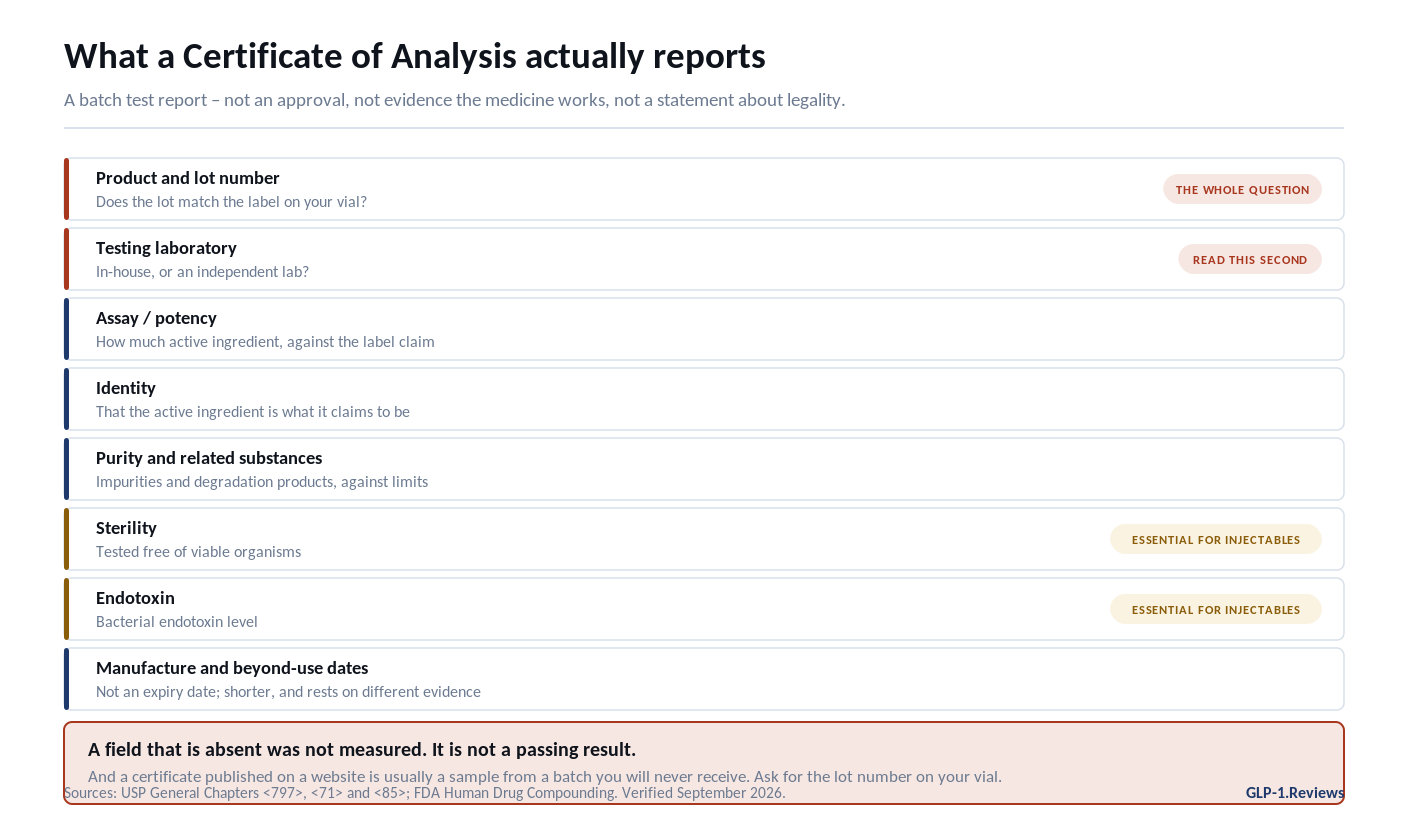
The specifics vary by pharmacy and by what was tested, but a sterile injectable preparation’s CoA generally covers a recognisable set of things.
| Section | What it reports | What to look for |
|---|---|---|
| Product and lot number | The preparation and the specific batch | Does the lot match the label on your vial? This is the whole question. |
| Date of manufacture and beyond-use date | When it was made and how long it is considered good for | A beyond-use date is not an expiry date; it rests on different evidence and is usually shorter |
| Identity | That the active ingredient is what it claims to be | A pass/fail or a confirmation against a reference standard |
| Assay or potency | How much active ingredient is present, against the label claim | A percentage, usually with a stated acceptable range. Far from 100% is the thing to ask about. |
| Purity and related substances | Impurities and degradation products | Reported against limits. Blank fields are not the same as zero. |
| Sterility | Whether the batch tested free of viable organisms | Essential for an injectable. Its absence on an injectable CoA is a question. |
| Endotoxin | Bacterial endotoxin level | Also essential for injectables, and also frequently absent |
| Testing laboratory | Who ran the tests | An independent lab is a stronger signal than in-house testing |
The two lines that matter most
The lot number. Everything else is context. If the lot on the certificate does not match the lot on your vial, you are reading a document about somebody else’s medication.
The testing laboratory. A pharmacy testing its own product is doing what the standards require. A pharmacy sending samples to an independent laboratory is doing more, and the CoA will name which. That difference is worth reading for.
Batch-specific versus sample: the distinction that decides it
This is where the marketing and the document part company.
A batch-specific CoA is generated for a particular production lot. It carries that lot number, its own dates, and results from that batch’s tests. It tells you about the vial you were sent.
A sample or representative CoA is a document a pharmacy or provider publishes to show what its testing looks like. It is real, and it tells you the pharmacy tests its products. It says nothing about your batch, because it was not about your batch.
Both are commonly described as “we provide a Certificate of Analysis.” Only one of them is a fact about your medication.
So the question to ask is not “do you provide a CoA.” It is: can I have the Certificate of Analysis for the lot number on the vial I received, from the pharmacy that compounded it? That sentence is difficult to answer evasively.
What a CoA does not tell you
Worth being blunt, because this is where the document gets over-claimed.
It is not FDA approval. Compounded preparations are not reviewed by the FDA for safety, effectiveness or quality, and a test report does not change that. A CoA reports measurements; approval is a regulatory determination about a body of evidence. They are not comparable and a provider presenting one as the other is making a claim the FDA has issued warning letters over.
It is not evidence the medication works. Potency testing confirms how much active ingredient is present. It says nothing about clinical outcomes, which come from trials that compounded preparations have not undergone.
It is not a statement about the legality of the preparation. A perfectly clean CoA can accompany a product that should not have been compounded at all. Whether a compounded GLP-1 may lawfully be made is a separate question with a separate answer.
It does not cover what was not tested. A CoA reports the tests performed. Fields that are absent were not measured, and an absent line is not a passing result.
How to ask, and what the answer tells you
Ask in writing, with the lot number
“Please send the Certificate of Analysis for lot [number] from the pharmacy that compounded it.” Email rather than chat, so you have the reply.
Read the response as information
| What you get back | What it means | Worth doing next |
|---|---|---|
| A batch CoA matching your lot, from a named pharmacy | The strongest answer available in this category | Read the assay, sterility and endotoxin lines and the testing lab |
| A CoA with a different lot number | A sample document, not your batch | Ask again, specifying your lot |
| “All our medications come with a CoA” | A policy statement, not a document | Ask for the document |
| “Our pharmacies are licensed and FDA-registered” | A different claim, and “FDA-registered” is not approval | Ask which pharmacy, then ask them |
| No pharmacy named at any point | The situation 33 of 58 providers leave you in | Weigh that against the price difference before you commit |
If you take an FDA-approved medication — Wegovy, Ozempic, Zepbound, Mounjaro or an approved oral — there is no CoA to request and no need for one. Approved products are manufactured under federally inspected controls and the evidence base sits in the approval, not in a batch report.
This is also not a way to assess whether compounded medication is right for you clinically. It is a way to check what you were sent.
And a provider that cannot produce a batch CoA is not thereby supplying a bad product. It means you cannot check, which is a different problem and a real one.
Frequently asked questions
Does a Certificate of Analysis mean my compounded medication is FDA-approved?
No. Compounded preparations are not FDA-approved and cannot be. A CoA is a laboratory report on a batch, produced by or for the pharmacy that made it. Presenting one as evidence of approval is among the claim types the FDA has cited in warning letters to telehealth companies.
My provider published a CoA on its website. Is that mine?
Almost certainly not. A published CoA is usually a sample showing what the pharmacy’s testing looks like. Check the lot number against your vial. If they differ, you are reading about a different batch — which is still evidence the pharmacy tests, but not evidence about your medication.
What should the potency result be?
The certificate will state an acceptable range and the measured result. What counts as acceptable is set by the applicable standards for that preparation rather than by a number you can carry between products, so read the result against the range printed on that document. If a result sits at the edge of its range, that is a reasonable thing to ask the pharmacy about.
There is one number worth knowing as a floor. USP’s compounding chapters treat a preparation with no monograph of its own as out of specification if its strength falls outside 90.0% to 110.0% of the labeled amount: USP <795> states the range directly for nonsterile preparations, and USP <797> applies the same 10% limit to nonofficial sterile preparations. Many pharmacies print exactly that range. A tighter range is the pharmacy’s own specification; a looser one is worth a question.
What if there is no sterility or endotoxin line?
For an injectable preparation, ask why. Those tests exist because an injected product bypasses the body’s barriers, and their absence from a certificate means they were not reported — which is not the same as having passed.
What if I can’t find out which pharmacy made my medication?
Then you cannot obtain a batch CoA, because the pharmacy issues it and you have no addressee. That is the position 33 of the 58 compounding providers in our directory leave a customer in. It is worth knowing before you buy rather than after.
The document is only as good as the lot number on it
A Certificate of Analysis is a real quality signal and a narrow one. It reports what one batch was tested for and what the results were, from a laboratory that is named on the page.
Everything it is used to imply — approval, equivalence, effectiveness — it does not say. And the version most buyers are shown is a sample from a batch they will never receive.
Ask for the lot. If the answer is a pharmacy you can name and a document that matches your vial, you have learned something real. If the answer is a policy, you have learned something too.
Sources
- United States Pharmacopeia — General Chapter <797>, Pharmaceutical Compounding: Sterile Preparations.
- United States Pharmacopeia — General Chapter <71>, Sterility Tests, and <85>, Bacterial Endotoxins Test.
- U.S. Food and Drug Administration — Human Drug Compounding. fda.gov, accessed 8 Sep 2026.
- U.S. Food and Drug Administration — FDA to Telehealth Companies: What to Know When Promoting Compounded Drugs.
- U.S. Food and Drug Administration — FDA’s Concerns with Unapproved GLP-1 Drugs Used for Weight Loss.
- 21 U.S.C. § 353b — outsourcing facility labelling and reporting requirements.
- GLP-1 Reviews — pharmacy disclosure read of 76 provider websites, September 2026.
Corrected 8 October 2026. This page said that 44 of the 58 compounding providers name no pharmacy anywhere, and that only Polly and Eden name one where a shopper sees it before paying. Those figures came from a September read that missed some providers’ pages and could not see text inside collapsed sections, and they understated disclosure. That was our error. The figures here are from a re-read on 8 October 2026 that includes collapsed content; the full count and its correction.
Medical disclaimer. This article explains what a laboratory document reports. It is not medical advice, does not recommend any medication or provider, and does not address dosing. Questions about a specific batch belong with the dispensing pharmacy and your prescriber.
Note. Verified against USP standards and FDA guidance on 8 September 2026. The pharmacy disclosure counts come from our September 2026 browser-rendered read of 76 provider sites.
Keep exploring our GLP-1 resources: