
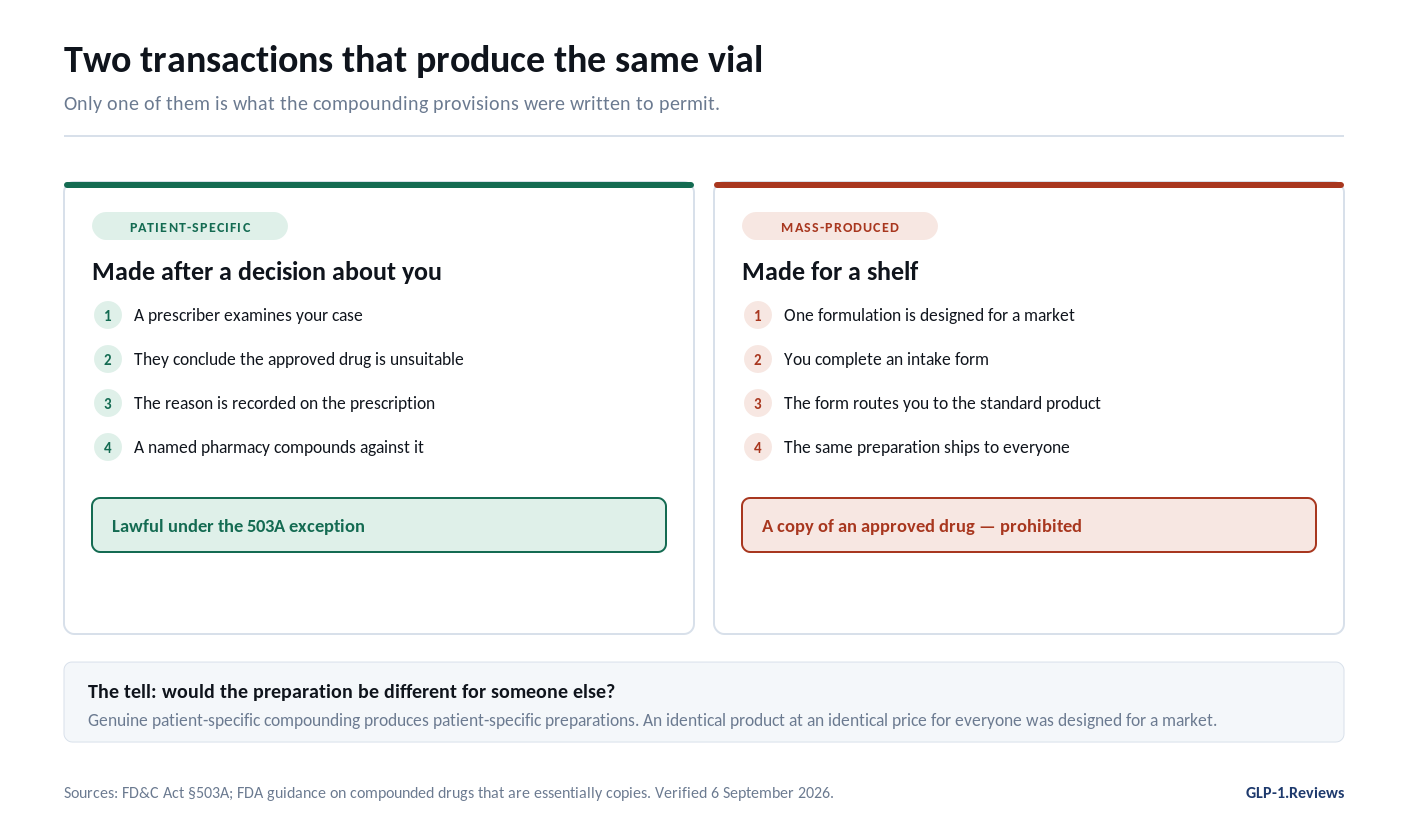
Two transactions can produce the same vial and be completely different things under federal law.
In the first, a prescriber examines your case, concludes that the FDA-approved product will not work for you, records why on the prescription, and a named pharmacy compounds against it. The preparation exists because of a decision about you.
In the second, a company offers one standardised formulation at one price to everyone who completes an intake form. The preparation existed before you did. That is a copy of an approved drug, and federal law prohibits compounding one.
Not a distinction about quality. Not a distinction about which pharmacy is better. Not something you can tell from the packaging.
The tell is whether anything about the medicine would have been different for someone else. Genuine patient-specific compounding produces patient-specific preparations. If everyone on the programme receives the same thing at the same price, no individual determination was doing any work — whatever the intake process implied.
Six signals separate them, and you can check most of them before you pay.
Why the law draws this line at all
Compounding exists to solve problems mass manufacturing cannot. A patient reacts to a preservative. A child needs a liquid version of a tablet. A dose falls between commercial strengths. Pharmacies have made one-off preparations for individual patients for as long as there have been pharmacies.
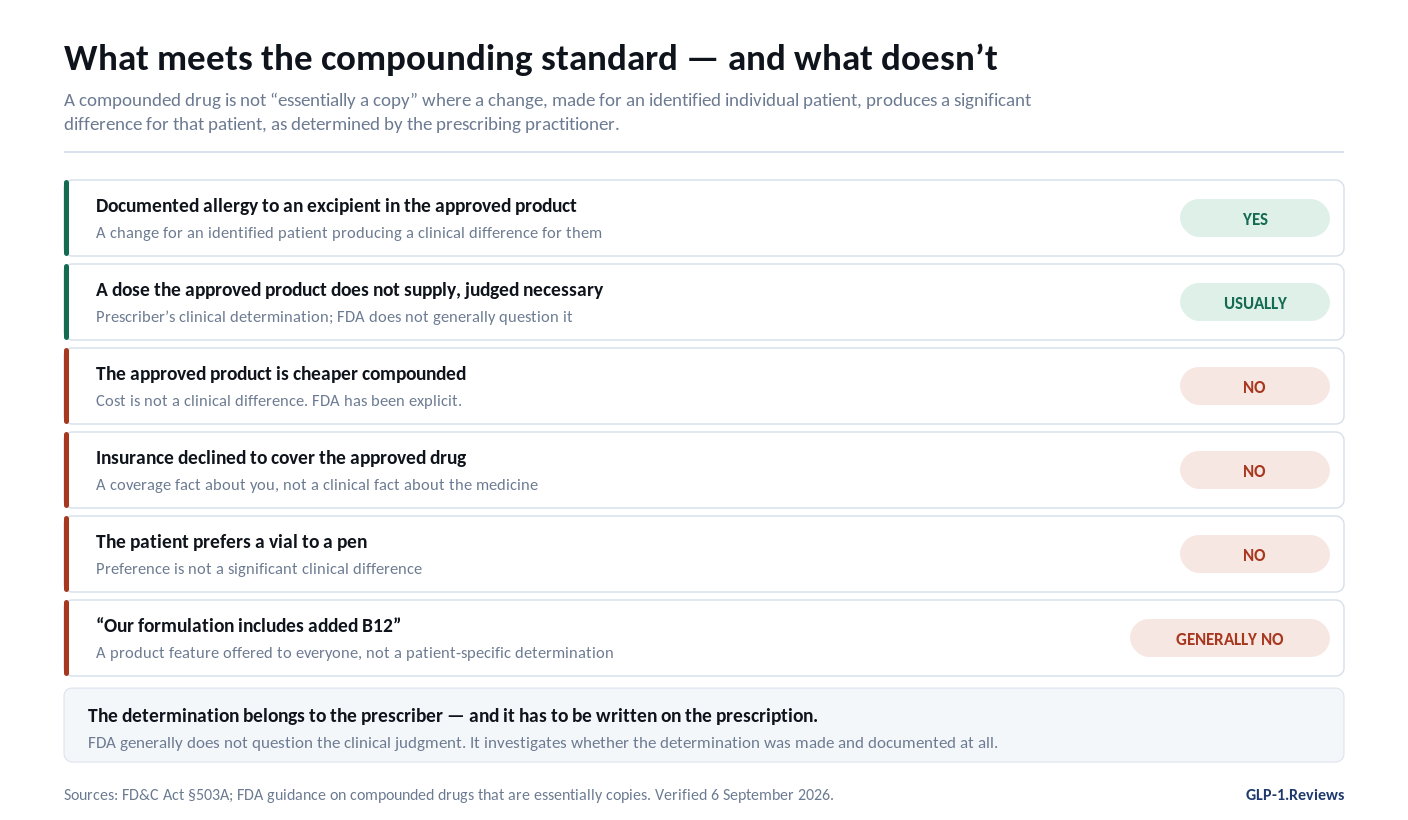
What the law will not permit is using that permission to manufacture. A compounding pharmacy producing a standardised product at scale is doing what a drug manufacturer does, without the approval, the inspection regime or the trials that manufacturing requires.
Hence the prohibition. Section 503A bars compounding a drug that is “essentially a copy of a commercially available drug product,” with an exception where a change, made for an identified individual patient, produces for that patient a significant difference as determined by the prescribing practitioner.
Read that exception as a description of a workflow rather than a legal formula and it becomes obvious. Someone has to look at you, decide something, and write it down.
The six signals
1. Would the preparation be different for someone else?
The clearest test. Patient-specific compounding produces variation, because patients vary. If the programme ships an identical formulation at an identical concentration to everyone enrolled, the preparation was designed for a market.
This does not require asking anyone. Look at how the product is described on the site. A single named product with a single price is a product. A preparation compounded to a prescription is described as a service.
2. Can anyone state your clinical reason?
There should be a recorded reason the approved product is unsuitable for you specifically — a documented reaction to an excipient, a dose the commercial ladder does not supply. Ask what yours was.
An answer about the programme is not an answer about you. “Compounded medication is more affordable” describes a business model. “You reported a reaction to a preservative in the commercial formulation” describes a determination.
3. Did a prescriber make the call, or did the form route you?
An intake questionnaire is a screening tool. It gathers information so a clinician can decide something. It is not itself a decision.
The statutory exception requires a determination by the prescribing practitioner. If your interaction consisted of completing a form and receiving a shipment, it is worth asking at what point a prescriber concluded anything about your case, and where that conclusion is recorded.
Length is not the variable. A fourteen-screen intake that produces the same standard formulation for everyone has collected more data without anyone determining anything patient-specific.
4. Is the price flat regardless of what you need?
Patient-specific preparations vary in what they cost to produce. Standardised products do not.
A single monthly price covering everyone is not proof of anything on its own — plenty of legitimate services price simply. But combined with an identical formulation and no stated clinical reason, it completes a picture: a product with a price, not a preparation with a prescription.
5. Is the medication branded with the seller’s name?
Compounded preparations come from a licensed pharmacy. When the vial carries the telehealth company’s logo and the pharmacy appears nowhere, the presentation is of a manufactured product.
The FDA’s guidance to telehealth companies identifies advertising a drug branded with the firm’s own name, without qualification, as a practice that obscures sourcing. It is one of six claim types behind the 55 warning letters the agency issued in 2026.
Our provider reviews record what each platform discloses about its compounding pharmacy; the Medvi, Eden and OrderlyMeds reviews are three where the pharmacies are named or the sourcing is published.
6. Is the formulation a marketed feature?
Combination preparations — semaglutide with added B12, for instance — are widely advertised as a product benefit. That framing is the tell. A change offered to every customer is a product specification, decided before any particular patient existed.
A prescriber could determine that such a combination produces a significant difference for a specific person. But then it would be described as something your prescriber decided, not as something the programme includes.
| Signal | Patient-specific compounding | Mass-produced copy |
|---|---|---|
| The preparation | Varies between patients | Identical for everyone enrolled |
| Your clinical reason | Stated, recorded on the prescription | Nobody can name one specific to you |
| Who decided | A prescriber, about your case | An intake form routed you to a product |
| Pricing | Reflects what was prepared | One flat monthly price for all |
| Branding | The compounding pharmacy is identified | The seller’s own brand, pharmacy unnamed |
| Formulation extras | Chosen for you if at all | Marketed as a feature of the programme |
Why this matters more than it used to
Through 2023 and 2024, the distinction was largely academic. Semaglutide and tirzepatide sat on the FDA’s shortage list, and a drug in shortage is not commercially available in the relevant sense — so the essentially-a-copy prohibition did not bite. Standardised compounded products were lawful because of the shortage, not because they were patient-specific.
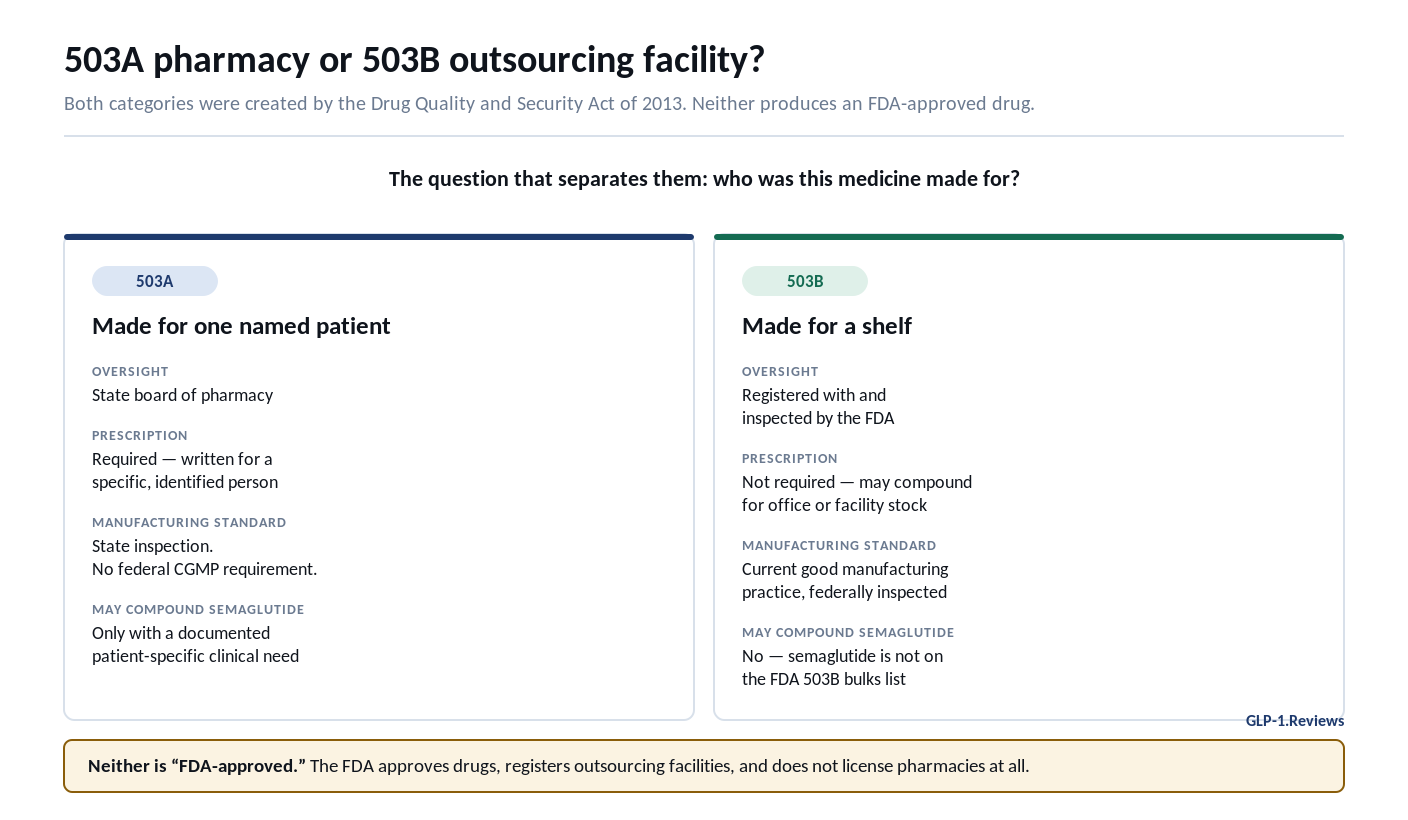
The shortages resolved in December 2024 and February 2025. The approved products became commercially available again, and the prohibition came back into force. What had been a technical distinction became the line between a lawful prescription and an unlawful one.
Businesses built during the shortage did not all restructure around this. Some did — moving to branded distribution, or narrowing to genuine patient-specific work. Others kept the model and absorbed the enforcement risk, which is a substantial part of what the 2026 warning letters describe.
What this does and does not tell you
Two limits worth stating clearly.
First, these signals describe the legal basis of a prescription, not the quality of a preparation. A mass-produced compounded vial is not thereby contaminated, and a patient-specific one is not thereby pure. The essentially-a-copy prohibition is about what may lawfully be made, not about what is in any particular batch.
Second, a provider failing several signals is not necessarily acting in bad faith. Much of this industry formed under the shortage exception and has not fully adjusted to its removal. Understanding the distinction and choosing to ignore it are different things, and from outside you often cannot tell which you are looking at.
What the signals do tell you is whether your supply rests on something durable. A prescription grounded in a documented determination survives regulatory tightening. A standardised product sold at volume does not, and the people who discover that first are usually patients waiting on a refill.
If you take an FDA-approved medication, none of this applies. There is no compounding, no essentially-a-copy analysis, and no distinction to draw.
This is also not a reason to stop a medication. If the signals point one way and that concerns you, the next step is asking your prescriber about the clinical basis and about alternatives — not discontinuation, which has its own consequences.
And genuinely patient-specific compounding is not a loophole. It is the activity the compounding provisions exist to permit, it solves real clinical problems, and pharmacies have done it uncontroversially for a very long time.
Frequently asked questions
My provider asked detailed medical questions. Doesn’t that make it patient-specific?
Not by itself. Screening and determining are different activities. A detailed intake gathers information; the statutory exception requires a prescriber to conclude that a change produces a significant difference for you, and to record it on the prescription. A thorough questionnaire that ends in the same standard formulation everyone else receives has screened you carefully without anyone determining anything about your case specifically.
Is mass-produced compounded semaglutide dangerous?
Not automatically, and it would be dishonest to imply otherwise. The prohibition is about whether a drug may lawfully be compounded, not about whether a given batch is contaminated. The real risks are that the product has not been reviewed by the FDA for safety, effectiveness or quality, and that a supply operating outside the statute can disappear without notice.
What if my compounded medication genuinely helps me?
That is a clinical fact and it is not in dispute. The legal question is separate: whether the preparation may lawfully be made. Those can point in different directions, which is genuinely uncomfortable and worth acknowledging rather than talking around. What it argues for is a conversation with your prescriber about a durable path — not stopping treatment.
Can a provider switch from mass-produced to patient-specific?
In principle, by restructuring so prescribers make and document individual determinations. In practice that changes the economics substantially, because patient-specific compounding does not scale the way a single product does. Providers that have adjusted have generally moved toward branded distribution instead, which is the direction the price convergence also points.
How can I tell before I sign up?
Signals one, four, five and six are visible on a provider’s website before you pay: whether the preparation is described as a single product, whether pricing is flat, whether the pharmacy is named, and whether formulation extras are marketed as features. Signals two and three need you to ask.
The vial does not tell you which one you have
Two patients can receive an identical preparation, from an identically licensed pharmacy, at an identical price. One prescription rests on a prescriber’s documented determination that the approved product is unsuitable for that person. The other rests on a completed form.
Only one of them is what the compounding provisions were written to permit — and only one of them survives the next regulatory tightening.
The medicine looks the same. The transaction is not.
Sources
- Federal Food, Drug, and Cosmetic Act, section 503A.
- U.S. Food and Drug Administration. Compounded Drug Products That Are Essentially Copies of a Commercially Available Drug Product Under Section 503A — guidance for industry. fda.gov.
- U.S. Food and Drug Administration. Human Drug Compounding. fda.gov, accessed 6 Sep 2026.
- U.S. Food and Drug Administration. FDA to Telehealth Companies: What to Know When Promoting Compounded Drugs. fda.gov.
- U.S. Food and Drug Administration. FDA warns 30 telehealth companies against illegal marketing of compounded GLP-1s. 3 Mar 2026.
- U.S. Food and Drug Administration. FDA clarifies policies for compounders as national GLP-1 supply begins to stabilize. fda.gov.
- U.S. Food and Drug Administration. FDA’s Concerns with Unapproved GLP-1 Drugs Used for Weight Loss. fda.gov.
- U.S. Food and Drug Administration. Warning Letters — public database. fda.gov.
- Drug Quality and Security Act of 2013, Pub. L. 113-54.
Medical disclaimer. This article explains a legal distinction in how compounded medications may be produced. It is not medical advice, does not recommend or discourage any medication or provider, and does not address dosing. Do not start or stop any medication based on this article.
Regulatory status note. Verified against the FD&C Act and FDA guidance on 6 September 2026. The FDA’s 503B bulks list determination was pending as of that date.
Keep exploring our GLP-1 resources:



