
Sometimes, and by much less than it used to be. The comparison that built this market — roughly $200 a month compounded against a branded list price above $1,300 — no longer describes anything a buyer actually faces.
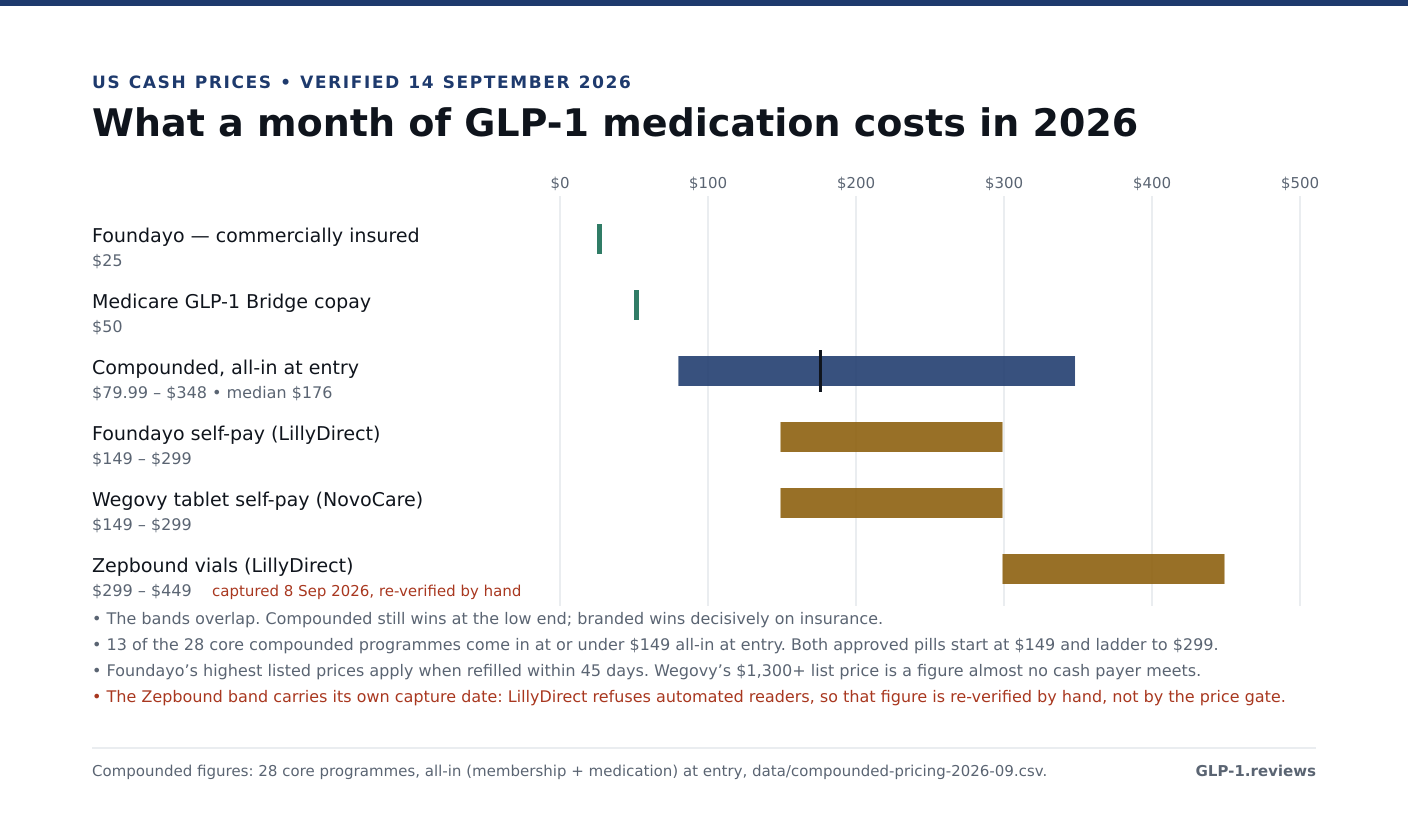
Across the 28 core compounded programmes we score, all-in monthly cost runs from $79 to $348, with a median of $176. All-in means membership plus medication, because most telehealth platforms charge both.
Branded manufacturers now sell direct. Foundayo starts at $149 a month self-pay through LillyDirect and $25 with a commercial savings card. NovoCare Pharmacy lists Wegovy at $149 to $299 for the pill and $199 to $399 for the pen. Zepbound vials run $299 to $449 by dose.
Not a rout in either direction. Not a reason to assume compounded is cheaper. Not a stable picture either — manufacturer prices moved at least three times in the past twelve months.
The honest summary is that the bands now overlap. Thirteen of the 28 core compounded programmes we score come in at or under $149, so compounded still wins at the low end. Branded wins decisively for anyone with commercial coverage or Medicare. And around the median the two are within roughly $25 of each other, which is inside the noise of dose changes and shipping fees.
When the price difference falls below about $30 a month, price stops being the deciding factor — and the questions that remain are whether the supply is lawful and whether it will still exist in six months.
What the comparison used to be
The compounded GLP-1 market was built on a genuine arbitrage. During the 2023 and 2024 shortages, semaglutide and tirzepatide appeared on the FDA’s shortage list, which lawfully permitted compounding. A compounded vial could be produced and sold for a fraction of a branded pen’s list price, and for patients without insurance coverage there was no comparable alternative.
The structural reason behind this is the molecule: a small molecule priced at $149 leaves far less room underneath it than a peptide did.
Two things ended that arrangement. The FDA declared the tirzepatide shortage resolved in December 2024 and the semaglutide shortage resolved in February 2025, which removed the legal basis for compounding at volume. And the manufacturers built direct-to-consumer channels that priced against the compounders rather than against insurance.
The second change gets far less attention than the first, and for a buyer comparing options today it matters more.
What branded medication actually costs in 2026
List price is now close to irrelevant for cash-paying patients. Wegovy’s list price sits above $1,300 per package, and almost nobody pays it. The relevant numbers are the manufacturer direct channels.
| Channel | Product | Cash price per month | What the price includes | Verified |
|---|---|---|---|---|
| LillyDirect | $18 Sep 2026 | |||
| LillyDirect | Foundayo with commercial insurance savings card | $25 | Medication only; eligibility conditions apply | 5 Sep 2026 |
| LillyDirect | Zepbound vials (tirzepatide), injection | $299–$449 by dose | Medication only | 5 Sep 2026 |
| NovoCare Pharmacy | $18 Sep 2026 | |||
| Medicare Part D (GLP-1 Bridge) | Eligible GLP-1s | $50 copay | Medication only; runs to 31 Dec 2027 | 5 Sep 2026 |
| Compounded programmes 28 core programmes scored on this site |
Compounded semaglutide or tirzepatide | $99–$224 all-in for 21 of 28 median $176, full range $79.99–$348 |
Membership plus medication — check which you were quoted | 9 Sep 2026 |
Read the right-hand column before the price column. This is where most comparisons go wrong, including comparisons published by review sites.
The two numbers that get conflated
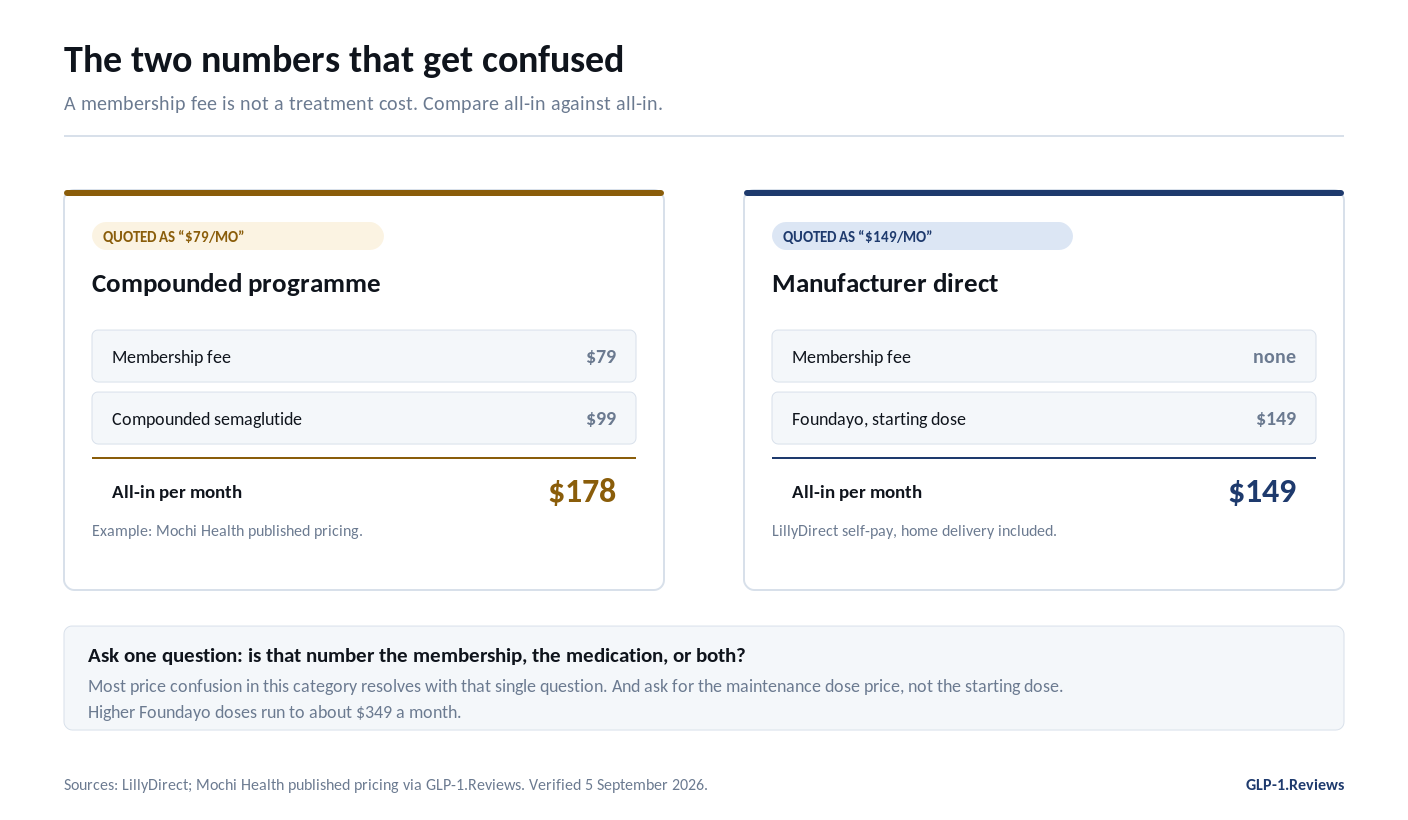
Telehealth platforms usually quote a membership fee — access to the clinician, the platform, sometimes coaching or dietitian support. Medication is billed separately. Manufacturer pharmacies quote a medication price with no membership at all, because there is no platform to pay for.
Ivim Health works the same way at a higher entry point: a $74.99 membership plus compounded semaglutide from $149, or $224 all-in. Ro, which sells only FDA-approved medication, charges $145 a month after a $45 first month with the medication billed separately, so its all-in figure depends entirely on which branded product is prescribed.
Comparing a $79 membership against a $149 medication price is comparing two different things. The honest comparison is all-in monthly cost: membership plus medication, or medication plus whatever you pay a prescriber.
Mochi Health illustrates the arithmetic clearly because it publishes both numbers. Its standard membership is $79 a month; compounded semaglutide is $99. All-in, that is $178 — almost exactly the $176 median across the programmes we score. Compounded tirzepatide at $199 brings the all-in figure to $278.
Against $149 for Foundayo or the low end of NovoCare’s Wegovy range, a median compounded programme is now the more expensive option by about $25 a month. A cheap one is still meaningfully less.
Why the branded floor is structural, not promotional
A reasonable objection at this point is that manufacturer pricing is a land grab that will be withdrawn once the compounders are gone. The manufacturing economics argue otherwise, at least for one product.
Semaglutide and tirzepatide are peptides. They are produced through complex biological synthesis, they are relatively unstable, and they need cold-chain handling. That complexity is part of why compounding them was viable business: a compounder replicating a peptide faces high costs, but so does the originator, which leaves room underneath the branded price.
Orforglipron is different. It is a non-peptide small molecule, manufactured by conventional chemical synthesis, with no peptide stability or cold-chain constraints. Small molecules are dramatically cheaper to produce at scale. That is the reason a $149 monthly self-pay price is sustainable rather than a temporary loss leader — and it is why a compounder cannot undercut it meaningfully while carrying regulatory risk that the manufacturer does not.
The industry has already acted on this. In March 2026 Hims & Hers announced it would stop advertising compounded GLP-1s, entered a collaboration with Novo Nordisk, and began moving patients to FDA-approved medicines. A company whose business was substantially built on compounded supply chose branded distribution instead — and it did so while compounded was still, for many patients, the cheaper option. That decision was about durability, not price.
When compounded still costs less — and what you give up
Frequently, and our own data says so plainly. Thirteen of the 28 core compounded programmes we score come in at or under $149 a month all-in, and the cheapest sits at $79.99 — roughly half the branded floor.
Compounded tirzepatide at the aggressive end of the market also undercuts Zepbound’s $299 to $449 band comfortably. Some programmes run promotional first-month pricing below their standing rate. And bundled programmes including coaching, dietitian access or lab testing are not directly comparable to a bare medication price, because they include something else.
There is one more asymmetry that favours compounding, and it is the one most price comparisons miss. Branded pricing ladders by dose; many compounded programmes charge a flat monthly rate. A patient who titrates up to a maintenance dose may pay $299 a month branded while a flat-rate compounded programme stays at $176. Over a year that is a real difference, and it runs in the opposite direction to the headline comparison.
What you give up is worth stating plainly. A compounded preparation has not been reviewed by the FDA for safety, effectiveness or quality. It has not been through the manufacturing controls, stability testing or clinical trials supporting the approved product. And its legal basis is narrow — lawful only where a prescriber has documented a clinical reason the approved drug will not work for you specifically.
There is also a continuity cost that does not appear on any price page. A provider relying on a supply route the FDA is actively enforcing against may have to change or stop its offering, and patients tend to find out mid-treatment. A price is only a good price if the supply lasts as long as the treatment.
| Scenario | Likely cheapest route | The catch to check |
|---|---|---|
| Commercial insurance covering weight-loss medication | Branded through insurance, or Foundayo at $25 with the savings card | Prior authorisation and step therapy requirements |
| No insurance coverage, willing to take an oral | Genuinely close — Foundayo from $149 against a cheap compounded programme at $99 | The $149 is the starting dose. If you titrate up, a flat-rate compounded programme may win over a year. |
| No coverage, wants injectable semaglutide | Often compounded — 14 of 32 programmes are at or under $149 | Compare all-in against all-in, and weigh the legal basis and continuity of the cheaper route |
| No coverage, wants injectable tirzepatide | Genuinely close — Zepbound $299–$449 against compounded all-in | Legal basis for the compounded route, and supply continuity |
| Medicare Part D eligible | The GLP-1 Bridge at a $50 copay | It sits outside Part D — no deductible, no TrOOP accrual, no low-income subsidy |
| Wants coaching, labs or dietitian support included | A bundled telehealth programme | Price the bundle against buying medication direct plus the services separately |
How to compare an offer properly
Get the all-in number for a maintenance dose
Not the intro month, not the starting dose, not the membership. Ask what you will pay per month once you are on a stable maintenance dose, with everything included. Every figure in this article is labelled for exactly this reason.
Ask what happens at dose escalation
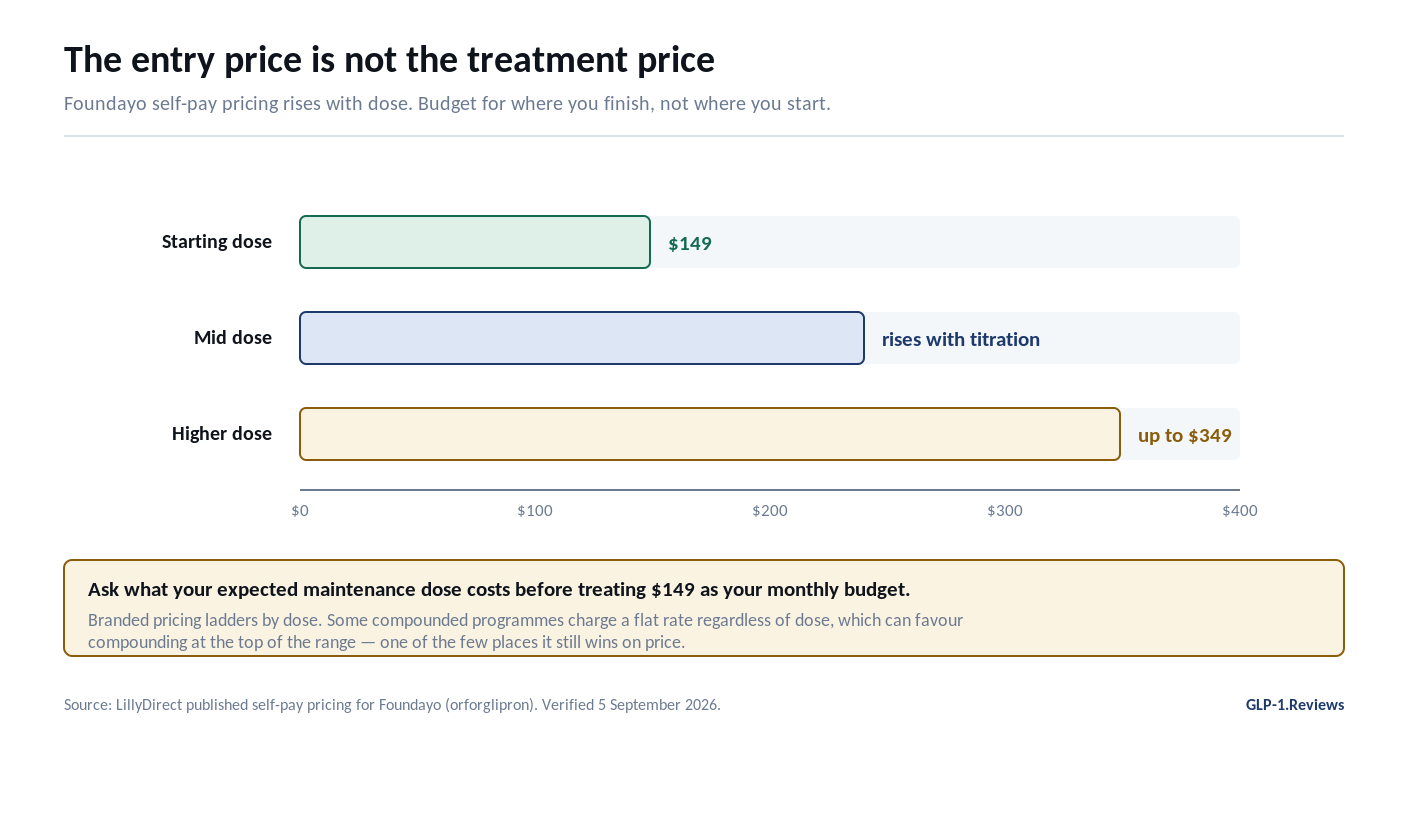
Branded pricing ladders by dose — Foundayo runs from $149 up to $299 at the higher doses. Compounded pricing sometimes does not, which can genuinely favour compounding at higher doses. Either way, the entry price is not the treatment price.
Check the manufacturer channel before assuming compounded is cheaper
This is the step almost nobody takes, because the 2023 comparison is still lodged in everyone’s head. LillyDirect and NovoCare publish their prices. Five minutes.
Price the continuity risk
If a compounded programme is $30 a month cheaper, ask what the provider’s plan is if the FDA finalises its proposal to exclude these substances from the 503B bulks list. A provider with a branded supply agreement can move you. One without may simply stop.
Every figure here is a cash-pay or manufacturer-direct price in the United States. If your insurance covers a GLP-1 with a modest copay, none of this comparison is your decision — take the covered route.
These are also planning figures, not quotes. Eligibility conditions apply to savings cards, dose ladders change what you pay, and manufacturer pricing has moved at least three times in twelve months. Verify against the manufacturer’s own page before deciding.
And cost is one input among several. A cheaper medication you cannot tolerate, or a programme without the clinical support you need, is not a saving.
Frequently asked questions
Is compounded semaglutide still cheaper than branded Wegovy in 2026?
Often, but by far less than before. Across the 28 core compounded programmes we score, the median all-in cost is $176 a month and 13 come in at or under $149. NovoCare Pharmacy lists Wegovy from $149.
So the cheap end of the compounded market still undercuts branded, the median is roughly a wash, and anyone with commercial insurance or Medicare coverage does better on branded. What is gone is the automatic, decisive price advantage that made this an easy decision.
Why did branded prices fall so much?
Manufacturers built direct-to-consumer channels that price against cash-paying patients rather than against insurance. LillyDirect and NovoCare Pharmacy sell without an insurer in the middle. For orforglipron specifically, low manufacturing cost as a small molecule makes an aggressive self-pay price sustainable rather than promotional.
What does “all-in” actually mean?
Membership or platform fee plus the medication itself, for one month, at a maintenance dose. It excludes labs you arrange separately, and it excludes anything a savings card covers only conditionally. When a provider quotes one number, ask which of those two components it is — that single question resolves most price confusion in this category.
Is the $149 Foundayo price the price I’ll keep paying?
Not necessarily. That is the self-pay price at the starting dose. Higher doses run substantially more, up to $299. Ask what your expected maintenance dose costs before treating $149 as your monthly budget.
Does Medicare cover any of this?
Through a temporary route. The Medicare GLP-1 Bridge has offered eligible Part D beneficiaries a $50 copay since 1 July 2026 and runs through 31 December 2027. It operates outside the standard Part D benefit, which has consequences most coverage does not explain: the deductible does not apply, the copay does not count toward true out-of-pocket costs, and the low-income subsidy does not apply to it.
Price was the easy question
For two years the honest answer to “why would I pay for branded?” was that many people could not. The price difference was large enough that the trade-offs barely needed debating.
That comparison has expired — not because compounded got expensive, but because branded got cheap. A branded oral GLP-1 at $149 a month self-pay, or $25 with a savings card, is not the same decision as $1,349 against $199.
Compounded is still the lower number for a large share of the market. It is simply no longer lower by enough to settle the question on its own. When two options sit within $25 a month of each other, the deciding factors become the ones price used to drown out: whether the supply has a lawful basis, and whether it will still be there when you reach your maintenance dose.
Price was the easy question. It has stopped being the important one.
Sources
- LillyDirect. Foundayo and Zepbound self-pay pricing. lilly.com, prices captured 5 Sep 2026.
- NovoCare Pharmacy. Wegovy injection and oral pricing. novocare.com, captured 5 Sep 2026.
- Eli Lilly and Company. FDA approves Lilly’s Foundayo (orforglipron), the only GLP-1 pill. Investor release, April 2026.
- Novo Nordisk. Wegovy pill now broadly available across America. Press release, 2026.
- Centers for Medicare & Medicaid Services. Medicare GLP-1 Bridge. cms.gov, accessed 5 Sep 2026.
- Hims & Hers Health, Inc. Announces Strategic Shift for US Weight Loss Business. Investor release, 9 Mar 2026.
- U.S. Food and Drug Administration. FDA clarifies policies for compounders as national GLP-1 supply begins to stabilize. fda.gov.
- U.S. Food and Drug Administration. FDA Proposes to Exclude Semaglutide, Tirzepatide, and Liraglutide on 503B Bulks List. 30 Apr 2026.
- GLP-1 Reviews. Mochi Health provider review — membership and medication pricing as published.
- New England Journal of Medicine. ATTAIN-1 trial results for orforglipron.
Medical disclaimer. This article reports published prices and manufacturer disclosures. It is not medical advice, does not recommend a medication or provider, and does not address dosing. Which GLP-1 is appropriate for you is a decision for a licensed healthcare provider who knows your medical history.
Pricing note. All figures verified 5 September 2026 against the manufacturer pharmacies and provider pages named above. Prices in this category have changed at least three times in the past twelve months. Confirm current pricing before making a decision.
Keep exploring our GLP-1 resources:



