The active molecule is the same. Almost nothing else is.
Wegovy has been through clinical trials, FDA review, and manufacturing under federally inspected controls. Its formulation is fixed, its stability is tested, and it arrives in a pre-filled pen where the dose is set by the device.
A compounded preparation has been through none of that. It has not been reviewed by the FDA for safety, effectiveness or quality. Its excipients and concentration may differ from the approved product. And it typically arrives as a vial and a syringe, which moves dose measurement from the manufacturer to you.
Not a knockoff. Not the same drug at a better price. Not a difference that shows up in how the injection feels.
That last difference is the one with documented harm attached. In a July 2024 safety alert the FDA reported dosing errors in which patients received five to twenty times the intended dose of compounded semaglutide, from confusion converting between milligrams, millilitres and units. Some cases required hospitalisation.
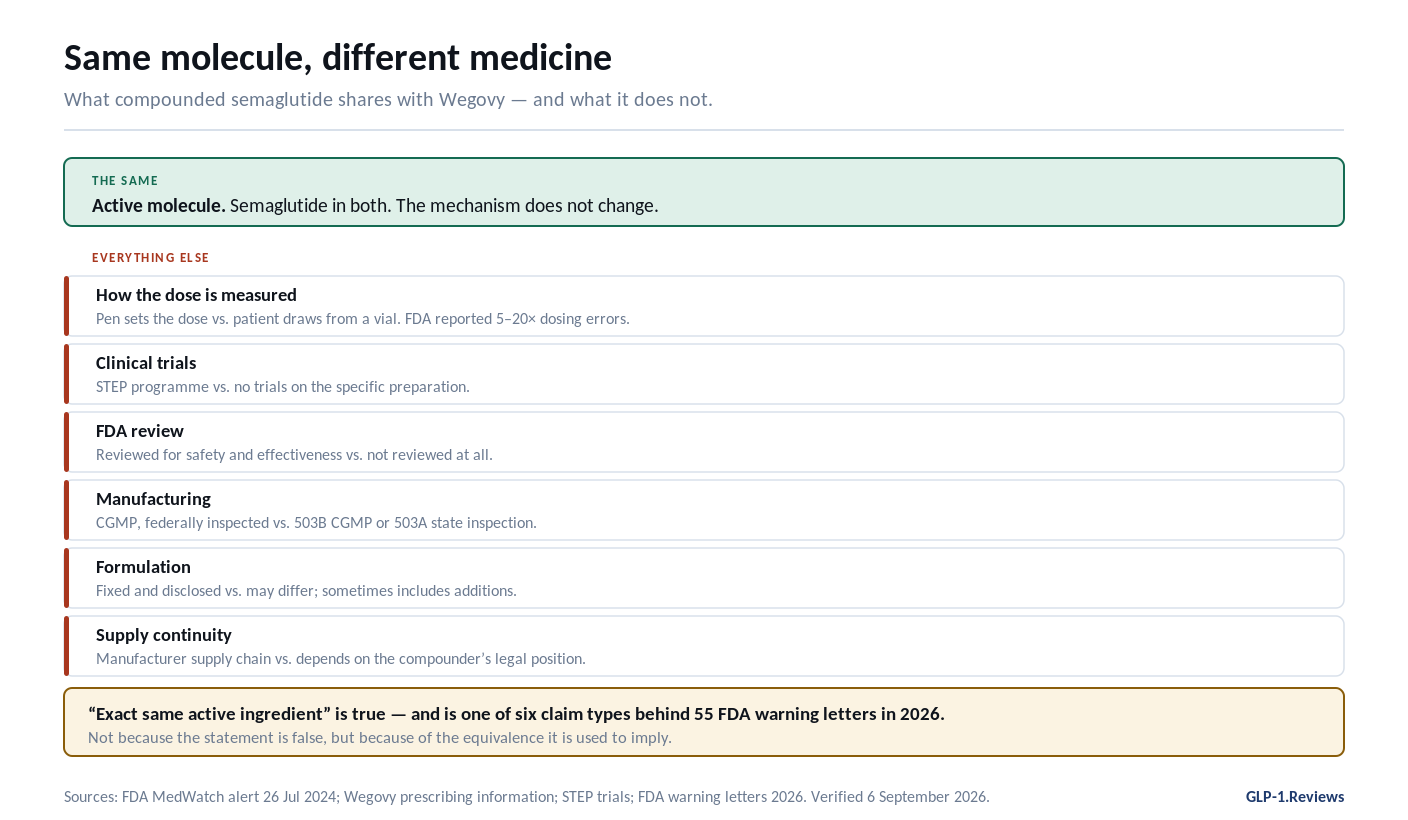
“Exact same active ingredient” is true, and it is doing a great deal of concealed work. It is also one of six claim types behind the 55 warning letters the FDA issued to telehealth companies in 2026 — not because the statement is false, but because of what it is used to imply.
What is genuinely the same
Worth establishing first, because dismissing the similarity would be as misleading as overstating it.
Semaglutide is semaglutide. It is a GLP-1 receptor agonist, and a compounded preparation using semaglutide base contains the same active molecule as Wegovy. The mechanism does not change because of who prepared it.
Patients on compounded semaglutide frequently lose weight. That is not surprising and it is not evidence that the products are equivalent — it is evidence that the molecule works, which nobody disputes.
The differences are in everything wrapped around the molecule, and those turn out to matter more than the equivalence argument suggests.
What differs, in order of how much it matters
How the dose gets measured
This is the difference with documented patient harm attached, and it is the one least discussed in marketing.
Wegovy is supplied in a pre-filled pen. The dose is set by the device. A patient cannot easily administer ten times the intended amount because the pen does not permit it.
Compounded semaglutide is typically supplied as a vial and a syringe. The patient draws up the dose. That requires converting a prescribed quantity into a volume on a syringe barrel, and the units involved — milligrams, millilitres, and syringe “units” — are not interchangeable.
On 26 July 2024 the FDA issued a safety alert about exactly this. It reported adverse events from patients and healthcare providers miscalculating doses, with patients receiving five to twenty times the intended dose. The agency attributed the errors to unfamiliarity with withdrawing medication from a vial and confusion between units of measurement. Reported effects included severe nausea and vomiting, severe hypoglycaemia, dehydration, fainting, gallstones and acute pancreatitis. Some cases required hospitalisation.
The FDA’s guidance to compounders was to supply an appropriate syringe for the intended dose and to counsel patients on measuring it. That is a mitigation, and it depends entirely on the compounder and prescriber doing it.
If you are using a vial-and-syringe product, the measurement instructions come from your prescriber and pharmacy. This article does not provide them, and no website should.
Clinical trial evidence
Wegovy’s approval rests on the STEP trial programme — thousands of participants, controlled conditions, published outcomes, and a safety database large enough to characterise uncommon adverse effects.
Those trials were conducted on the branded product as manufactured. A compounded preparation with different excipients, a different concentration and different manufacturing controls was not in them. The trial evidence transfers to the molecule; it does not transfer to a specific preparation nobody studied.
Which is why “clinically proven” applied to a compounded product is among the claim types the FDA has cited. The claim borrows evidence generated for a different product.
Manufacturing and stability
Approved drugs are manufactured under current good manufacturing practice, federally inspected, with stability testing establishing how long the product remains within specification and under what storage conditions.
Compounded preparations vary. A registered 503B outsourcing facility operates under CGMP and FDA inspection. A 503A pharmacy is inspected by its state board, and standards differ between states. Beyond-use dating for a compounded preparation is generally shorter and rests on different evidence than an approved product’s expiry.
Peptides are also less forgiving than small molecules. Semaglutide requires cold-chain handling, and degradation is not visible.
Formulation
Approved products have a fixed formulation. Compounded preparations may use different preservatives, buffers or concentrations, and some are marketed with additions such as vitamin B12.
Sometimes a formulation difference is the entire clinical justification — a patient reacting to an excipient in the commercial product is exactly the case compounding exists to solve. But a difference that exists across a whole product line was decided for a market, not for a patient.
Regulatory review
The simplest difference and the one most often obscured. Wegovy was reviewed by the FDA for safety and effectiveness. A compounded preparation was not, and cannot be — compounded drugs do not undergo FDA review as a category.
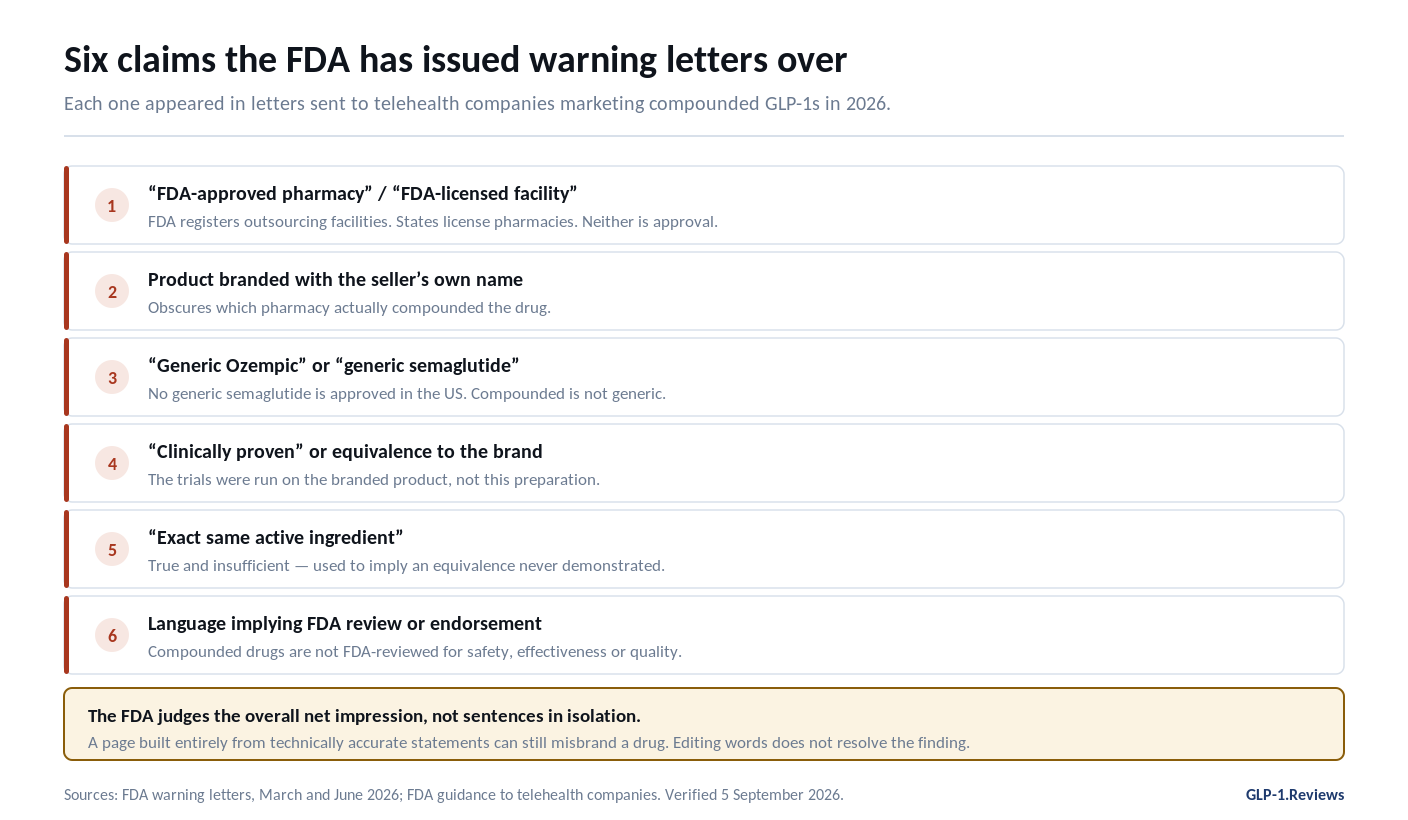
This is why “FDA-approved” and phrasing implying FDA review appear repeatedly in the 2026 warning letters. Registration of a facility is not approval of a product.
| Dimension | Wegovy (approved) | Compounded semaglutide | Why it matters |
|---|---|---|---|
| Active molecule | Semaglutide | Semaglutide | Genuinely the same |
| Dose measurement | Pre-filled pen, dose set by device | Usually vial and syringe, measured by the patient | FDA reported 5–20× dosing errors from unit confusion |
| Clinical trials | STEP programme, thousands of participants | None for the specific preparation | Trial evidence attaches to the product studied |
| FDA review | Reviewed and approved | Not reviewed for safety, effectiveness or quality | The claim most often blurred in marketing |
| Manufacturing | CGMP, federally inspected | 503B: CGMP. 503A: state inspection, varies | Depends entirely on which route |
| Formulation | Fixed and disclosed | May differ; sometimes includes additions | Can be the clinical justification, or a product feature |
| Supply continuity | Manufacturer supply chain | Depends on the compounder’s legal position | Enforcement can interrupt treatment |
The cost argument has weakened
For two years the trade-off was defensible on price alone. A compounded vial cost a fraction of a branded pen’s list price, and for patients without coverage there was no alternative.
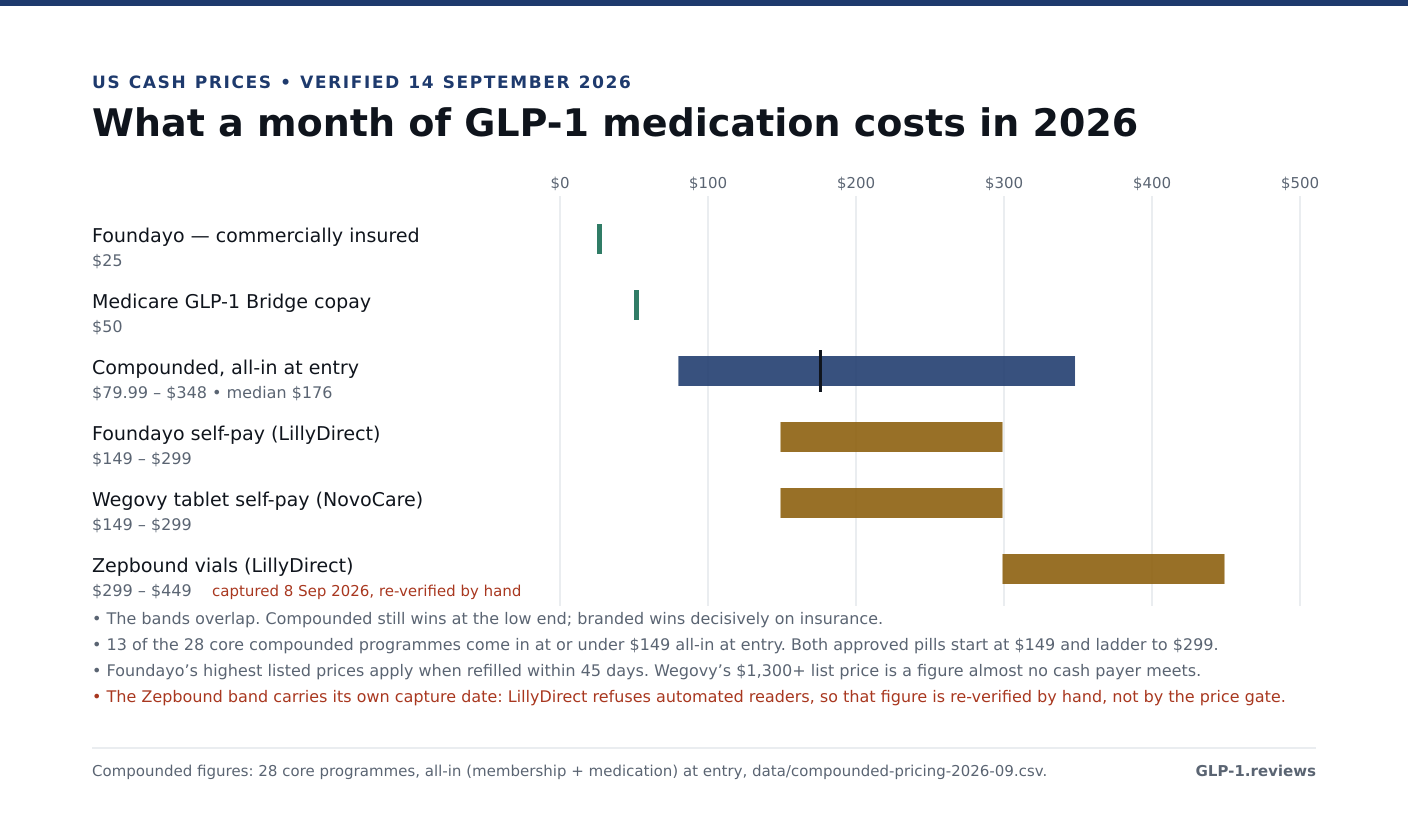
That gap has largely closed. Across the 28 core compounded programmes we score, all-in monthly cost — membership plus medication — runs from $79 to $348 with a median of $176. NovoCare Pharmacy lists Wegovy from $149. Thirteen of the 28 core compounded programmes come in at or under that.
Our provider reviews list which medications each platform prescribes; the Noom, LifeMD and Midi Health reviews cover programmes that offer Wegovy alongside compounded semaglutide, so this comparison is a live choice at intake rather than a hypothetical.
So compounded still wins at the low end and branded wins decisively for anyone with commercial coverage. Around the median the two are within about $25 a month of each other.
Which changes what the comparison is about. When the difference was several hundred dollars, weighing trial evidence and dose-measurement risk against affordability was a real dilemma. At $25 a month it is a different question, and the differences above start doing the deciding.
If your prescriber has determined that a compounded preparation is clinically necessary for you — a documented reaction to an excipient, or a dose the commercial product does not supply — this comparison does not describe your situation. That is the narrow lawful category, it is real, and the differences above are the reason it requires a clinical justification rather than a preference.
This is also not a reason to stop a medication that is working. If the dose-measurement risk concerns you, the useful step is asking your prescriber and pharmacy about it — not discontinuing.
And nothing here says compounded preparations are contaminated. Most are not. The differences described are about evidence, oversight and how the dose reaches you.
Frequently asked questions
If it’s the same molecule, why isn’t it the same drug?
Because a drug is not only its active molecule. It is a specific formulation, at a specific concentration, manufactured under specific controls, tested for stability, delivered by a specific device, and studied in trials that produced its labelling. Semaglutide is common to both. Everything that turns a molecule into a medicine is not.
Is compounded semaglutide less effective than Wegovy?
There is no head-to-head trial, so the honest answer is that nobody has measured it. The molecule is the same, so comparable results would not be surprising. What is missing is evidence about any particular preparation — potency, stability over its beyond-use period, and whether the delivered dose matches the intended one.
How common are the dosing errors the FDA described?
The FDA’s alert did not publish a rate, and it reflects voluntarily reported cases, which understate incidence. What the agency did report is severity: patients receiving five to twenty times the intended dose, with some cases requiring hospitalisation. The mechanism — converting between milligrams, millilitres and syringe units — is a foreseeable consequence of moving measurement from a device to a patient.
Do compounded pens exist, or is it always a vial?
Some compounders have supplied pen-type devices, but vial-and-syringe is the common presentation. If you are choosing, it is a reasonable thing to ask about, and the FDA’s own mitigation guidance was that compounders should supply an appropriate syringe and counsel patients on measuring the dose — which implies the measurement burden usually sits with the patient.
My provider says its compounded version is “exactly the same.” Is that a lie?
The molecule claim is accurate. The implication is what the FDA objects to — the agency evaluates the overall net impression rather than sentences in isolation, and “exact same active ingredient” is one of six claim types cited in the 2026 warning letters. It is true, incomplete, and used to suggest an equivalence that has not been demonstrated.
The molecule is the same. The medicine is not.
The equivalence argument survives only as long as nobody asks what else is in the box.
Wegovy arrives having been studied in thousands of people, manufactured under inspected controls, tested for stability, and packaged in a device that sets your dose. A compounded preparation arrives with the same molecule and none of that — and, usually, with the measurement left to you.
That was a trade many people made deliberately when it saved them a thousand dollars a month. At a $25 difference, it is worth asking what the saving is actually buying.
Sources
- U.S. Food and Drug Administration. FDA Alerts Health Care Providers, Compounders and Patients of Dosing Errors Associated with Compounded Injectable Semaglutide Products. MedWatch safety alert, 26 Jul 2024.
- U.S. Food and Drug Administration. FDA’s Concerns with Unapproved GLP-1 Drugs Used for Weight Loss. fda.gov, accessed 6 Sep 2026.
- Novo Nordisk. Wegovy (semaglutide) prescribing information.
- STEP clinical trial programme — published outcomes, New England Journal of Medicine and associated publications.
- U.S. Food and Drug Administration. FDA to Telehealth Companies: What to Know When Promoting Compounded Drugs. fda.gov.
- U.S. Food and Drug Administration. FDA warns 30 telehealth companies against illegal marketing of compounded GLP-1s. 3 Mar 2026.
- U.S. Food and Drug Administration. Human Drug Compounding and Compounding Laws and Policies. fda.gov.
- U.S. Food and Drug Administration. FDA clarifies policies for compounders as national GLP-1 supply begins to stabilize. fda.gov.
- NovoCare Pharmacy — Wegovy self-pay pricing, captured 5 Sep 2026.
- GLP-1 Reviews — compounded pricing dataset, data/compounded-pricing-2026-09.csv, derived 9 September 2026: 28 core programmes, all-in at entry. Metric definition, inclusion rule and per-provider rows are published in that file.
- Federal Food, Drug, and Cosmetic Act, sections 503A and 503B.
Medical disclaimer. This article compares regulatory, manufacturing and delivery differences between an approved medication and compounded preparations. It is not medical advice, does not recommend or discourage any medication, and does not provide dosing or measurement instructions. If you use a vial-and-syringe product, obtain measurement instructions from your prescriber and pharmacy. Do not start or stop any medication based on this article.
Regulatory status note. Verified against FDA safety communications and prescribing information on 6 September 2026. The FDA’s 503B bulks list determination was pending as of that date.
Keep exploring our GLP-1 resources: