Is Call-On-Doc legit and worth it?
Call-On-Doc is a real GLP-1 telehealth provider; we read its site and scored it 4.1/5 in our independent review (Strong Choice). It is best for self-directed patients who want fast, affordable access to both brand-name and compounded GLP-1 medications without scheduling hassles. Biggest plus: Brand-name FDA-approved medication options available. Watch-out: No lab testing included.
Scorecard: strongest in Access (4.7/5) and Cost & Value (4.6/5); weakest in Patient Protection (3.4/5) and Support (3.5/5).
Medications
Semaglutide, Tirzepatide, Microdose options, Brand-name options (as listed on its site, 7 April 2026); Oral semaglutide (oral, seen on its site 14 October 2026); Foundayo (oral, seen on its site 7 October 2026)
Monthly Cost
$199-$399 (as listed on its site, 7 April 2026)
Speed to Start
Fast
Prices and medications in this review are as listed on Call-On-Doc’s site on 7 April 2026, unless a line is marked otherwise, and have not been re-checked since. Note added 13 October 2026.
Corrected 14 October 2026: this review previously gave a Better Business Bureau rating or listing status. We kept no record of where it came from, so it has been removed. Trustpilot figures in this review are as recorded in April 2026 and have not been re-checked.
About Call-On-Doc
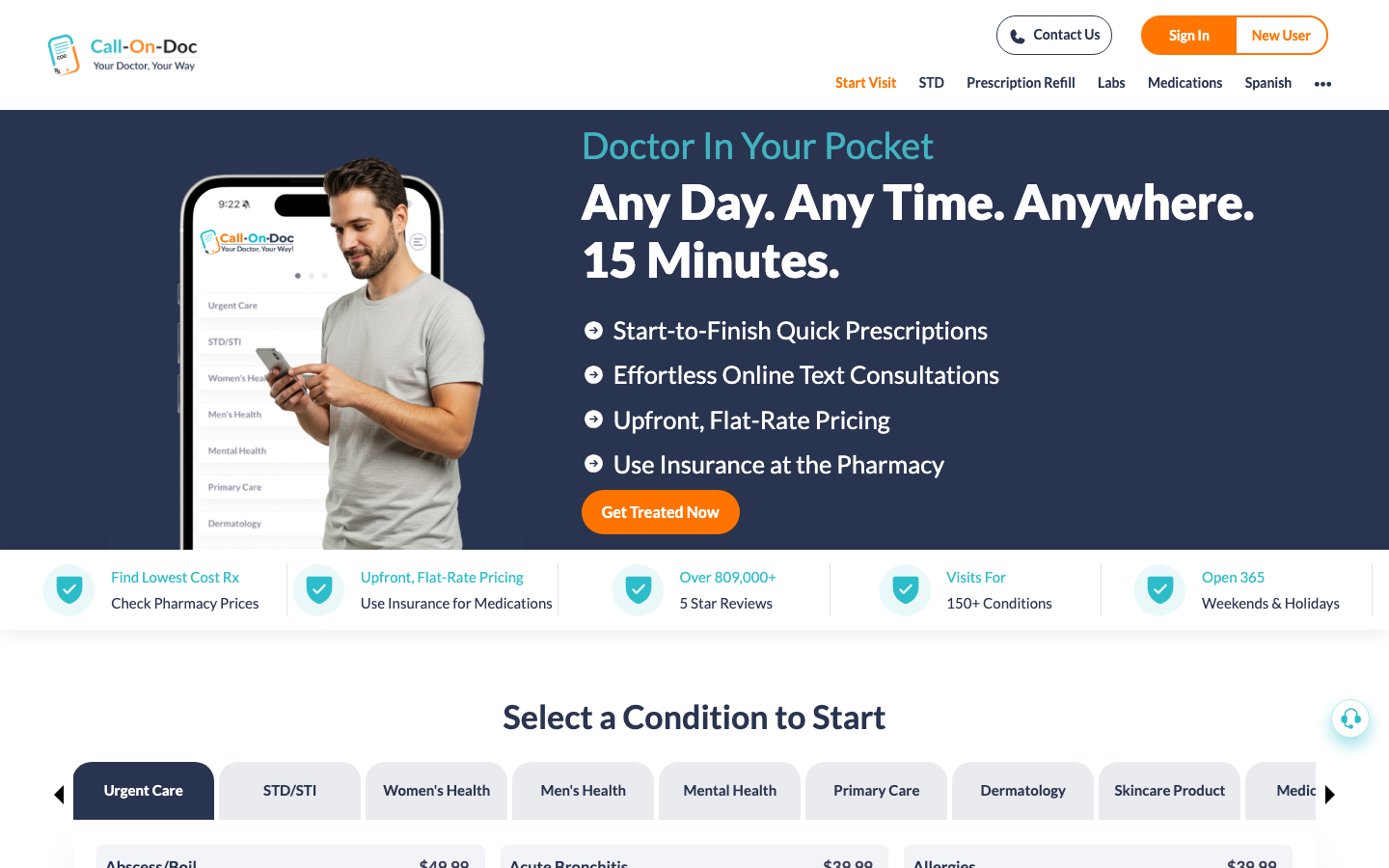
CallOnDoc is one of the more established players in the telehealth space, having been founded in 2017, well before the GLP-1 boom reshaped the industry. That head start shows in the numbers: the platform claims over 16,000 weight-loss success stories and has built a broad-spectrum telehealth operation that covers everything from UTI treatment to GLP-1 prescriptions. Their weight-loss program offers both brand-name and compounded semaglutide and tirzepatide, with unique microdose options for patients who want a gentler on-ramp, priced between $199 and $399.
The operational model is built for speed and convenience. CallOnDoc requires no appointments; patients complete an asynchronous questionnaire reviewed by a licensed provider, and prescriptions are typically processed the same day. For patients who dread video calls or have unpredictable schedules, this frictionless approach is a major selling point. The microdose option also deserves attention, as it allows patients prone to GLP-1 side effects like nausea to start at lower thresholds before titrating up.
Third-party trust signals are among the strongest in the telehealth weight-loss category. CallOnDoc holds a 4.4-star rating across 6,475+ reviews on Trustpilot. That combination of high review volume and strong star average places CallOnDoc in the top tier for verified patient trust among platforms we have evaluated.
The platform’s maturity also shows in its clinical infrastructure. With nearly a decade of telehealth operations, CallOnDoc has refined its prescription workflows, pharmacy partnerships, and patient communication systems in ways that newer startups simply have not had time to develop. Patients consistently report fast turnaround from intake to medication delivery, and the support team is generally responsive to dosing questions and refill issues.
Where CallOnDoc loses a fraction of a point is in personalized ongoing support. The no-appointment model is efficient but can feel transactional for patients who want regular check-ins, coaching, or dietitian access. If you value speed, affordability, and a proven track record over high-touch concierge care, CallOnDoc is hard to beat.
Call-On-Doc GLP-1 Medications
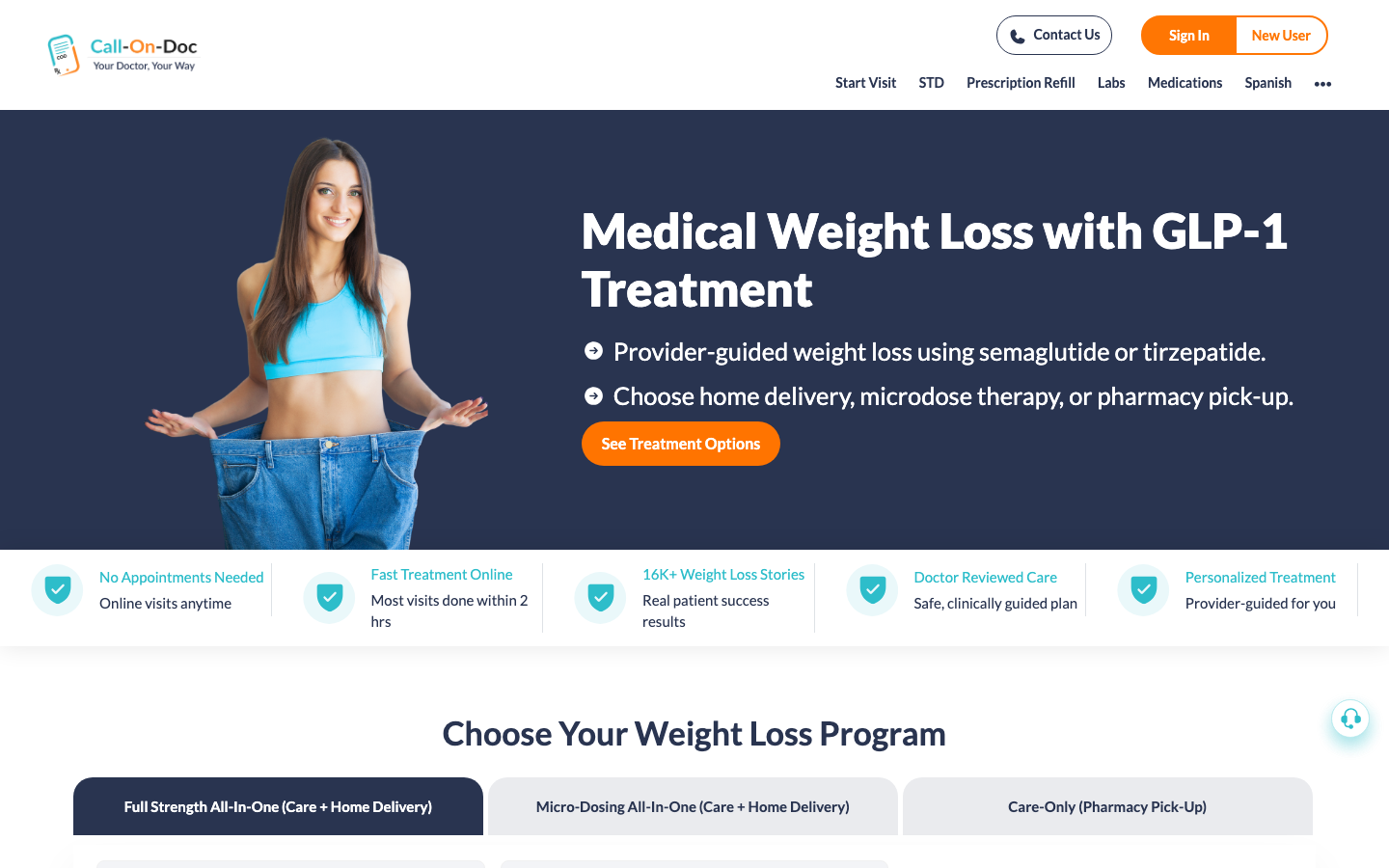 Screenshot of Call-On-Doc, captured by 10 April 2026
 Screenshot of Call-On-Doc, captured by 10 April 2026
At a Glance
Medications Offered
Semaglutide, Tirzepatide, Microdose options, Brand-name options (as listed on its site, 7 April 2026); Oral semaglutide (oral, seen on its site 14 October 2026); Foundayo (oral, seen on its site 7 October 2026)
Both
Cost & Insurance
- Monthly: $199-$399 (as listed on its site, 7 April 2026)
- 6-month estimate: $1,194-$2,394 (as listed on its site, 7 April 2026)
- Insurance: No
- Self-pay: Yes
Clinical Features
- Lab testing: No
- Dietitian access: No
- Pharmacies named: Licensed U.S. compounding pharmacies; specific partners not publicly named
Delivery & Access
- Format: Both (home delivery or pharmacy pick-up)
- Nationwide telehealth: Yes
- Speed: Fast
- Spanish-speaking providers: Not stated Corrected 13 October 2026: this line said “Not available”, but our research had recorded it as unknown.
Start your GLP-1 weight loss journey with Call-On-Doc today
Medical Disclaimer: This review is for informational purposes only and does not constitute medical advice. GLP-1 medications are prescription drugs that should only be used under the supervision of a licensed healthcare provider. Individual results may vary.
Editorial Independence: GLP-1.Reviews maintains full editorial independence. We read providers’ own pages and public records and publish what we find, with the date we checked.
Corrected 13 October 2026: this review showed a “Verified Provider” badge and said our scores were “based on verified data and standardized criteria”. Neither described a check we had done, so both have been removed.
What the Call-On-Doc Intake Looks Like
We walked through the Call-On-Doc intake ourselves, from the Demographic tab through an unusually thorough medical Questionnaire, a mandatory subscription authorization, a Digital Identity Verification step, and the final Checkout. The flow reads more like an HIPAA onboarding contract than a shopping quiz — 49 screens, roughly 10 minutes, and a $250 monthly subtotal pinned to the top the entire way.
Very strong. Dedicated family history MTC screen, Multiple Endocrine Neoplasia as a separate option, waist circumference capture (rare), self-reported BP, Suicidal Behavior and Ideation in the present-conditions list, comprehensive safety disclosure acknowledgment, Medication Disclosure Clause attestation, and a hard photo ID upload gate.
High. 49 screens, ID verification, an explicit e-signed subscription authorization with a $150 minimum chargeback fee, a Medication Disclosure indemnification clause, and a non-refundable-once-charged $250/month subscription. Credit card only — no Apple Pay / Google Pay / Affirm / Klarna at checkout.
The 9 Stages
Call-On-Doc’s “Which of these conditions are you presently experiencing?” multi-select includes Suicidal Behavior and Ideation as a selectable option alongside pancreatitis, seizures, and thyroid cancer. That’s rare in our catalog and clinically meaningful — GLP-1 medications carry an ongoing suicidal-ideation signal in post-marketing surveillance, and surfacing it as a structured gate in the intake (rather than burying it in a general “anything else?” field) helps the clinician triage the case before prescribing.
Call-On-Doc is one of very few platforms in our catalog that captures waist circumference in inches as a structured signal (most skip it entirely in favor of BMI alone). Pair that with self-reported blood pressure ranges, a stand-alone family history of medullary thyroid carcinoma screen, and Multiple Endocrine Neoplasia Syndrome as a separate option in the present-conditions multi-select, and the intake handles the FDA black-box + obesity-medicine basics more thoroughly than most compounded-GLP-1 peers.
Toward the end of the Questionnaire tab, Call-On-Doc requires a hard Digital Identity Verification step — front and back of a driver’s license or government-issued ID, via an Upload It or Snap It flow. This puts Call-On-Doc alongside MyStart Health as one of only two platforms in our catalog that hard-gate on photo ID verification before prescribing. It’s meaningful protection against intake-form abuse and identity fraud.
Call-On-Doc’s subscription authorization, financial responsibility agreement, cancellation policy, and pause-and-resume language is more contract-like than any other intake we’ve audited. The patient e-signs an authorization to charge $250/month that explicitly states subscription fees are non-refundable once charged, the plan auto-renews until cancelled inside the patient portal, and any chargeback triggers a minimum $150 collection fee plus potential legal costs. The Medication Disclosure Clause requires the patient to indemnify and hold Callondoc and its employees harmless for non-disclosure of current medications. Read carefully — these are real contractual obligations, and the chargeback and indemnification clauses have teeth.
No validated PHQ-2 or PHQ-9 depression instrument (suicidal ideation is captured as a present-condition multi-select option instead), no dedicated eating disorder screen, no dedicated substance use or alcohol screen (substance use is covered only by the Medication Disclosure Clause attestation — an indemnification-style certification rather than a structured gate), no structured current medications list (the patient attests they are not taking any medications rather than enumerating them), and no Apple Pay / Google Pay / Affirm / Klarna payment options at checkout (credit card only). No phone OTP beyond the general phone number collection.
Source: GLP-1.Reviews editorial walkthrough on April 14, 2026. We completed every screen of the Call-On-Doc weight-loss intake using a representative GLP-1 candidate persona and stopped before submitting payment and the ID upload.
Opens callondoc.com in a new tab. We may earn a commission if you start treatment through this link, at no additional cost to you.