Is Teladoc Health legit and worth it?
Teladoc Health is a real GLP-1 telehealth provider; we read its site and scored it 4.3/5 in our independent review (Strong Choice). Biggest plus: Brand-name FDA-approved medication options available. Watch-out: Low Trustpilot rating (2.2).
Scorecard: strongest in Clinical Quality (5.0/5) and Authenticity (5.0/5); weakest in Reputation (2.2/5) and Cost & Value (3.8/5).

Medications
Wegovy, Zepbound, Ozempic, Mounjaro (as listed on its site, 7 April 2026)
Monthly Cost
$99-$299 (as listed on its site, 7 April 2026)
Speed to Start
Moderate
Prices and medications in this review are as listed on Teladoc Health’s site on 7 April 2026, unless a line is marked otherwise, and have not been re-checked since. Note added 13 October 2026.
Corrected 14 October 2026: this review previously gave a Better Business Bureau rating or listing status. We kept no record of where it came from, so it has been removed. Trustpilot figures in this review are as recorded in April 2026 and have not been re-checked.
Est. 2002
About Teladoc Health
Teladoc Health is the largest telehealth platform in the United States, founded in 2002 and publicly traded on the NYSE. Its entry into the GLP-1 weight-management space carries a level of institutional credibility that no startup can replicate. Teladoc prescribes brand-name medications exclusively, including Wegovy, Zepbound, Ozempic, and Mounjaro, with program costs ranging from $99-$299 depending on the plan tier and whether insurance is applied.
The clinical infrastructure behind Teladoc’s GLP-1 program is arguably the most robust in the telehealth category. Patients receive access to board-certified providers, registered dietitians, and structured behavioral health support. The platform also serves employer-sponsored wellness programs, meaning millions of Americans may have access to Teladoc’s weight-management services through their workplace benefits. Spanish-speaking providers are available, expanding accessibility for Hispanic and Latino patients who are disproportionately affected by obesity and type 2 diabetes.
Teladoc’s third-party review profile is unusual. The company holds a B rating with the Better Business Bureau, consistent with a large-scale operation that handles complaints through formal channels. However, its Trustpilot rating sits at just 2.2 stars across a very small sample of 9 reviews. Our editorial team attributes this primarily to the fact that Teladoc’s massive user base does not funnel feedback through Trustpilot; the company’s internal review systems and employer program satisfaction surveys provide a more representative picture.
The brand-name-only formulary is both a strength and a limitation. Patients get FDA-approved medications with full clinical trial backing, manufacturer support programs, and insurance billing pathways. However, patients without insurance coverage for GLP-1 medications may face significantly higher out-of-pocket costs compared to compounded alternatives available through smaller telehealth platforms. Teladoc does not offer compounded GLP-1s.
Our editorial team views Teladoc Health as the institutional gold standard for telehealth-based GLP-1 prescribing. The combination of 20+ years of operational history, dietitian access, employer program integration, and brand-name-only prescribing creates a level of clinical rigor and accountability that is unmatched. The higher cost floor is the tradeoff, but for patients with insurance coverage or employer benefits, that gap narrows considerably.
Teladoc Health GLP-1 Medications
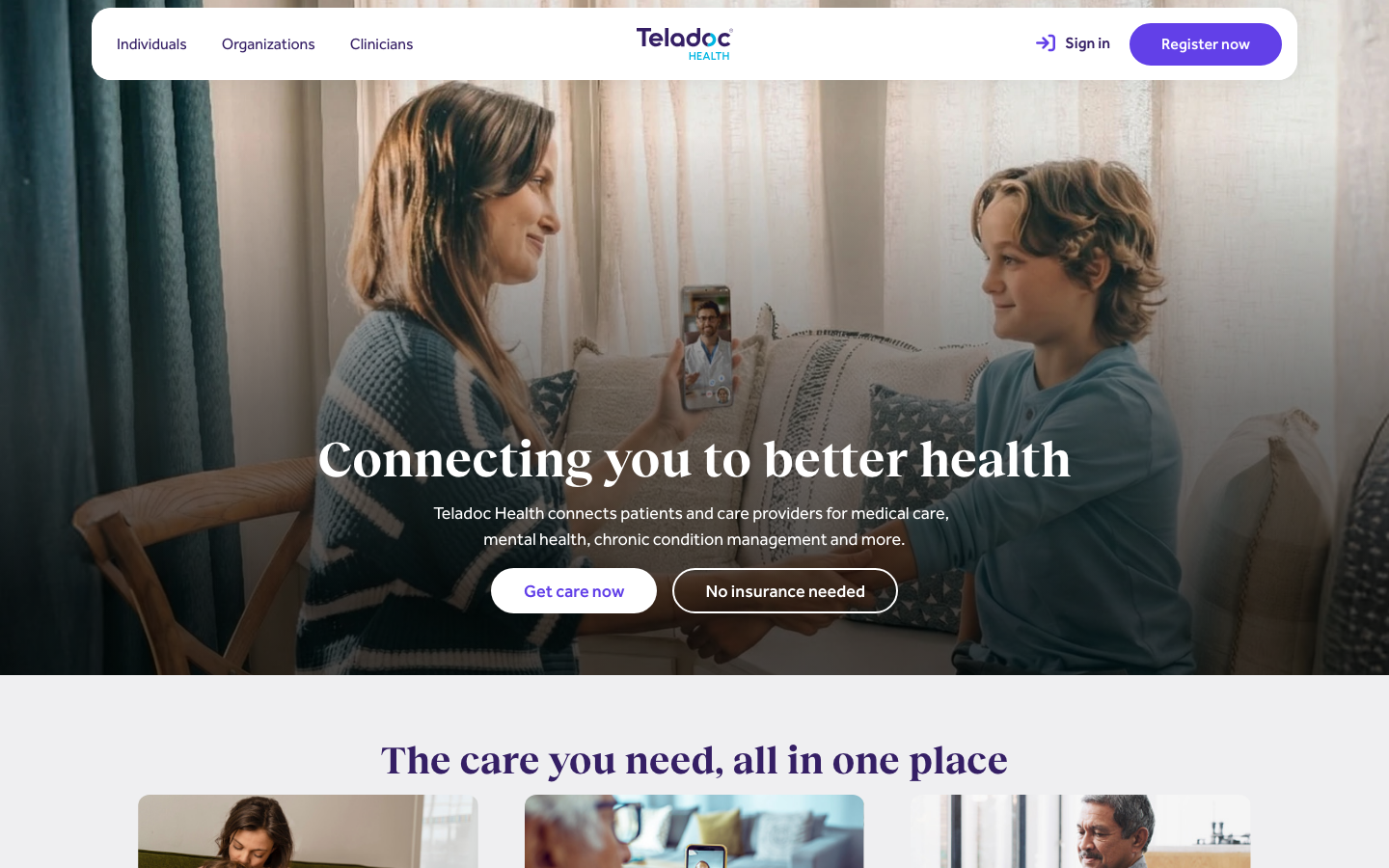
 Screenshot of Teladoc Health, captured by 10 April 2026
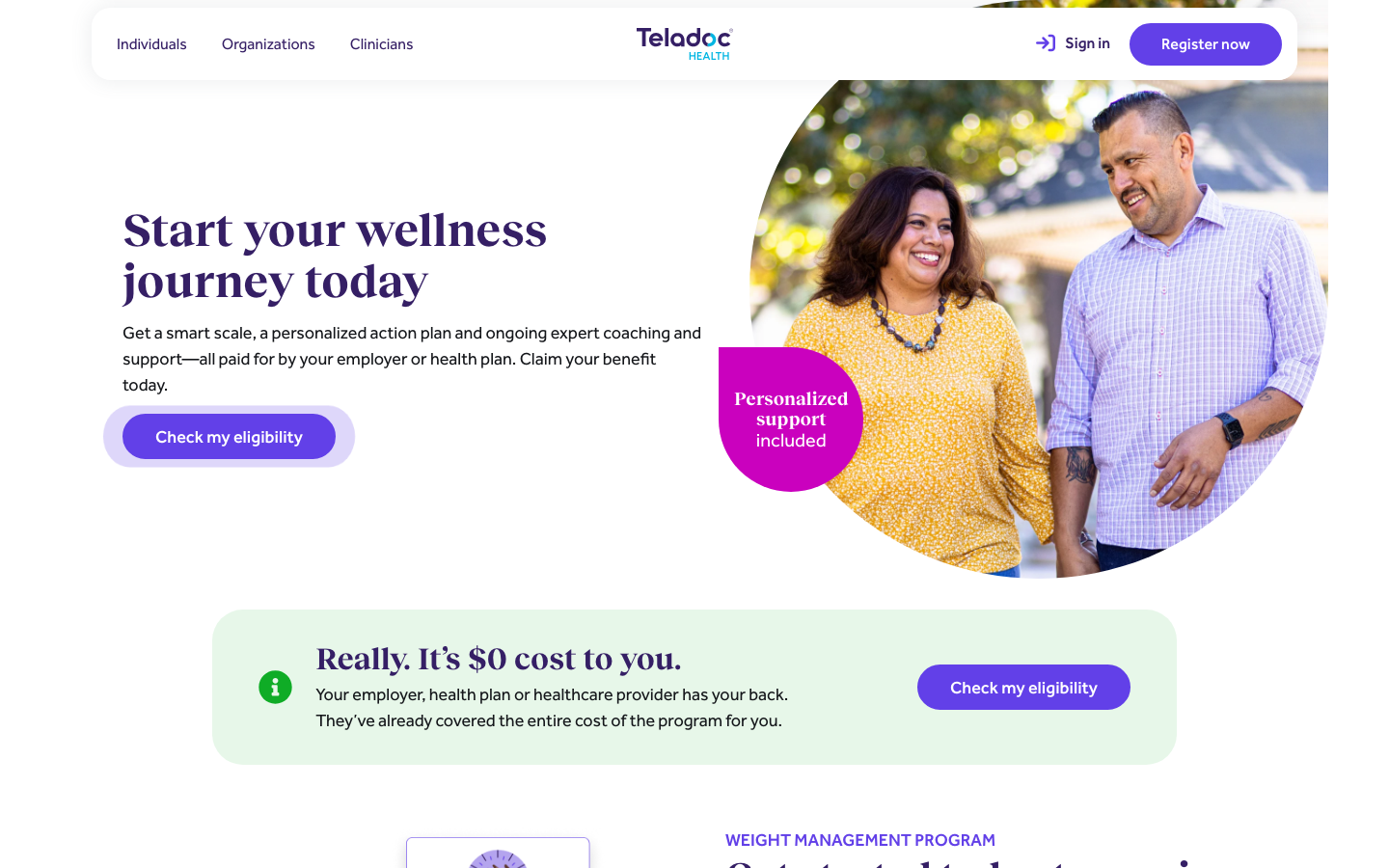
 Screenshot of Teladoc Health, captured by 10 April 2026
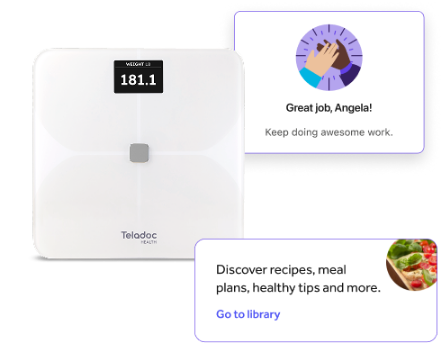
 Screenshot of Teladoc Health, captured by 10 April 2026
 Screenshot of Teladoc Health, captured by 10 April 2026
 Screenshot of Teladoc Health, captured by 10 April 2026
At a Glance
Medications Offered
Wegovy, Zepbound, Ozempic, Mounjaro
Brand-Name
Cost & Insurance
- Monthly: $99-$299 (as listed on its site, 7 April 2026)
- 6-month estimate: $594-$1,794 (as listed on its site, 7 April 2026)
- Insurance: Employer / health-plan program dependent
- Self-pay: No clear national direct-to-consumer self-pay program identified
Clinical Features
- Lab testing: Not stated Corrected 13 October 2026: this line said “No”, but our research had recorded lab testing as variable, not absent. A con that repeated it has been removed or reworded.
- Dietitian access: Yes
- Pharmacies named: N/A — Brand-name only (Wegovy, Zepbound, Ozempic, Mounjaro); employer programs
Delivery & Access
- Format: Subcutaneous
- Nationwide telehealth: State and program dependent
- Speed: Moderate
- Spanish-speaking providers: Yes
Medical Disclaimer: This review is for informational purposes only and does not constitute medical advice. GLP-1 medications are prescription drugs that should only be used under the supervision of a licensed healthcare provider. Individual results may vary.
Editorial Independence: GLP-1.Reviews maintains full editorial independence. We read providers’ own pages and public records and publish what we find, with the date we checked.
What the Teladoc Health Intake Looks Like
Teladoc Health is fundamentally different from the purpose-built GLP-1 funnels that dominate this catalog. There is no GLP-1 landing page, no “Compounded Semaglutide $199” product tile, no weight-loss-specific questionnaire, and no pre-selected subscription bundle at checkout. Instead, the public intake is a general-purpose telemedicine registration — account creation, insurance coverage capture, a comprehensive primary-care medical history, and then a live phone or video visit with a licensed clinician. GLP-1 assessment happens during the live visit itself, not during the intake.
Corrected 13 October 2026: this review showed a “Verified Provider” badge and said our scores were “based on verified data and standardized criteria”. Neither described a check we had done, so both have been removed.
Mid-range for GLP-1 safety gating — but with a very important caveat. The general primary-care medical history Teladoc collects is genuinely thorough (tobacco and alcohol use toggles, long Health Problems checklist including anxiety and panic attacks, family history checklist, past surgeries, medications, allergies). What it does not ask in the public intake is any GLP-1-specific safety question — no dedicated MTC/MEN-2 family history, no PHQ-2 depression instrument, no eating-disorder screen, no pregnancy or breastfeeding check. All of that is deferred to the live phone or video visit with the clinician.
Moderate-low. 17 screens across four stages, roughly six minutes if done in one sitting. Full account creation is required upfront, which is the main friction. What’s absent is the subscription-commerce machinery — no countdown timers, no pre-selected monthly auto-renew bundle, no “Lowest Price Ever!” banners. The visit fee is $89 per visit with “Add a card” or PayPal, charged after the visit, and the whole relationship is visit-by-visit rather than a recurring subscription.
The 4 Stages
The Lifestyle section of the medical history form has two explicit toggle switches: “Do you smoke / use tobacco?” and “Do you drink alcohol?” These are rare in purpose-built GLP-1 shopping funnels, which usually skip substance questions entirely and defer them to the clinician. Teladoc surfaces them as a standard part of the general medical history, which means they are collected before the first visit with any clinician.
Unlike the shopping-funnel model where the patient answers a long questionnaire up-front and then receives an async provider review, Teladoc’s model is the opposite: the intake collects general medical history, and the actual clinical decision-making happens during a live phone or video visit with a licensed clinician. For a patient interested in a GLP-1 prescription, that means the FDA black-box family-history questions, the pregnancy status check, the eating-disorder screen, the pancreatitis and gallbladder history, and the mental-health review are all asked during the actual visit by the clinician — not pre-committed on a form. That is how traditional telemedicine has always worked and it is arguably a stronger safety model than reading a pre-committed online questionnaire with no follow-up clarification. The trade-off is that the $89 visit fee is committed before the clinician has seen any information.
The very first post-registration screen is “Add your coverage”, with fields for insurance company and member ID. Self-pay is offered as the fallback via a “No insurance coverage? You can also pay per visit” link beneath the form — the opposite of the compounded-GLP-1 shopping funnels that are cash-pay by default and treat insurance either as an afterthought or as a disqualifier. For patients whose employer plans include Teladoc as a telehealth benefit (which is common in large employer plans), the visit may be free or a modest copay rather than the $89 self-pay rate. Worth checking your benefits portal before registering.
The payment screen says “This visit will cost $89.00 — You’ll be charged after the visit. You may find a small validation hold on your bank statement that will go away.” There is no monthly subscription, no pre-selected multi-month prepay plan, no “$100 off” discount framing, and no countdown timer pressuring the patient to commit. Each visit is billed individually — the patient can return for a follow-up visit, schedule a different type of visit, or not return at all, without any auto-renew consequences. That fee structure also means a patient who wants to discuss GLP-1 options can book a single $89 General Medical visit, have the conversation, and walk away with a prescription routed to a local pharmacy of their choice, without committing to a multi-month program.
Anyone looking for a “Compounded Semaglutide” product tile, a weight-loss questionnaire, or a pricing sheet for GLP-1 medications inside the Teladoc intake will not find one. The visit-type selector on Stage 4 lists exactly four options: General Medical, Mental Health, Dermatology, and Nutrition. A patient interested in a GLP-1 prescription would choose General Medical and discuss it with the clinician during the live visit — the prescribing decision and the medication pricing are then handled between the clinician and whatever pharmacy fills the prescription. That also means Teladoc is not the right fit for a patient who specifically wants compounded semaglutide or tirzepatide at a cash-only subscription price; the Teladoc model is a traditional prescription routed to a traditional pharmacy and dispensed at that pharmacy’s price.
The Teladoc medical history form does not ask a dedicated family-history MEN-2 or medullary thyroid cancer screen, does not ask the eating-disorder question, does not ask pregnancy or breastfeeding status, does not include a validated PHQ-2 depression instrument (anxiety and panic attacks are on the Health Problems checklist, but not the standard “past 2 weeks” screening items), and does not capture blood pressure or resting heart rate. These are all legitimate questions for a GLP-1 prescribing conversation, and a patient should expect the clinician to raise them during the live visit. For anyone who has a complicated mental-health history, is pregnant or planning pregnancy, or has a family history of endocrine cancer, being prepared to answer these questions verbally during the first visit is worth thinking about in advance.
Source: GLP-1.Reviews editorial walkthrough on April 15, 2026. We completed the public Teladoc Health registration, medical history, and visit request flow and stopped before authorizing the $89.00 General Medical visit payment.
Opens teladochealth.com in a new tab. We may earn a commission if you start treatment through this link, at no additional cost to you.