
Neither drug is approved by the FDA. That single fact settles it.
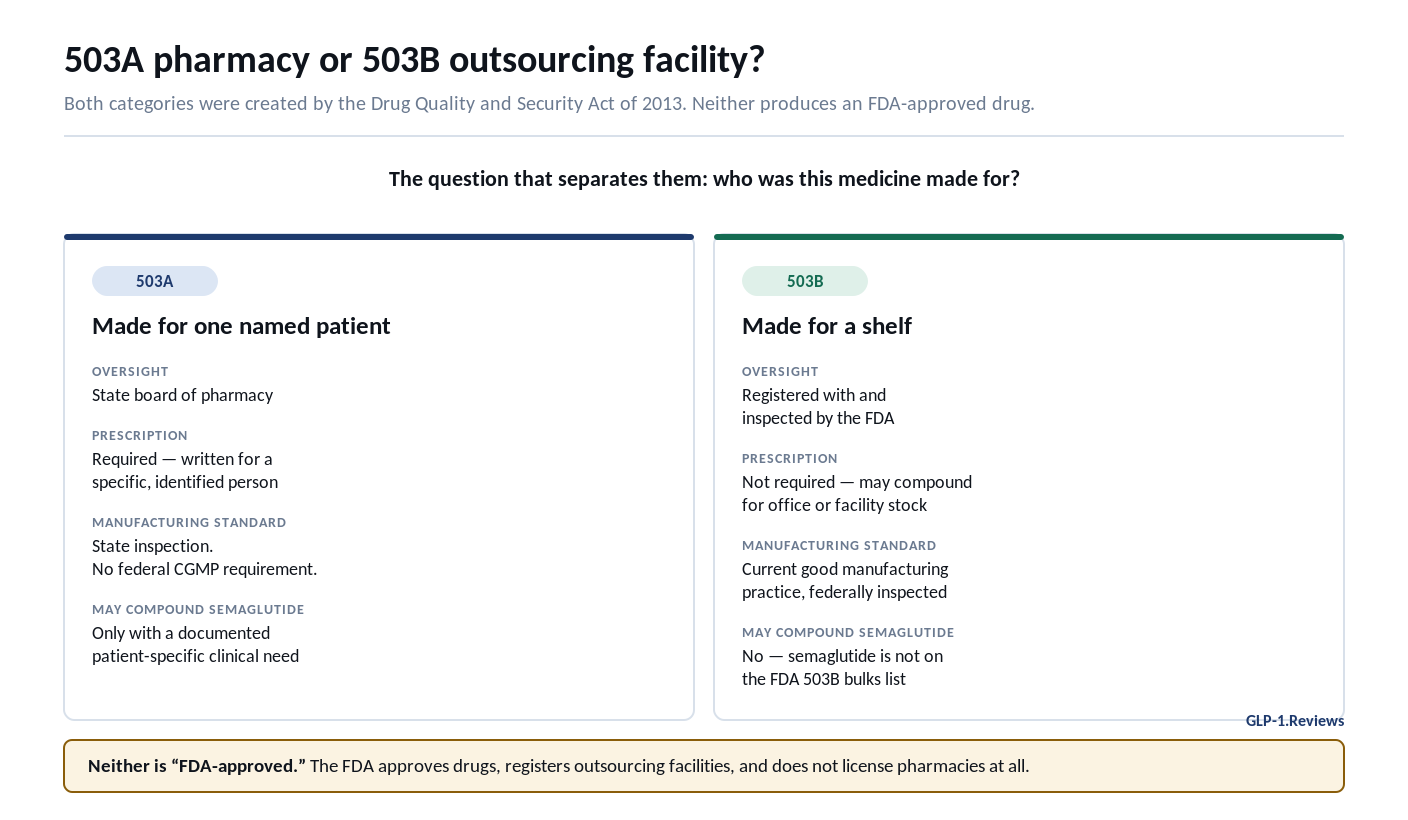
Compounding law is built on approved medicines. A 503A pharmacy compounds a preparation for an individual patient, and the rules about what it may and may not copy are written in relation to commercially available approved products. A 503B outsourcing facility may compound in bulk only from substances on the FDA’s approved bulks list. An unapproved investigational drug is in neither category.
Not a grey area. Not a shortage question. Not something a documented clinical need can authorise.
The FDA says it in one sentence: “Retatrutide and cagrilintide cannot be used in compounding under federal law.” (FDA, concerns with unapproved GLP-1 drugs used for weight loss, updated 1 September 2026.)
The shortage exception, which made compounded semaglutide lawful for a period, cannot apply here either — a drug that has never been approved has never been in shortage in the regulatory sense, because there is no approved supply to fall short.
Framing these substances as “research peptides” or “not for human consumption” does not create an exemption. It relabels the sale.
We checked. In September 2026 we read all 76 providers in our directory in a browser with JavaScript running, searching visible text and page source for retatrutide, cagrilintide, survodutide and mazdutide. Zero are offering any of them. That is a genuinely reassuring finding about this directory, and it is not a statement about the wider market, where these substances are sold.
What these two drugs are
Retatrutide is an investigational Eli Lilly molecule acting on three receptors rather than one or two. It has produced striking results in trials and it is not approved. Lilly said on 23 July 2026 that it plans to submit its application to the FDA in the first quarter of 2027, later than it had first guided, to gather more manufacturing and quality data (CNBC, 23 July 2026; Lilly, what to know about retatrutide). A submission is the start of a review rather than the end of one.
Cagrilintide is a Novo Nordisk molecule, an amylin analogue, developed principally in combination with semaglutide as CagriSema. Novo Nordisk submitted that combination to the FDA on 18 December 2025 and has said it expects a decision by late 2026 (Novo Nordisk, 18 December 2025). It is also not approved, and a decision could arrive while this page is live, which is why the date at the top of it matters.
Both appear constantly in coverage of what is coming next, which is why they turn up in search and occasionally in marketing. Neither can lawfully be compounded, and the reason is the same for both.
Submitted is not approved
The distinction matters because the language blurs it. A company announcing a regulatory submission is announcing that it has asked. Review takes time, can end in approval, rejection, or a request for more data, and until it concludes the drug is investigational.
An investigational drug may be given to people only in a clinical trial, under an investigator’s protocol and with informed consent. That is the lawful route, and it is not a purchase.
Why the compounding provisions do not reach them
Both compounding pathways start from an approved product, and neither has a door for a drug that has never had one. Two directory providers own the pharmacies at each end of this: Eden owns a 503A pharmacy and Hims & Hers owns a 503B outsourcing facility, and neither pathway reaches an unapproved drug.
| Route | What it permits | Why it cannot apply |
|---|---|---|
| 503A patient-specific | Compounding for an identified patient, with limits on copying commercially available approved drugs | The framework presumes an approved product to compound or to differ from. There is no approved retatrutide or cagrilintide. |
| 503B bulk compounding | Compounding from substances on the FDA’s approved bulks list | Neither substance is on the list. Nomination is a formal process and neither has completed it. |
| Shortage exception | Compounding a drug on FDA’s shortage list | A drug that was never approved cannot be in shortage. There is no approved supply to fall short. |
| Documented clinical need | A prescriber determining a change produces a significant difference for a patient | That provision governs how a compounded version may differ from an approved drug. It does not authorise compounding an unapproved one. |
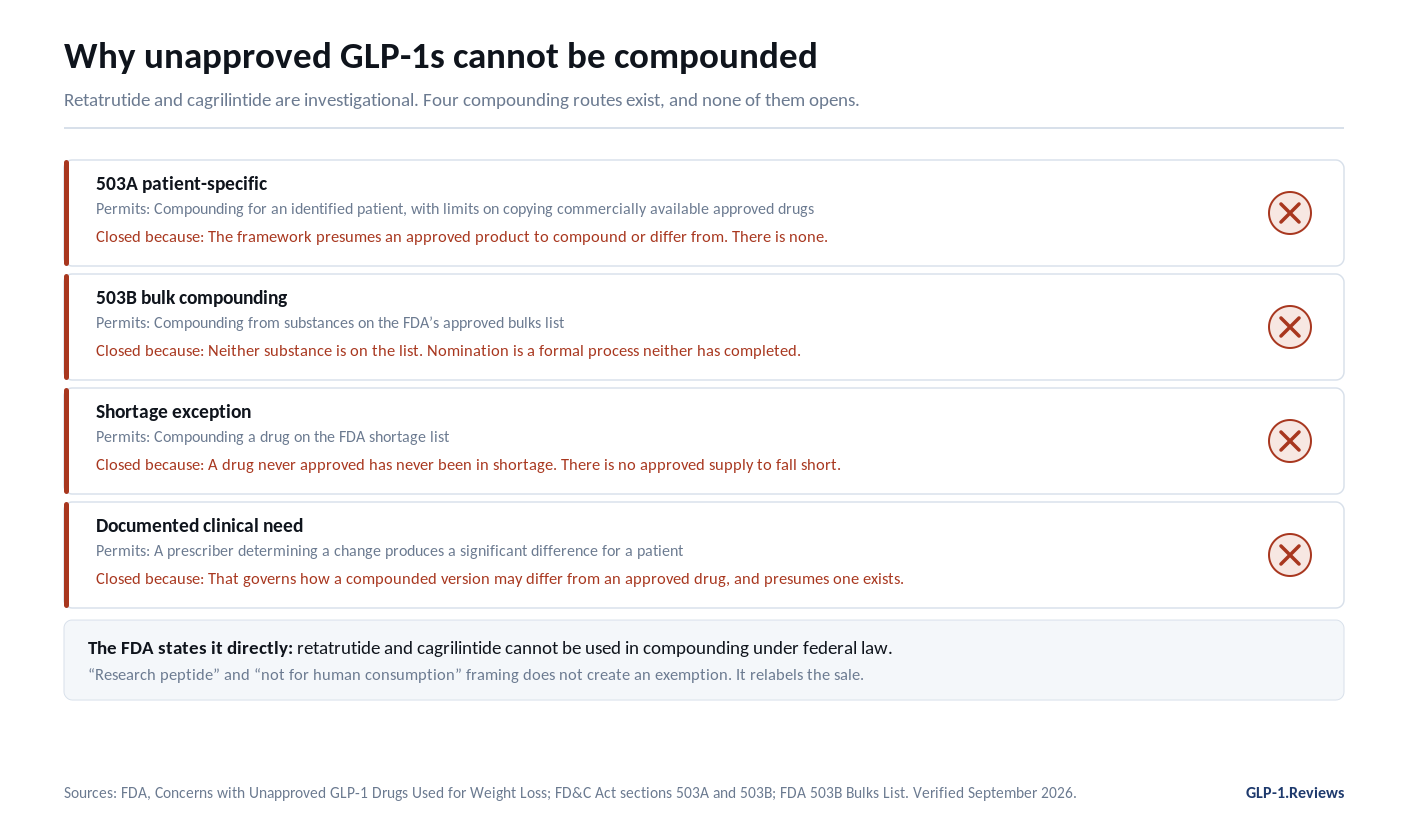
Four routes, four different reasons, one destination. This is unusual — most questions in this category have arguable edges, and this one does not.
The “research peptide” framing
Where these substances are sold to consumers, they are usually sold with a disclaimer: research use only, not for human consumption, for laboratory purposes.
That framing does not change what the sale is. A vial marketed with a label saying it is not for human use, sold at a consumer dose, to a consumer, with dosing information adjacent, is being sold for human use. The disclaimer is positioned as a legal shield rather than a description.
It also removes every protection a patient might otherwise have. There is no prescriber accountable for the decision, no pharmacy accountable for the preparation, no approved labelling, and no adverse-event pathway. If something goes wrong, the product was sold to you on the stated basis that it was never intended to enter a human body.
What we found, and what it does not cover
Because we maintain a directory, we could check rather than assume.
In September 2026 we read all 76 provider sites in a real browser with JavaScript executing, searching both visible text and page source for retatrutide, cagrilintide, survodutide and mazdutide. No provider in our directory offers any of them.
Two findings sit alongside that. One provider’s page source contained a scaffolded page for retatrutide that returns “we can’t find the page” and appears nowhere in the rendered site or any sitemap — a content-management artefact rather than an offer. Another mentions retatrutide only in an internal routing map for its own editorial articles.
Two caveats, because the number is only worth what its method is worth. Two sites block automated browsers and were read from their static HTML. And a marketplace platform cannot show what every independent practice using it might prescribe; we did not enter booking flows.
We record this as a dated checked negative and re-run it monthly, because the finding that matters is not that nobody offered these in September. It is whether that changes.
If you are enrolled in a clinical trial of retatrutide or CagriSema, none of this concerns you. Trial participation is the lawful route to an investigational drug, with a protocol, monitoring and informed consent behind it.
This also does not apply to approved medications. Semaglutide, tirzepatide and the approved oral GLP-1s are approved drugs, and questions about compounding them are different questions with genuinely arguable answers.
And if either drug is approved in future, this article changes. Approval would move them into the framework that currently has no door for them, and we will update rather than leave a stale page.
Frequently asked questions
Could a pharmacy compound retatrutide if a doctor prescribed it?
No. A prescription does not create authority to compound an unapproved drug. The clinical-need provision governs how a compounded preparation may differ from an approved product — it presumes an approved product exists. Retatrutide has none, so there is nothing for the provision to operate on.
What about buying it as a research peptide?
That is a purchase of an unapproved drug with a disclaimer attached. The disclaimer protects the seller’s framing, not the buyer. You get no prescriber, no pharmacy accountability, no approved labelling, no adverse-event route, and no recourse — because the product was sold to you on the express basis that it was not for human use.
CagriSema has been submitted to the FDA. Doesn’t that count for something?
It counts as a submission. Review can end in approval, rejection or a request for more data, and until it concludes the drug is investigational and cannot be compounded or lawfully sold for use. Announcements about submissions are frequently reported in ways that blur this.
Is any provider on your site offering these?
No. We checked all 76 in September 2026 in a browser with JavaScript running, searching visible text and page source, and found none. Two sites block automated browsers and were read statically, and we cannot see what independent practices on marketplace platforms might do. We re-run the check monthly.
If retatrutide is approved, will it be compoundable then?
Approval would move it into the framework — but into the same position semaglutide occupies, not into a permissive one. A newly approved drug that is commercially available is precisely what the essentially-a-copy prohibition is written about, and it would not appear on the 503B bulks list without going through nomination.
The clearest line in a category full of grey ones
Most compounding questions here are genuinely arguable. Whether a particular preparation is essentially a copy, whether a documented clinical need was properly recorded, whether a shortage had truly resolved on a given date — reasonable people have litigated these.
This is not one of those. An unapproved drug has no compounding pathway, and no amount of paperwork, prescriber involvement or disclaimer language creates one.
Which makes it a useful test. A seller offering retatrutide or cagrilintide has not found a clever reading of an ambiguous rule. It has stepped outside a rule with no ambiguity in it — and that tells you what to expect about everything else it sells.
Sources
- U.S. Food and Drug Administration — Human Drug Compounding and Compounding Laws and Policies. fda.gov, accessed 8 Sep 2026.
- U.S. Food and Drug Administration — 503B Bulk Drug Substances List.
- U.S. Food and Drug Administration — FDA’s Concerns with Unapproved GLP-1 Drugs Used for Weight Loss.
- Federal Food, Drug, and Cosmetic Act, sections 503A and 503B.
- Eli Lilly and Company — retatrutide development and regulatory guidance.
- Novo Nordisk — CagriSema regulatory submission announcements.
- ClinicalTrials.gov — retatrutide and CagriSema trial records.
- GLP-1 Reviews — browser-rendered sweep of 76 provider websites for retatrutide, cagrilintide, survodutide and mazdutide, September 2026.
Medical disclaimer. This article explains the legal position of two investigational drugs. It is not medical advice, does not recommend or discourage any medication, and does not address dosing. Investigational medicines are available lawfully only through clinical trials; speak to a clinician about whether trial participation is appropriate for you.
Regulatory status note. Verified against FDA sources on 5 October 2026. Neither retatrutide nor cagrilintide was FDA-approved as of that date. Automated checks of FDA approval records and the companies’ SEC filings run every week and flag any change. Lilly announcements made only by press release can take up to about two weeks to appear in its SEC filings, so a quiet week here does not rule out recent Lilly news. If either is approved, this article will be updated.
Keep exploring our GLP-1 resources:



