
Compounded semaglutide is still legal in narrow circumstances, and illegal in the way most people encounter it. A state-licensed 503A pharmacy may compound semaglutide for an individual patient when a prescriber documents a clinical need that the FDA-approved product cannot meet — an allergy to an inactive ingredient, for example, or a dose the commercial product does not supply.
What is no longer permitted is the thing that built the market: pharmacies and outsourcing facilities producing semaglutide at scale as a cheaper substitute for Wegovy or Ozempic.
That practice was lawful only because of a drug shortage, and the shortage is over. FDA declared the tirzepatide shortage resolved on 19 December 2024 and the semaglutide shortage resolved on 21 February 2025. Enforcement discretion ended for 503B outsourcing facilities in March 2025 and for 503A pharmacies in May 2025. A federal court upheld the agency in May 2025.
Not a temporary pause. Not a grey area awaiting clarification. Not a rule that applies only to bad actors.
The distinction that decides legality is patient-specific compounding versus mass production of a copy. A prescription written for you, from a pharmacy that documented why the approved drug will not work for you, is compounding. A flat monthly price for a standard dose shipped to anyone who fills in a form is a copy of an approved drug, and copies are what the statute prohibits.
FDA has been enforcing this actively. In 2026 alone the agency issued 55 warning letters to telehealth companies over compounded GLP-1 marketing — 30 in March and 25 in June — following more than 100 similar letters in 2025.
What actually changed: the shortage era ended
For roughly two years, compounded semaglutide occupied a legal space that most patients never understood and most sellers never explained. Federal law generally prohibits compounding a drug that is “essentially a copy” of a commercially available FDA-approved product. There is an exception: when a drug appears on FDA’s official shortage list, compounders may produce it.
Two edges of this question have their own pages: why retatrutide and cagrilintide cannot be compounded at all, because neither is approved, and how to read the Certificate of Analysis for a batch that was.
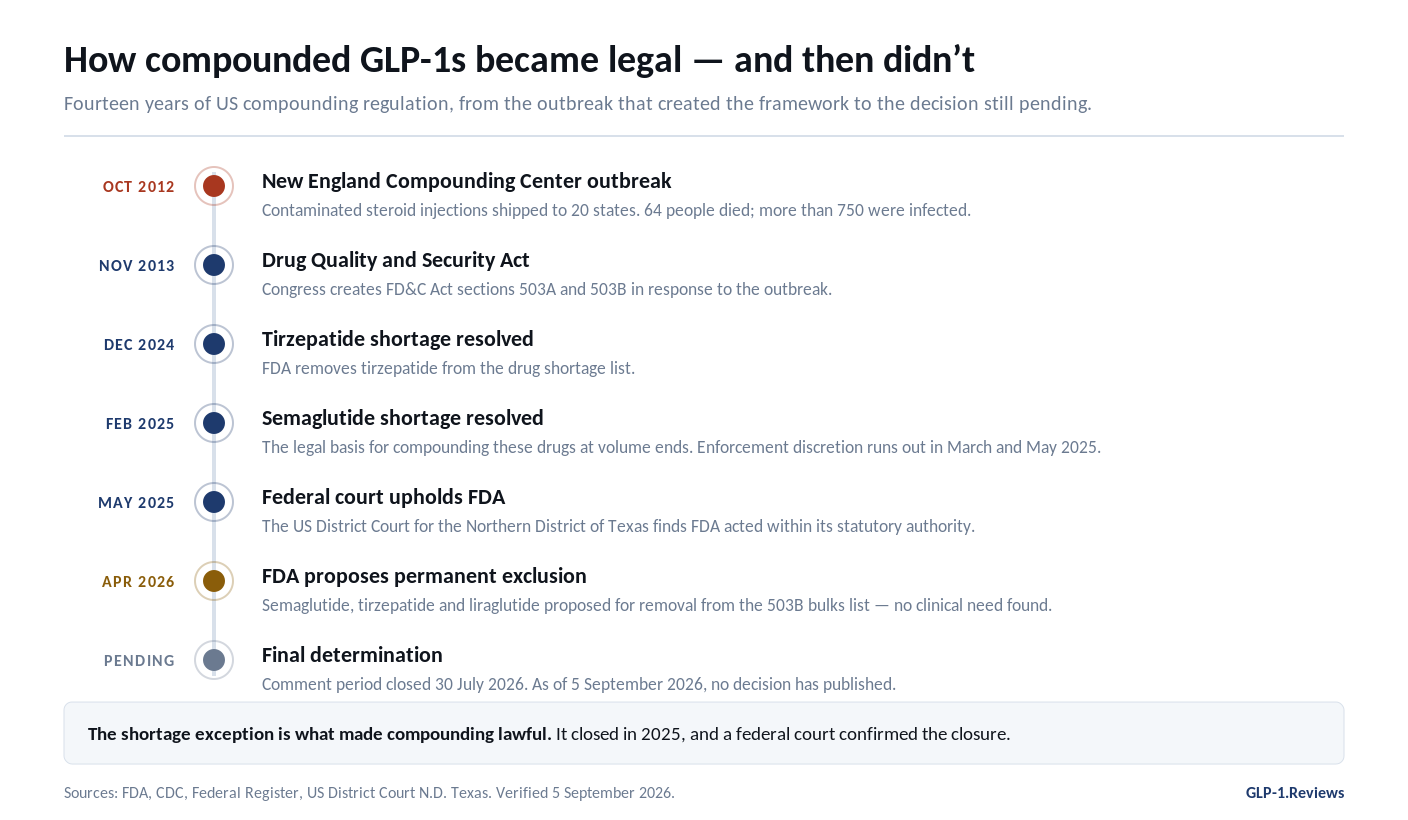
Semaglutide and tirzepatide were on that list. That exception is what made a $99-a-month vial of compounded semaglutide possible, and it is the entire legal basis on which the compounded GLP-1 industry was built.
The exception is gone. FDA removed tirzepatide from the shortage list on 19 December 2024 and semaglutide on 21 February 2025, and published a plain-language explanation of what that meant for compounders. The agency gave the industry a wind-down window rather than an immediate cutoff: 503B outsourcing facilities had until March 2025, and 503A pharmacies until May 2025, before FDA would begin taking action.
Compounders challenged the tirzepatide decision in federal court. On 7 May 2025 the U.S. District Court for the Northern District of Texas ruled for FDA, finding the agency had acted within its statutory authority in declaring the shortage resolved. The legal question is settled.
What this means practically is that the market did not become slightly more restricted. The specific legal permission that the entire category depended on was withdrawn, and a court confirmed the withdrawal.
Why so many providers still sell it
Because two narrower permissions survive, and some sellers stretch them.
The first is patient-specific 503A compounding, described below, which is legitimate and quite narrow. The second is simple non-compliance — continuing to operate and treating warning letters as a cost of doing business. FDA’s enforcement pattern suggests the agency is aware of both. The 55 warning letters issued in 2026 went to companies that were, by definition, still selling.
The rule that governs it now: 503A versus 503B
Almost every question about whether a specific provider is operating legally resolves into one question: which section of the statute is their pharmacy operating under, and are they respecting its limits?
503A pharmacies are traditional state-licensed compounding pharmacies. They compound for an identified individual patient in response to a valid prescription. They are not registered with FDA as manufacturers and are not inspected the way manufacturers are.
503B outsourcing facilities register with FDA, submit to manufacturer-grade inspection, and may compound in bulk without patient-specific prescriptions — but only from substances on FDA’s approved bulks list. Semaglutide, tirzepatide and liraglutide are not on that list, and FDA has proposed permanently excluding them.
| Question | 503A pharmacy | 503B outsourcing facility | What it means for you |
|---|---|---|---|
| Who authorizes it | State board of pharmacy | Registered with FDA | 503A oversight varies by state; 503B is federal |
| Prescription required | Yes — for a named individual patient | No — may compound for office stock | A 503A product made without a real individual assessment is the compliance problem |
| May compound semaglutide now | Only with documented patient-specific clinical need | No — not on the 503B bulks list | Any bulk-produced compounded semaglutide has a legality problem |
| Inspection standard | State inspection; no FDA manufacturing standard | FDA inspection under CGMP | 503B carries the higher manufacturing bar |
| What “clinical need” means | Documented reason the approved drug will not work — ingredient allergy, unavailable dose | Not applicable | “Cheaper” is not a clinical need |
The phrase doing the most work in that table is documented patient-specific clinical need. It does not mean the patient prefers compounded. It does not mean insurance declined to cover the approved drug. It does not mean the approved product is expensive. It means a prescriber has recorded a clinical reason why the FDA-approved medication is unsuitable for this specific person.
A program that charges a flat monthly rate for a standard compounded dose, available to anyone who completes an intake form, is not producing a patient-specific determination for each of those patients. That is the gap most enforcement is aimed at.
What the FDA has actually penalized
FDA’s warning letters are public, and reading them is more useful than reading anyone’s opinion about where the line sits. Across the 2026 letters, six claim types recur. Each one is a phrase you can look for on a provider’s website today.
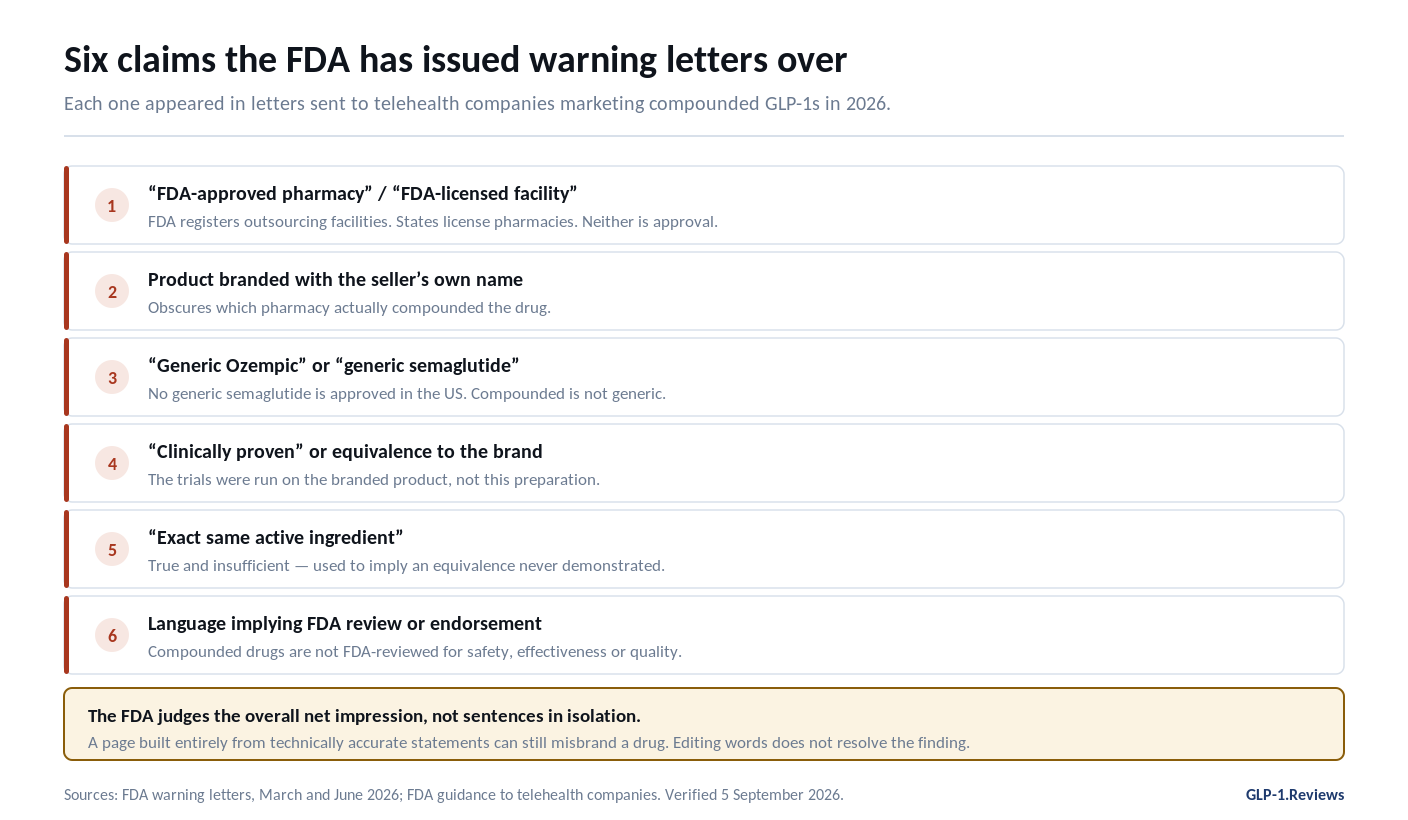
The March 2026 wave went to 30 companies; the June wave to 25. Both followed the February 2026 announcement that the Department of Health and Human Services had referred Hims & Hers Health to the Department of Justice for investigation.
| Claim on a provider’s site | Why FDA objects | What to ask instead |
|---|---|---|
| Product branded with the telehealth company’s own name | Obscures who actually compounded the drug and implies the seller manufactured it | “Which licensed pharmacy compounds this, and in which state?” |
| “Generic Ozempic” or “generic semaglutide” | No generic semaglutide is approved in the United States. Compounded is not generic. | “Is this an FDA-approved product or a compounded preparation?” |
| “FDA-approved” or language implying FDA review | Compounded drugs are not FDA-approved and are not reviewed for safety or efficacy | “Has FDA reviewed this specific product?” — the answer is no |
| “Clinically proven” or claims of equivalence to the brand | Compounded products have not been through the trials that support the approved drug | “What clinical data exists for this preparation specifically?” |
| “FDA-approved pharmacy” or “FDA-licensed facility” | FDA registers outsourcing facilities; it does not approve or license pharmacies | “Are you 503A or 503B, and can I see the registration?” |
| “Exact same active ingredient” as the brand | Used to imply sameness with an approved drug that has not been demonstrated | “Where is the API sourced, and is there a Certificate of Analysis?” |
One point matters more than the individual phrases. FDA evaluates the overall net impression of a provider’s marketing, not sentences in isolation. A page can be composed entirely of technically accurate statements and still be found misbranding, if the impression it leaves is that a compounded product is equivalent to an approved one. Providers who responded to warning letters by editing individual words, rather than changing what their marketing communicates, have generally not resolved the underlying finding.
Two substances that cannot be compounded at all
Retatrutide and cagrilintide are not approved drugs, and FDA has stated they may not be used in compounding. Any seller offering either — including sellers marketing them as “research peptides” — is outside the law regardless of pharmacy licensure or documentation.
FDA has also placed foreign-sourced GLP-1 active pharmaceutical ingredients under Import Alert 66-80, allowing detention without physical examination unless the API and the firm appear on a vetted list. Where a compounded product’s raw ingredient came from is a legitimate question, and a provider unable to answer it is telling you something.
What is still pending: the 503B bulks proposal
The most consequential open question in this category has not been decided.
On 30 April 2026, FDA proposed excluding semaglutide, tirzepatide and liraglutide from the 503B bulks list, having reviewed the nominations submitted and found insufficient evidence of clinical need. The Federal Register notice published 1 May 2026, and after a request for more time, the comment period was extended to 30 July 2026.
As of 4 September 2026, FDA has not published a final determination. The comment period has closed and the decision is pending.
| Scenario | Effect on 503B facilities | Effect on 503A pharmacies | Effect on patients |
|---|---|---|---|
| FDA finalizes the exclusion | Bulk compounding of these three molecules ends outright | Unchanged — patient-specific compounding still governed by the essentially-a-copy rule | Remaining large-scale compounded supply contracts sharply; expect provider transitions |
| FDA declines to finalize | Substances remain eligible for the bulks list | Unchanged | Does not reopen the shortage exception; the copy prohibition still applies |
| Decision continues to be delayed | Status quo — not on the list, so not permitted from bulks | Unchanged | Continued uncertainty; enforcement continues in the meantime |
Worth understanding clearly: even the outcome most favourable to compounders would not restore the pre-2025 market. The bulks list governs one specific pathway. The prohibition on compounding essentially a copy of an available approved drug is separate, and it is what closed the door.
We maintain a page tracking this decision and will update it when FDA publishes.
How to check where your provider stands
Five questions, answerable in about ten minutes, that establish whether a provider is operating on the right side of this.
1. Which pharmacy, and under which section?
Ask for the compounding pharmacy’s name, state, and whether it operates as a 503A pharmacy or a registered 503B outsourcing facility. A provider that will not name the pharmacy is a provider you cannot verify. FDA publishes the list of registered outsourcing facilities; state boards of pharmacy publish licensure.
2. What is the documented clinical need?
If the product is compounded semaglutide from a 503A pharmacy, there must be a recorded clinical reason the approved drug is unsuitable for you specifically. Ask what that reason is in your case. If nobody can state it, the prescription may not meet the standard.
3. Has the company received an FDA warning letter?
FDA’s warning letter database is public and searchable. Given 55 letters in 2026 and more than 100 in 2025, this is not a remote possibility — it is a realistic check. A letter is not proof a company is unsafe, but it tells you what FDA found and whether the company changed anything afterwards.
4. Where does the active ingredient come from?
Ask for a Certificate of Analysis and the API source. Import Alert 66-80 exists because foreign-sourced GLP-1 API has been a genuine problem. A provider who publishes CoAs is meaningfully more transparent than one who does not.
5. What happens to you if the rules tighten?
This is the question almost nobody asks, and in 2026 it may matter most. If FDA finalizes the bulks exclusion, or if the provider receives an enforcement action, what is the continuity plan? Providers with branded supply agreements can move patients to approved products. Providers without one may simply stop.
Hims & Hers is the working example. In March 2026 the company announced it would stop advertising compounded GLP-1s, entered a collaboration with Novo Nordisk, and began transitioning patients to FDA-approved medicines. That is what a continuity plan looks like. Ask whether your provider has one.
For what this means for your monthly cost — and why branded cash pricing now undercuts parts of the compounded market — see our breakdown of current all-in GLP-1 pricing.
This covers compounded semaglutide and related GLP-1 medications in the United States. It does not apply to FDA-approved products — Ozempic, Wegovy, Mounjaro, Zepbound and the approved oral formulations are unaffected by any of it, and nothing here is a reason to hesitate about an approved prescription.
It also does not apply outside the US. Regulatory frameworks differ, and semaglutide patent protection lapsed in Canada in January 2026, creating a generic pathway that does not exist in the United States.
And it does not address compounding of drugs currently in genuine shortage. The shortage exception is a real provision of the statute. It simply does not apply to semaglutide or tirzepatide any more.
Frequently asked questions
Is it illegal for me, as a patient, to buy compounded semaglutide?
No. Federal enforcement in this area is directed at pharmacies, outsourcing facilities and the telehealth companies marketing the products — not at patients. FDA’s warning letters go to companies. You are not exposed to legal risk for having filled a prescription.
The risk to you is different in kind: a compounded product has not been reviewed by FDA for safety, effectiveness or quality, and if your provider’s supply becomes unavailable, your treatment may be interrupted mid-course. Those are the practical concerns worth weighing, rather than legal exposure.
My provider says their pharmacy is FDA-approved. Is that true?
No, and it is one of the six claim types FDA has issued warning letters over. FDA approves drugs. It registers outsourcing facilities and inspects them, and state boards license pharmacies. There is no such thing as an FDA-approved pharmacy.
A provider using that phrase is either unaware of a distinction central to its own regulatory obligations, or aware and using it anyway. Neither is reassuring. The accurate question is whether the pharmacy is a registered 503B outsourcing facility or a state-licensed 503A pharmacy, and both are verifiable.
If the shortage is over, how is anyone still selling compounded semaglutide?
Three ways. Some are compounding legitimately for individual patients with documented clinical need, which remains lawful and is genuinely narrow. Some are relying on interpretations of the essentially-a-copy standard that FDA does not share. And some are simply continuing and absorbing the enforcement risk.
From the outside these look similar, because they produce the same website and the same monthly price. The five checks above are how you tell them apart.
Will the FDA’s 503B decision make compounded semaglutide illegal everywhere?
No — it addresses one pathway. The proposal would exclude semaglutide, tirzepatide and liraglutide from the list of bulk substances that 503B outsourcing facilities may compound from. Patient-specific 503A compounding is governed by a different provision and would not be directly changed.
The practical effect would still be substantial, because bulk production is what supplies volume. But it is not a blanket prohibition, and anyone describing it as one is overstating it.
Is compounded semaglutide the same drug as Wegovy?
No, and claiming so is one of the specific things FDA has issued warning letters over. Compounded preparations may use the same active molecule, but they have not been through the manufacturing controls, the stability testing, or the clinical trials that support an approved product, and formulation, concentration and excipients can differ.
“Same active ingredient” is doing a great deal of concealed work in that sentence. It is accurate as far as it goes, and FDA’s position is that using it to imply equivalence leaves a misleading net impression.
The rule has not changed since 2025. What changed is enforcement.
The most common misunderstanding about compounded semaglutide is that its legal status is unsettled. It is not. The shortage exception closed, a court affirmed the closure, and the prohibition on compounding copies of available approved drugs is the same statute it has always been.
What changed in 2026 is that FDA started acting on it at scale — 55 warning letters across two waves, a DOJ referral, and a proposal to shut the remaining bulk pathway permanently.
For a patient, this resolves into something simpler than the regulatory detail suggests. A compounded prescription written for you, by a prescriber who documented why the approved drug will not work for you, from a pharmacy willing to name itself, is a defensible arrangement. A flat monthly price for a standard dose from a company that will not tell you who made it is a different thing wearing the same words.
Ask which one you have.
Sources
- U.S. Food and Drug Administration. FDA clarifies policies for compounders as national GLP-1 supply begins to stabilize. fda.gov — accessed 4 Sep 2026.
- U.S. Food and Drug Administration. FDA’s Concerns with Unapproved GLP-1 Drugs Used for Weight Loss. fda.gov — accessed 4 Sep 2026.
- U.S. Food and Drug Administration. FDA to Telehealth Companies: What to Know When Promoting Compounded Drugs. fda.gov — accessed 4 Sep 2026.
- U.S. Food and Drug Administration. FDA warns 30 telehealth companies against illegal marketing of compounded GLP-1s. Press announcement, 3 Mar 2026.
- U.S. Food and Drug Administration. FDA Proposes to Exclude Semaglutide, Tirzepatide, and Liraglutide on 503B Bulks List. Press announcement, 30 Apr 2026.
- Federal Register. List of Bulk Drug Substances for Which There Is a Clinical Need Under Section 503B. 91 FR, 1 May 2026 (doc. 2026-08552).
- Federal Register. Extension of Comment Period. 26 Jun 2026 (doc. 2026-12937).
- U.S. Food and Drug Administration. Declaratory order: tirzepatide shortage resolved. fda.gov/media/184606.
- U.S. District Court, N.D. Texas. Ruling upholding FDA’s removal of tirzepatide from the shortage list, 7 May 2025.
- U.S. Food and Drug Administration. Import Alert 66-80: Detention Without Physical Examination of GLP-1 APIs. accessdata.fda.gov.
- U.S. Food and Drug Administration. 503B Bulk Drug Substances List and Human Drug Compounding hub. fda.gov.
- U.S. Food and Drug Administration. Warning Letters database. fda.gov — searched 4 Sep 2026.
- Sheppard Mullin. FDA’s Focus Returns to Compounding and Telehealth: Another Wave of Warning Letters. June 2026.
- Hims & Hers Health, Inc. Hims & Hers Announces Strategic Shift for US Weight Loss Business. Investor release, 9 Mar 2026.
Medical disclaimer. This article is for informational purposes and is not medical advice. It does not recommend or discourage any medication, and it does not address dosing. Decisions about GLP-1 treatment should be made with a licensed healthcare provider who knows your medical history. GLP-1.Reviews does not prescribe, dispense or sell medication.
Regulatory status note. Regulation in this area is actively changing. Facts stated here were verified against FDA, Federal Register and court records on 4 September 2026. The FDA 503B bulks list determination was pending as of that date.
Keep exploring our GLP-1 resources:



