
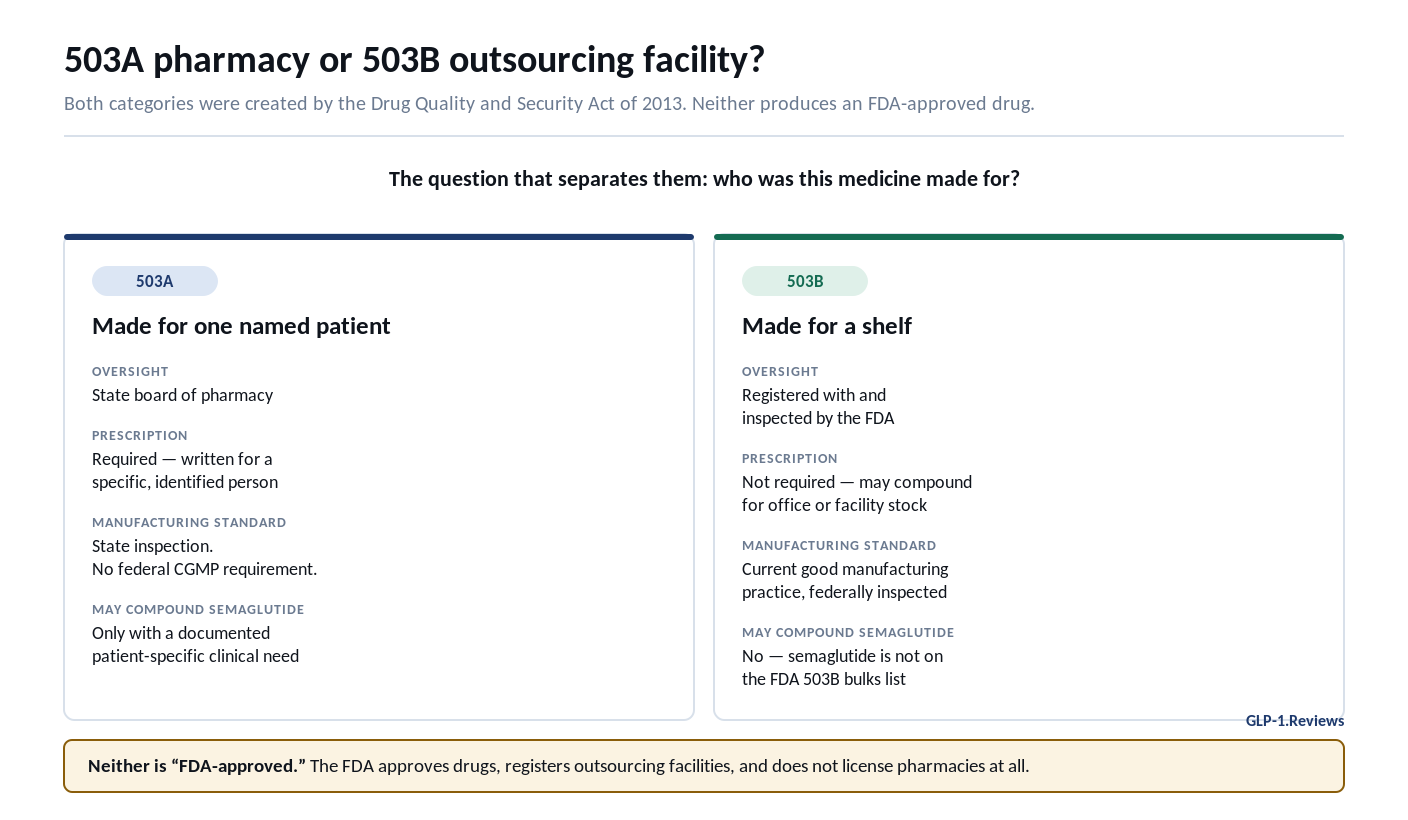
A 503A pharmacy is a traditional compounding pharmacy licensed by a state board. It prepares a medication for one named patient in response to a prescription written for that person. It is not registered with the FDA as a manufacturer and is not inspected to manufacturing standards.
A 503B outsourcing facility registers with the FDA, submits to federal inspection under current good manufacturing practice, and may compound in bulk without a prescription for any individual patient — but only from substances on the FDA’s approved bulks list.
Semaglutide, tirzepatide and liraglutide are not on that list. In April 2026 the FDA proposed excluding all three permanently, having found no clinical need for outsourcing facilities to compound them from bulk.
Not a difference in quality tier. Not a difference in state versus federal branding. Not a distinction that only matters to pharmacists.
The practical difference is who the medicine was made for. A 503A preparation is made for you specifically, because a prescriber documented a reason the approved drug will not work for you. A 503B preparation is made for a shelf. That is why one requires a patient-specific determination and the other requires a federally approved ingredient list.
Both sections exist because of a public health disaster. In 2012 a compounding pharmacy in Massachusetts shipped contaminated steroid injections across twenty states, causing a fungal meningitis outbreak that killed 64 people. Congress wrote the current framework in response.
Where these two categories came from
Before 2013, pharmacy compounding sat in a regulatory grey zone. State boards licensed pharmacies. The FDA regulated drug manufacturers. A compounding pharmacy operating at industrial scale fell awkwardly between the two, and enforcement authority was contested.
Both pathways start from an approved drug. For a substance that has never been approved, neither pathway exists.
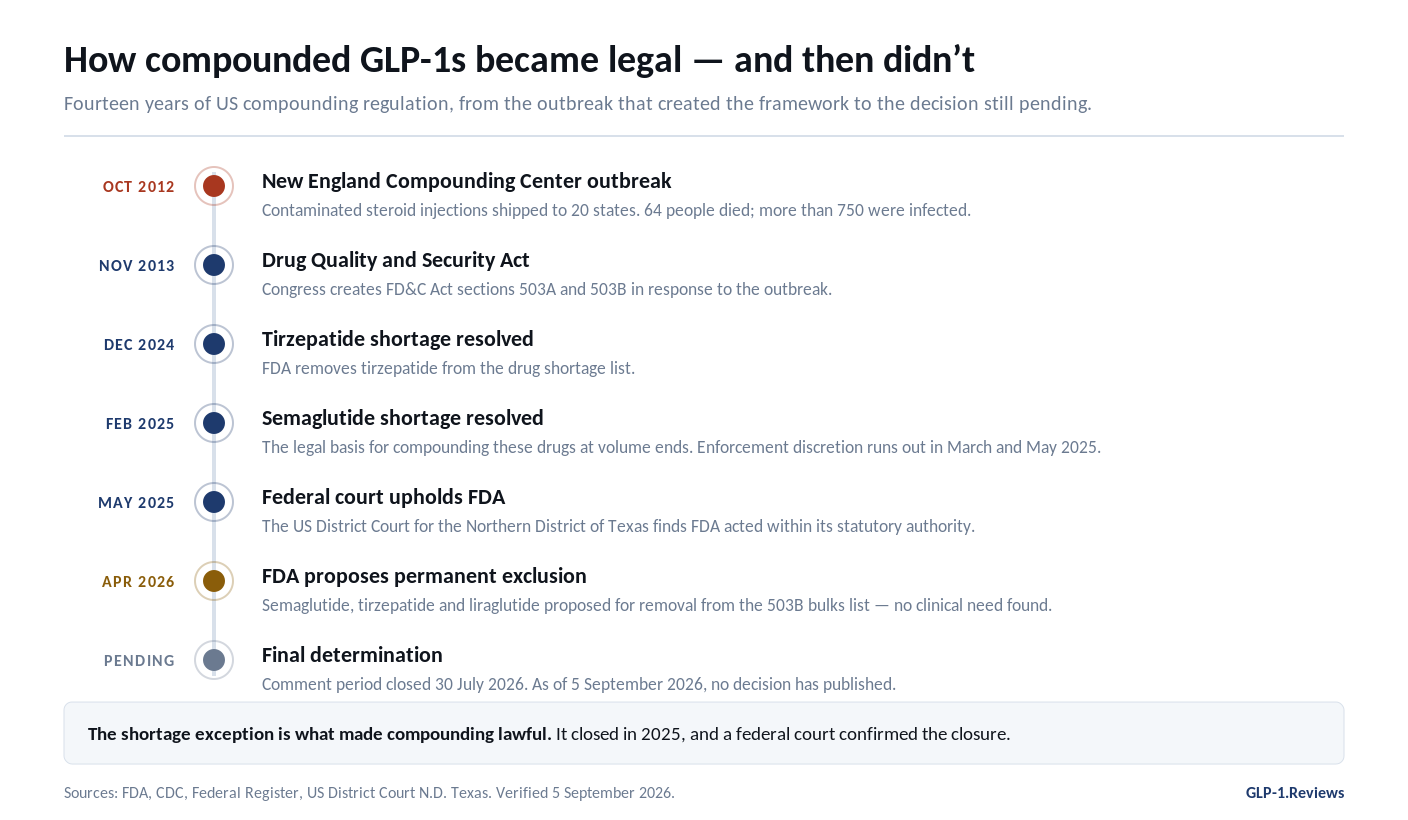
That ambiguity ended with the New England Compounding Center. In 2012 the Massachusetts pharmacy distributed contaminated preservative-free methylprednisolone acetate injections to clinics in twenty states. The resulting fungal meningitis outbreak infected more than 750 people and killed 64. Investigators found the facility had been operating as a manufacturer while licensed as a pharmacy.
Congress responded with the Drug Quality and Security Act of 2013, which created the two categories now written into the Federal Food, Drug, and Cosmetic Act as sections 503A and 503B. The law’s design goal was straightforward: let traditional pharmacies keep doing traditional compounding, and create a federally supervised category for anyone compounding at scale.
Understanding that origin explains why the rules look the way they do. The framework is not about product quality in the abstract. It is about who the medication was prepared for, and how much federal oversight that triggers.
503A: compounding for one named patient
A 503A pharmacy is what most people picture when they hear “compounding pharmacy.” It holds a state license, is inspected by its state board, and prepares medications in response to individual prescriptions.
The defining constraint is that a 503A preparation must be made for an identified individual patient. A prescriber writes a prescription for a named person, and the pharmacy compounds against it. There is no lawful 503A route to producing a standardised product and holding it in inventory for whoever orders next.
The second constraint is the one that governs GLP-1 medications specifically. Federal law prohibits compounding a drug that is “essentially a copy” of a commercially available FDA-approved product. A 503A pharmacy may compound something similar to an approved drug only when a prescriber documents a clinical reason the approved product will not work for that patient — an allergy to an inactive ingredient, for instance, or a dose the commercial product does not supply.
Cost is not a clinical need. Insurance denial is not a clinical need. Patient preference is not a clinical need. The FDA has been explicit on this point, and it is the standard on which most current enforcement turns.
What a 503A pharmacy is not
A 503A pharmacy is not FDA-approved, because the FDA does not approve pharmacies. It is not FDA-registered as a manufacturer. Its products have not been reviewed by the FDA for safety, effectiveness or quality, and they carry no FDA approval of any kind.
These are not criticisms. They are the design of the category. A pharmacy compounding a single preparation for a single patient with a documented need is doing something the system deliberately permits without federal drug review.
503B: registered, inspected, and limited by a list
A 503B outsourcing facility is a different animal. It registers with the FDA, reports what it produces twice a year, and is inspected on a risk-based schedule under current good manufacturing practice — the same broad standard that governs pharmaceutical manufacturing.
In exchange for that oversight, a 503B facility gets a permission a 503A pharmacy does not have: it may compound without a prescription for any individual patient. A hospital can order a batch for its own stock. That is the point of the category, and it is why outsourcing facilities exist at all.
But the permission comes with a hard limit. A 503B facility may compound from a bulk drug substance only if that substance appears on the FDA’s 503B bulks list, or is a component of an approved drug on the shortage list.
Semaglutide, tirzepatide and liraglutide appear on neither. They were compoundable during the shortage era because of the shortage provision, not because they were ever on the bulks list. When the FDA declared the tirzepatide shortage resolved in December 2024 and the semaglutide shortage resolved in February 2025, that permission ended.
| Question | 503A pharmacy | 503B outsourcing facility | Why it matters to you |
|---|---|---|---|
| Who oversees it | State board of pharmacy | Registered with and inspected by the FDA | 503A oversight varies considerably by state; 503B is a single federal standard |
| Prescription required | Yes — for one named patient | No — may compound for office or facility stock | A 503A product made without a genuine individual assessment is the central compliance problem |
| Manufacturing standard | State inspection; no federal CGMP requirement | Current good manufacturing practice, federally inspected | 503B carries the higher and more consistent production bar |
| May compound semaglutide today | Only with a documented patient-specific clinical need | No — not on the 503B bulks list | Any bulk-produced compounded semaglutide has a legality problem |
| FDA reviews the product | No | No | Neither category produces an FDA-approved drug. Registration is not approval. |
Why neither category can mass-produce semaglutide now
This is where the two sections converge, and it is the part most coverage gets wrong.
A 503B facility cannot mass-produce compounded semaglutide because the substance is not on the bulks list. That is a straightforward statutory bar.
A 503A pharmacy cannot mass-produce it either, for a different reason: the essentially-a-copy prohibition. A pharmacy producing a standardised semaglutide preparation for anyone who requests it is not compounding for identified individual patients with documented needs. It is manufacturing a copy of an approved drug, which the statute forbids regardless of state licensure.
So the two routes fail for different reasons and arrive at the same place. There is no lawful high-volume compounded semaglutide business in the United States today. What remains lawful is genuinely narrow: individual preparations for individual patients whose prescribers have recorded why the approved product is unsuitable.
The picture may narrow further. On 30 April 2026 the FDA proposed excluding semaglutide, tirzepatide and liraglutide from the 503B bulks list entirely, stating it had reviewed the nominations received and found insufficient evidence of clinical need. The comment period closed on 30 July 2026. As of 5 September 2026 no final determination has published.
How to find out which one your provider uses
The question is answerable, and a provider’s willingness to answer it is itself informative.
Ask for the pharmacy’s name and state
Not the telehealth company’s name — the compounding pharmacy’s. Many platforms brand the medication with their own name, which is one of the claim types the FDA has issued warning letters over, precisely because it obscures who made the drug. A provider that will not name the pharmacy is a provider whose claims you cannot verify.
Our provider reviews record what each platform discloses about its compounding pharmacy; the Mochi Health and Ivim Health reviews are two examples of what a disclosed sourcing answer looks like.
Check the FDA’s registered outsourcing facility list
The FDA publishes the list of registered 503B outsourcing facilities. If a provider claims 503B sourcing, the facility should appear there. If it does not, the claim is wrong.
Check state licensure for a 503A claim
State boards of pharmacy publish licensure records, and most permit a public lookup. A 503A pharmacy compounding for patients in your state generally needs to be licensed or registered to do so.
Ask what the documented clinical need is in your case
If the answer is a 503A pharmacy, there must be a recorded clinical reason the FDA-approved product is unsuitable for you specifically. Ask what that reason is. If nobody can state one, the prescription may not meet the standard the statute sets.
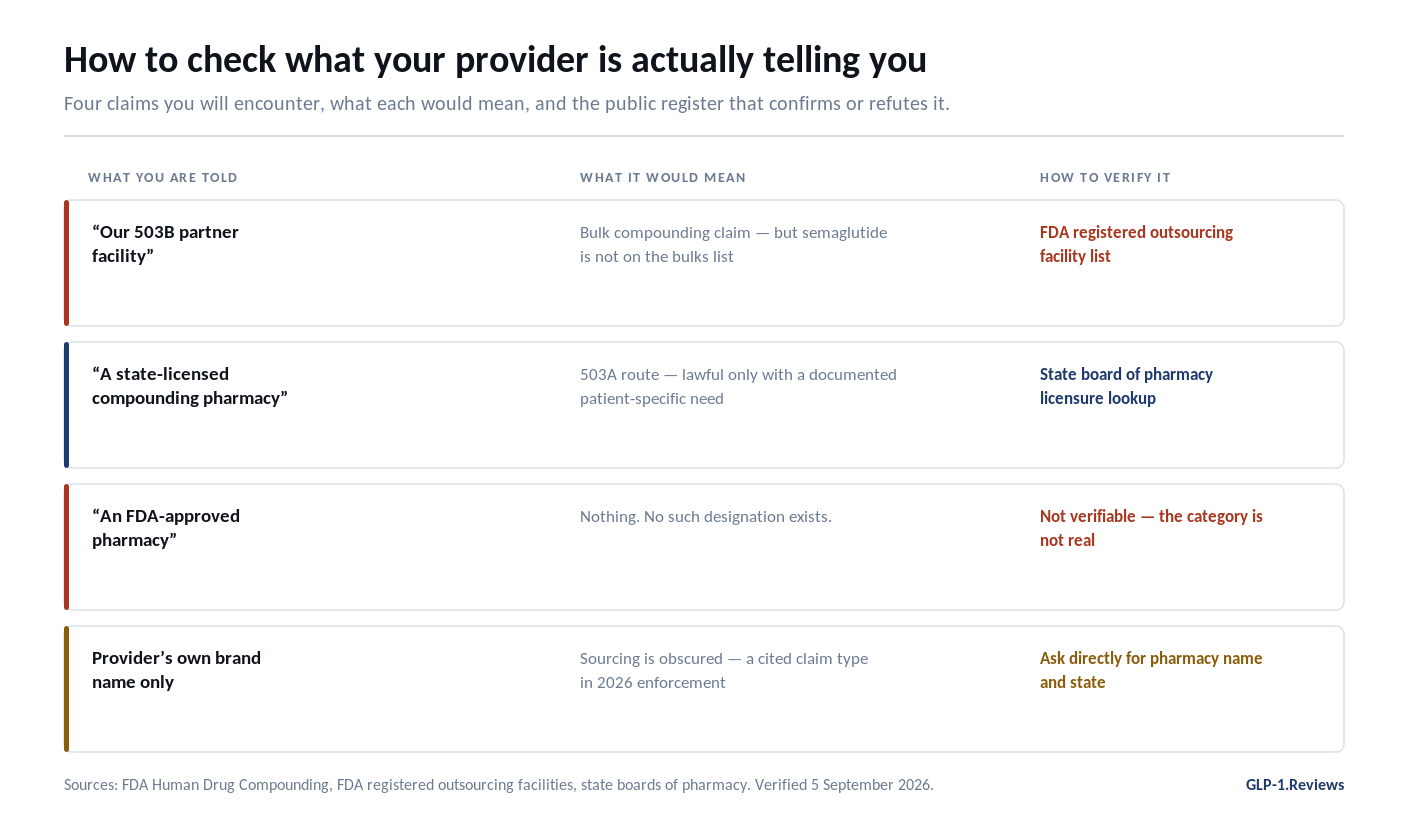
| What you are told | What it would mean | How to verify it | What a non-answer suggests |
|---|---|---|---|
| “Our 503B partner facility” | Bulk compounding claim — but semaglutide is not on the bulks list | FDA registered outsourcing facility list | Either the facility is unregistered or the substance claim is wrong |
| “A state-licensed compounding pharmacy” | 503A route — requires patient-specific need | State board licensure lookup, plus ask what your documented need is | No stated clinical need means the essentially-a-copy bar likely applies |
| “An FDA-approved pharmacy” | Nothing — no such category exists | Not verifiable, because it is not a real designation | The FDA has issued warning letters over this exact phrase |
| Provider’s own brand name only | Sourcing is obscured | Ask directly for the pharmacy name and state | Obscured sourcing is itself a cited claim type in 2026 enforcement |
None of this affects FDA-approved medications. Ozempic, Wegovy, Mounjaro, Zepbound and the approved oral formulations are manufactured under full FDA approval, and the 503A and 503B framework has nothing to do with them.
It also does not apply to compounding of drugs genuinely in shortage. The shortage provision is a real part of the statute and it functions as intended. It simply no longer covers semaglutide or tirzepatide.
And this is a United States framework. Other countries regulate compounding under entirely different rules.
Frequently asked questions
Is a 503B outsourcing facility safer than a 503A pharmacy?
More federally supervised, which is not identical to safer for any given preparation. A 503B facility is inspected by the FDA under current good manufacturing practice, so its production standards are federally enforced and consistent. A 503A pharmacy is inspected by its state board, and those standards vary.
What neither offers is FDA review of the product itself. Neither a 503A nor a 503B preparation has been evaluated by the FDA for safety, effectiveness or quality the way an approved drug has.
Can a 503B outsourcing facility compound semaglutide right now?
No. Semaglutide is not on the 503B bulks list, and it is no longer on the shortage list, which was the provision that made bulk compounding lawful during 2023 and 2024. The FDA has proposed excluding it from the bulks list permanently; that decision was still pending as of September 2026.
My pharmacy says it is FDA-registered. Is that the same as FDA-approved?
No, and the distinction is significant. Registration means a facility has told the FDA it exists and has accepted inspection. Approval means the FDA has reviewed a specific drug’s safety and effectiveness data and authorised its marketing. A registered outsourcing facility produces unapproved drugs under federal oversight. Those are different claims and only one of them is about the medicine.
What counts as a documented clinical need for 503A compounding?
A recorded clinical reason the FDA-approved product cannot be used for that specific patient. A documented allergy to an inactive ingredient in the commercial formulation is the clearest example. A dose the approved product does not supply is another.
Price is not a clinical need. Neither is an insurance denial, nor a preference for a different delivery format. The determination has to be clinical and it has to be about you.
Does it matter which one my provider uses if the medication seems fine?
It matters for continuity more than for any single vial. A provider relying on a route the FDA is actively enforcing against may have to stop supplying it, and patients discover that mid-treatment. Asking which section your provider operates under is really asking whether your supply has a legal basis that will survive the next twelve months.
The framework is about who the medicine was made for
Strip away the section numbers and the distinction is simple. A 503A pharmacy makes a medication for a named person because a prescriber documented why the approved drug will not do. A 503B facility makes medications for a shelf, under federal inspection, from an approved list of ingredients.
Sixty-four people died in 2012 because a pharmacy was doing the second thing while regulated as though it were doing the first. The two sections exist to keep those activities separate and supervised appropriately.
When a telehealth company offers a standard monthly dose of compounded semaglutide at a flat price to anyone who completes an intake form, it is worth asking which of those two things is actually happening — and which set of rules is supposed to be governing it.
Sources
- U.S. Food and Drug Administration. Human Drug Compounding — regulatory hub. fda.gov, accessed 5 Sep 2026.
- U.S. Food and Drug Administration. Compounding Laws and Policies — FD&C Act sections 503A and 503B. fda.gov.
- Drug Quality and Security Act of 2013, Pub. L. 113-54.
- Centers for Disease Control and Prevention. Multistate Outbreak of Fungal Meningitis and Other Infections — 2012–2013 case counts and deaths. cdc.gov.
- U.S. Food and Drug Administration. Registered Outsourcing Facilities — searchable list. fda.gov.
- U.S. Food and Drug Administration. 503B Bulk Drug Substances List. fda.gov.
- U.S. Food and Drug Administration. FDA clarifies policies for compounders as national GLP-1 supply begins to stabilize. fda.gov.
- U.S. Food and Drug Administration. FDA Proposes to Exclude Semaglutide, Tirzepatide, and Liraglutide on 503B Bulks List. Press announcement, 30 Apr 2026.
- Federal Register. List of Bulk Drug Substances for Which There Is a Clinical Need Under Section 503B. 1 May 2026, doc. 2026-08552.
- Federal Register. Extension of Comment Period. 26 Jun 2026, doc. 2026-12937.
- U.S. Food and Drug Administration. FDA’s Concerns with Unapproved GLP-1 Drugs Used for Weight Loss. fda.gov.
Medical disclaimer. This article reports what federal statute and FDA guidance say about pharmacy compounding categories. It is not medical advice, does not recommend or discourage any medication, and does not address dosing. Decisions about GLP-1 treatment belong with a licensed healthcare provider who knows your medical history.
Regulatory status note. Facts verified against FDA, Federal Register and CDC sources on 5 September 2026. The FDA’s 503B bulks list determination was pending as of that date.
Keep exploring our GLP-1 resources:



