
Yes, counterfeit Ozempic pens have been found in the legitimate U.S. supply chain, and the FDA has published three separate alerts about them (December 2023, April 2025 and December 2025). The FDA’s guidance is consistent across all three: get Ozempic only with a valid prescription from a state-licensed pharmacy, look at the pen label before every use, and do not use a pen that carries the markers the agency describes. For the lot named in the December 2025 alert, the lot number alone does not tell you whether a pen is fake, because that lot also exists as genuine product; the FDA points to where the “EXP/LOT” text sits on the label instead.
Why this matters beyond one brand
Most coverage of GLP-1 safety focuses on what the medicine does inside the body. This guide is about a different risk: whether the pen in your hand is the product it claims to be. The FDA has said in plain terms that counterfeit medicines can contain the wrong ingredients, or too much, too little or none of the active ingredient. That is a general statement about counterfeits, not a finding about any one pen, but it is the reason the agency asks patients to check what they receive.
We read the FDA’s alert page on counterfeit Ozempic and its general page on counterfeit medicine on 15 October 2026. We describe what the agency published; we have not tested any product, and we do not know whether any specific pen you hold is genuine. If you have a pen you are worried about, the steps near the end of this article tell you who to contact.
What the FDA has published, alert by alert
The agency’s page covers three alerts. The details below are taken from that page; the FDA notes that its investigation is continuing and that Novo Nordisk announcements are the main source of further updates.
December 2023: lot NAR0074
On 21 December 2023 the FDA said it had seized thousands of units of counterfeit Ozempic 1 mg in the legitimate U.S. supply chain. The lot number given was NAR0074, with serial number 430834149057, and the agency said some product might still be available for purchase. Analysis found that the needles were counterfeit, so their sterility could not be confirmed, which the FDA described as raising the risk of infection. The pen label, the health care professional and patient information, and the carton were also counterfeit. The FDA said it was aware of five adverse event reports, none serious, consistent with the known effects of Ozempic: nausea, vomiting, diarrhea, abdominal pain and constipation. The page includes photographs comparing authentic and counterfeit needles.
April 2025: lot PAR0362
On 14 April 2025 the FDA reported that Novo Nordisk had notified it on 3 April 2025 that several hundred counterfeit units were in the U.S. supply chain, and that the FDA seized them on 9 April 2025. The lot was PAR0362, with a serial number beginning 51746517. Six adverse event reports were associated with that lot number; the FDA said none appeared to be linked to the counterfeit product and that Novo Nordisk had submitted all six. At the time of the alert, the FDA and Novo Nordisk were still testing the products and had no information on their identity, quality or safety.
December 2025: lot PAR1229
On 5 December 2025 the FDA described a third episode. Novo Nordisk notified the agency on 18 November 2025, and the FDA had recently seized dozens of units. The notable detail is that PAR1229 is also a genuine lot number, so the lot number cannot be used to separate real from fake. The FDA instead told patients to look at the label on the pen: on counterfeit pens the “EXP/LOT” text sits to the left of the expiration date and lot number, whereas on authentic pens it sits above them. The agency said not to use a pen if that text appears on the left. It also said that patients who received lot PAR1229 through the Novo Nordisk Patient Assistance Program may keep using it, because that product is authentic. Six adverse event reports were associated with this lot, and the FDA said none appeared to be associated with the counterfeit product.
| Alert date | Lot named | What the FDA said identifies the problem |
|---|---|---|
| 21 Dec 2023 | NAR0074 (serial 430834149057) | Counterfeit needles, pen label, patient information and carton; sterility of needles could not be confirmed. |
| 14 Apr 2025 | PAR0362 (serial starting 51746517) | Counterfeit units seized; testing of identity, quality and safety was still under way at the time of the alert. |
| 5 Dec 2025 | PAR1229 (also a genuine lot) | Counterfeit pens have “EXP/LOT” text to the left of the expiration date and lot number; authentic pens have it above. |
One caution about reading this table: an alert is a snapshot. A lot number in an old alert is useful for the pen in your hand only if the FDA still lists it, and the third alert shows that even a lot number can be shared by real and fake pens. The label layout and the source of the pen matter more than any single number.
What the FDA tells patients to do
- Use a state-licensed pharmacy and a valid prescription. The alert says to obtain Ozempic only with a valid prescription from a state-licensed pharmacy.
- Look at the pen before every use. The alert asks patients to check for signs of counterfeiting, not just on the first pen. Compare the label layout with the FDA’s published examples and check where the “EXP/LOT” text sits.
- Stop and ask if a pen matches the counterfeit markers. Do not use it, and contact your pharmacy, your prescriber or Novo Nordisk customer care. The FDA lists 1-800-727-6500 (Monday to Friday, 8:30 a.m. to 6 p.m. Eastern) for Novo Nordisk, and 1-888-INFO-FDA (1-888-463-6332) for the FDA’s general line.
- Report problems. Adverse events go to the FDA’s MedWatch program. Suspected counterfeits can be reported to the FDA through its consumer complaint coordinators or its online form for suspected criminal activity.
The FDA’s general advice on buying medicine online
The agency’s general counterfeit page adds context that applies to any prescription medicine, including GLP-1s. It says counterfeit medicines may be harmful, that they may contain the wrong ingredients or too much, too little or no active ingredient, and that many are made abroad and enter the country by mail or smuggling. To lower the risk, it advises people to watch for changes in the drug or its packaging and for new or unusual side effects, to be cautious with online pharmacies, and to buy only from state-licensed pharmacies. It points readers to a tool for checking state-licensed online pharmacies and to its BeSafeRx information, and it describes how to report a counterfeit drug or an unsafe online pharmacy.
The FDA’s page does not say that every online source is unsafe, and neither do we. It says licensing is the thing to verify. We could not load the FDA’s separate BeSafeRx page during this review, so we do not summarize it here.
A practical pre-use check
None of this replaces the FDA’s own pictures and wording, so open the alert page beside your pen. A sensible routine, built from what the agency has published, looks like this.
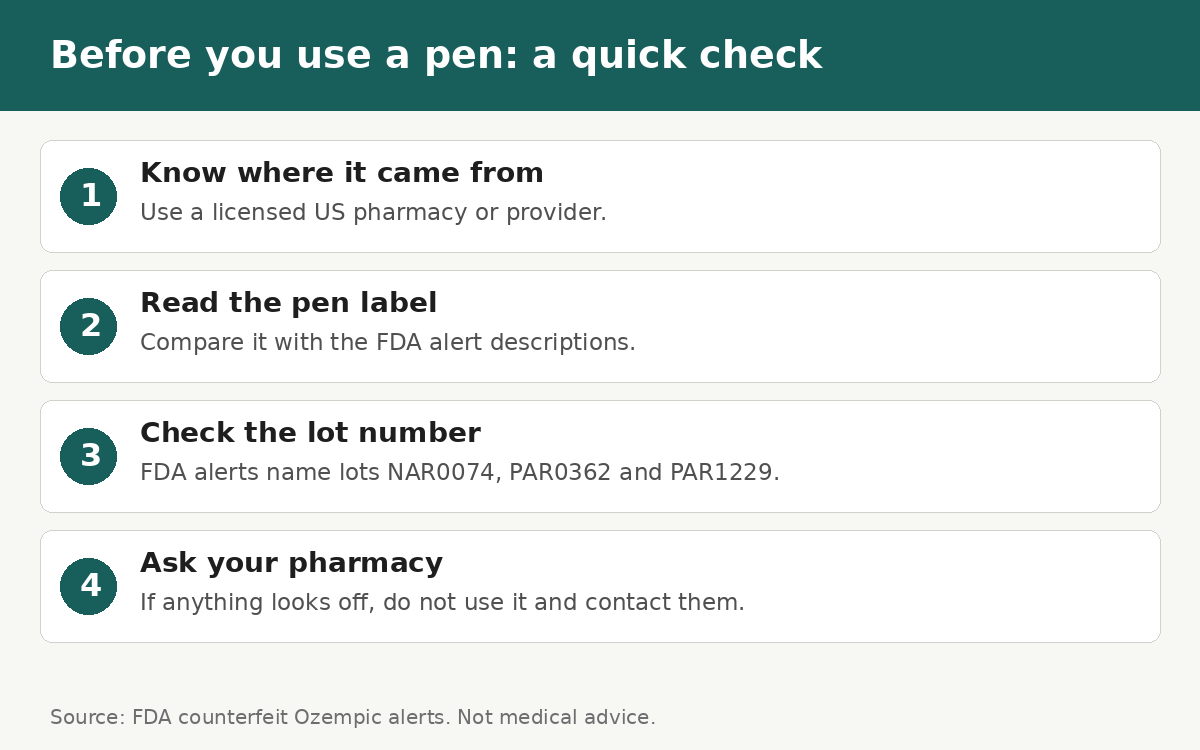
- Know where the pen came from. Was it dispensed by a pharmacy you can identify, against a prescription written for you? A pharmacy’s state license can be looked up with the state board of pharmacy or through the tool the FDA links.
- Read the label. Find the expiration date and lot number and check the position of the “EXP/LOT” wording relative to them.
- Check the lot against the alerts. If your lot matches one of the three named above, compare the specific markers the FDA describes for that lot rather than assuming it is fake or genuine.
- Look at the packaging and needles. The 2023 alert found counterfeit needles, cartons and printed information. Anything that looks different from your previous pens, including the paperwork inside the carton, is worth a call to the pharmacist.
- Notice unusual effects. The FDA specifically lists new or unusual side effects as a reason to question a product. Report them to your prescriber and, if you wish, to MedWatch.
How this connects to compounded and telehealth sources
The counterfeit alerts concern pens made to look like the brand-name product. That is a different problem from compounded medicine, which is a legal category made by a licensed pharmacy for a prescription, with its own rules and its own risks. Our guides on how to verify which pharmacy is compounding your semaglutide, on who made your compounded GLP-1 and on why “FDA-approved pharmacy” is a claim the FDA has issued warning letters over cover that side. If you want to understand what an FDA enforcement document actually says, see how to read an FDA warning letter.
What links the two topics is traceability: a license you can verify, a prescription written for you, and a pharmacy that will tell you where the product came from. The official manufacturer programs are one route that keeps the chain short; whichever route you use, the same questions apply.
Questions to ask your pharmacy or telehealth provider
- Which pharmacy is dispensing my medicine, and in which state is it licensed?
- Is this product purchased from the manufacturer or an authorized distributor?
- If I have a concern about a specific pen, who do I call and what will you do with the pen?
- Will you tell me the lot number and expiration date of what you shipped?
Frequently asked questions
Has the FDA found counterfeit Ozempic in the United States?
Yes. Its alert page describes counterfeit Ozempic 1 mg found in the legitimate U.S. supply chain in December 2023, April 2025 and December 2025, with units seized each time.
Can I tell if my pen is fake from the lot number?
Not reliably. The December 2025 alert says lot PAR1229 is also a genuine lot number. The agency pointed to the placement of the “EXP/LOT” text on the label.
Were people harmed?
The FDA reported five adverse events for the 2023 lot, none serious and consistent with Ozempic’s known effects, and said none of the six reports for each of the 2025 lots appeared to be linked to the counterfeit product. The agency also said testing of the April 2025 product had not yet established its identity, quality or safety at the time. These are reported cases only; they do not establish how common harm is.
Is this only about Ozempic?
The alerts we reviewed name Ozempic. The FDA’s general guidance about licensed pharmacies and inspecting packaging applies to any prescription medicine.
Where do I report a suspected counterfeit pen?
The FDA directs adverse events to MedWatch and suspected counterfeits to its consumer complaint coordinators or online reporting form. Novo Nordisk also takes calls at the customer care number the FDA lists.
Sources
- U.S. Food and Drug Administration, FDA warns consumers not to use counterfeit Ozempic (semaglutide) found in U.S. drug supply chain, alerts dated 21 December 2023, 14 April 2025 and 5 December 2025, read 15 October 2026.
- U.S. Food and Drug Administration, Counterfeit medicine, read 15 October 2026.
Medical disclaimer. This article is informational, was prepared by the GLP-1.Reviews editorial team from the public sources listed above, and has not been reviewed by a physician. It is not medical advice. Label wording and regulator pages can change; confirm the instructions for your product with the Medication Guide that came with it. Talk to your prescriber or pharmacist about your own treatment, and see our medical disclaimer and editorial standards.
Keep exploring our GLP-1 resources:



