
No GLP-1 medicine is FDA-approved to treat alcohol use disorder, and the Wegovy and Ozempic labels list no such indication. What exists is early randomized research on semaglutide. A 2025 JAMA Psychiatry trial (48 people, 9 weeks) found less alcohol consumed in a laboratory task and lower craving. A 2026 American Journal of Psychiatry trial of oral semaglutide (50 people, 8 weeks) found fewer heavy drinking days but no significant change in its primary craving measure. A 2026 Lancet trial in 108 people with both alcohol use disorder and obesity found a larger fall in heavy drinking days on weekly semaglutide 2.4 mg than on placebo. All three call for larger trials.
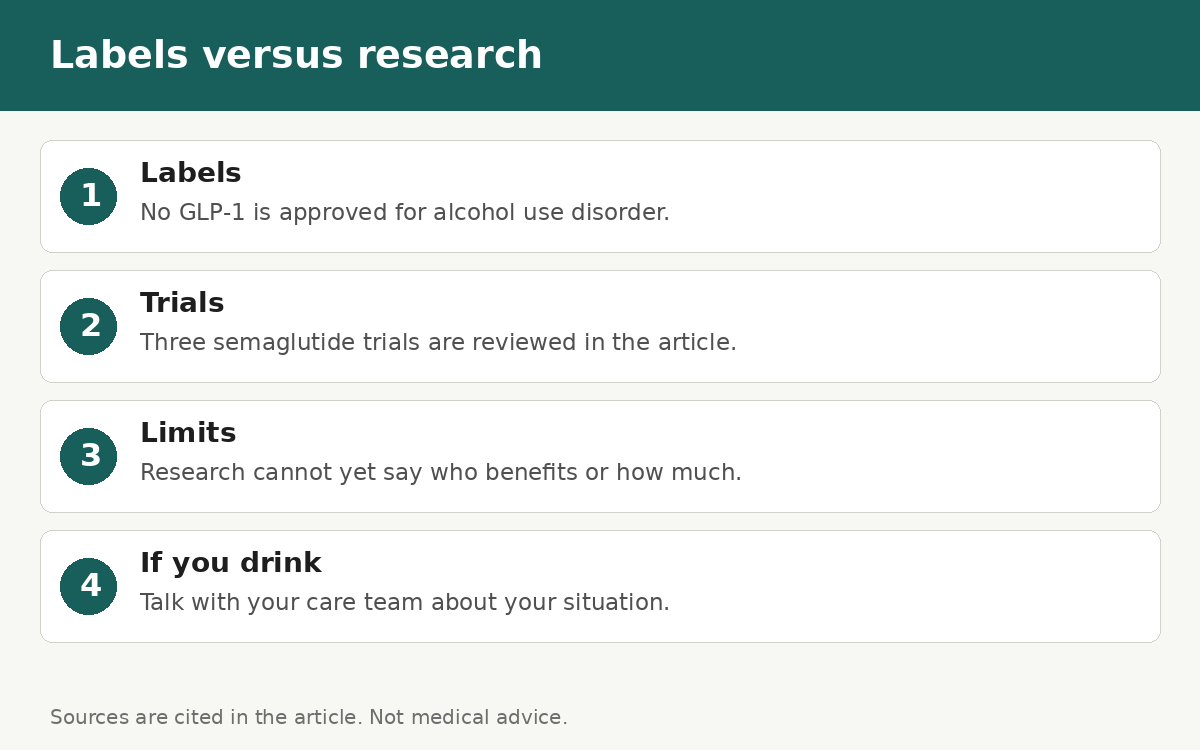
A question people are asking, and what is actually established
People who take GLP-1 medicines sometimes report that they want to drink less. That anecdote has led to a real research field, and to a lot of loose claims online. This guide separates three things: what the FDA labels say, what randomized trials have measured, and what is still unknown. It is about published research, not a recommendation to use any medicine for drinking problems. Alcohol use disorder is a medical condition with approved treatments and professional support, and decisions about it belong with a clinician.
We read the current Wegovy prescribing information (revised 06/2026), the Ozempic prescribing information and the Zepbound prescribing information on 15 October 2026, and the PubMed records and ClinicalTrials.gov entries for the trials below.
What the labels say, and do not say
The Wegovy label lists indications for cardiovascular risk reduction, weight reduction and weight maintenance in adults and in children aged 12 and older with obesity, and for noncirrhotic MASH with moderate to advanced liver fibrosis. The Ozempic label lists glycemic control in adults with type 2 diabetes, reduction of major adverse cardiovascular events in adults with type 2 diabetes and established cardiovascular disease, and reduction of the risk of sustained eGFR decline, end-stage kidney disease and cardiovascular death in adults with type 2 diabetes and chronic kidney disease. Alcohol use disorder is not among them.
We also searched the text of the three label PDFs for the word “alcohol.” In the Wegovy and Ozempic documents it appears in injection instructions (alcohol swabs and wipes) and in the term “nonalcoholic” for liver disease. In the Zepbound document it appears as an excipient, benzyl alcohol. In the copies we read, none of the three gives dosing, warnings or advice about drinking. That absence is not proof that nothing matters: it means the labels are silent, so questions about drinking while on treatment are best put to your prescriber or pharmacist.
That silence matters for one more reason. Label warnings on other conditions may matter to people who drink heavily. Our guides cover pancreatitis, dehydration and acute kidney injury, and severe stomach problems, in each case as the labels describe them, without any link to alcohol use.
Trial 1: low-dose weekly semaglutide, JAMA Psychiatry 2025
Hendershot and colleagues ran a phase 2, double-blind, randomized, parallel-arm trial at a single U.S. academic center, published in JAMA Psychiatry in April 2025. Of 504 people assessed, 48 non-treatment-seeking adults with alcohol use disorder were randomized (71% female, mean age 39.9). They received weekly subcutaneous semaglutide, stepped from 0.25 mg for 4 weeks to 0.5 mg for 4 weeks to 1.0 mg for 1 week, or placebo, over 9 weeks of outpatient treatment.
The primary outcome was alcohol self-administration in a laboratory session, measured before and after treatment. Semaglutide reduced the amount of alcohol consumed in that task (grams consumed: beta -0.48, 95% CI -0.85 to -0.11) and the peak breath alcohol concentration (beta -0.46, 95% CI -0.87 to -0.06). Outside the laboratory, semaglutide did not change average drinks per calendar day or the number of drinking days, but it reduced drinks per drinking day (beta -0.41, 95% CI -0.73 to -0.09) and weekly craving (beta -0.39, 95% CI -0.73 to -0.06). The authors concluded the results were initial prospective evidence that justified larger trials. The ClinicalTrials.gov record (NCT05520775) lists the study as completed with 48 participants enrolled.
Trial 2: oral semaglutide in treatment-seeking adults, American Journal of Psychiatry 2026
A second phase 2 trial, reported by Schacht and colleagues in the American Journal of Psychiatry in September 2026, tested oral semaglutide in 50 people with moderate to severe alcohol use disorder who were seeking treatment. Participants received 3 mg a day for 4 weeks and then 7 mg a day for 4 weeks, or placebo, for 8 weeks. The primary outcome was alcohol cue-elicited craving in the laboratory at week 6, and the preregistered secondary outcomes were heavy drinking days and drinks per day over the last 4 weeks of treatment.
The result was mixed, and the abstract says so. Semaglutide did not significantly reduce laboratory craving or drinks per day compared with placebo. It did significantly reduce heavy drinking days (beta -0.580, 95% CI -1.012 to -0.148), drinks per drinking day, naturalistic craving, alcohol-related consequences and cannabis use days, and more participants in the semaglutide group lowered their World Health Organization risk drinking level by one or more levels. The authors wrote that the findings support continued development of semaglutide for the condition. A primary outcome that was not met, alongside several secondary outcomes that were, is the kind of result that needs a larger confirmatory trial before anyone can say how much it helps.
Trial 3: semaglutide 2.4 mg with comorbid obesity, The Lancet 2026
The largest and longest of the three, by Klausen and colleagues in The Lancet in May 2026, was a 26-week, single-center, randomized, double-blind, placebo-controlled trial in Denmark. It enrolled 108 treatment-seeking adults with moderate to severe alcohol use disorder and obesity, 54 in each arm, all receiving standard cognitive behavioural therapy. The treatment arm received semaglutide 2.4 mg subcutaneously once weekly, the dose used in the Wegovy label for weight management; the control arm received saline injections.
The primary endpoint was the change in heavy drinking days after 26 weeks. Heavy drinking days fell by 41.1 percentage points from baseline with semaglutide (95% CI -48.7 to -33.5) and by 26.4 with placebo (95% CI -34.1 to -18.6), an estimated treatment difference of -13.7 percentage points (95% CI -22.0 to -5.4; p=0.0015). Both groups improved, so the comparison with placebo is the figure that matters. In all, 88 participants (81%) completed the full intervention. The paper reports that adverse events were transient, generally mild to moderate gastrointestinal effects, and more frequent in the semaglutide group. The paper lists funding from a Danish regional mental health service and several foundations, including the Novo Nordisk Foundation. The trial is registered as NCT05895643.
| Trial | Who and how long | Main finding as reported |
|---|---|---|
| Hendershot, JAMA Psychiatry 2025 | 48 non-treatment-seeking adults; 9 weeks; weekly semaglutide up to 1.0 mg | Less alcohol consumed in a laboratory task and lower craving; no change in average drinks per day or drinking days. |
| Schacht, Am J Psychiatry 2026 | 50 treatment-seeking adults; 8 weeks; oral semaglutide 3 then 7 mg a day | Primary craving outcome and drinks per day not significantly reduced; heavy drinking days reduced. |
| Klausen, The Lancet 2026 | 108 treatment-seeking adults with obesity; 26 weeks; weekly 2.4 mg plus CBT | Heavy drinking days fell more than with placebo: difference -13.7 percentage points. |

What the research cannot yet tell you
- It is small and short. The three trials together enrolled 206 people for between 8 and 26 weeks. Effects beyond that period, or after stopping, were not measured in the abstracts we read.
- The populations differ. One trial enrolled people who were not seeking treatment; another required obesity. The findings may not carry across to other groups.
- Single centers. The JAMA Psychiatry and Lancet trials were each run at one site, the latter in Denmark, so results may not generalize.
- Dose and form vary. The trials used different doses and one used a tablet. They do not tell anyone what dose, if any, would be appropriate for a drinking problem.
- No approval. The labels remain silent. A trial result is not a regulatory decision, and using a medicine for a purpose not on its label is a decision between a patient and a prescriber.
- Other medicines. We have not covered tirzepatide, because we did not find a randomized trial of it for alcohol use disorder in the sources we reviewed.
If you take a GLP-1 and drink alcohol
Because the labels are silent, this is a conversation rather than a rule. The questions below are worth bringing to a prescriber or pharmacist, who know your history, other medicines and conditions.
- Given my dose and my other conditions, is drinking alcohol a concern for me on this medicine?
- If I have had pancreatitis, gallbladder or liver problems, or kidney problems, does that change the advice?
- If I have noticed a change in how much I want to drink, should I tell you, and should we track it?
- If I am worried about my drinking, what approved treatments and support are available for me?
If drinking is causing harm in your life, treatment for alcohol use disorder exists and is separate from weight treatment. A primary care clinician or an addiction medicine service can start that conversation.
Frequently asked questions
Is Ozempic or Wegovy approved for alcohol use disorder?
No. Neither label lists alcohol use disorder as an indication.
Have randomized trials tested semaglutide for drinking?
Yes, three that we read: a 48-person JAMA Psychiatry trial, a 50-person oral semaglutide trial in the American Journal of Psychiatry and a 108-person Lancet trial. All are phase 2, and all call for larger studies.
Did semaglutide work in every measure?
No. In the oral semaglutide trial the primary craving outcome and drinks per day were not significantly reduced, while heavy drinking days were. In the JAMA Psychiatry trial, drinks per calendar day and drinking days did not change.
Do the labels warn about alcohol?
In the copies of the Wegovy, Ozempic and Zepbound labels we read, the word appears only in injection instructions, in “nonalcoholic” liver terms and, for Zepbound, as an excipient. Ask your prescriber about your own circumstances.
Sources
- Novo Nordisk, Wegovy prescribing information, revised 06/2026, section 1 (indications), searched 15 October 2026.
- Novo Nordisk, Ozempic prescribing information, highlights revised 05/2026, section 1, searched 15 October 2026.
- Eli Lilly and Company, Zepbound prescribing information, searched 15 October 2026.
- Hendershot CS, et al. Once-Weekly Semaglutide in Adults With Alcohol Use Disorder: A Randomized Clinical Trial. JAMA Psychiatry, 1 April 2025 (PubMed 39937469; doi 10.1001/jamapsychiatry.2024.4789), abstract read 15 October 2026.
- Schacht JP, et al. Oral Semaglutide for Alcohol Use Disorder: A Randomized Clinical Trial. Am J Psychiatry, 1 September 2026 (PubMed 42522065; doi 10.1176/appi.ajp.20260003), abstract read 15 October 2026.
- Klausen MK, et al. Once-weekly semaglutide versus placebo in patients with alcohol use disorder and comorbid obesity: a randomised, double-blind, placebo-controlled trial. Lancet, 2 May 2026 (PubMed 42070571; doi 10.1016/S0140-6736(26)00305-3), abstract read 15 October 2026.
- ClinicalTrials.gov NCT05520775, completed, 48 enrolled, record read 15 October 2026.
Medical disclaimer. This article is informational, was prepared by the GLP-1.Reviews editorial team from the public sources listed above, and has not been reviewed by a physician. It is not medical advice. Label wording and regulator pages can change; confirm the instructions for your product with the Medication Guide that came with it. Talk to your prescriber or pharmacist about your own treatment, and see our medical disclaimer and editorial standards.
Keep exploring our GLP-1 resources:



